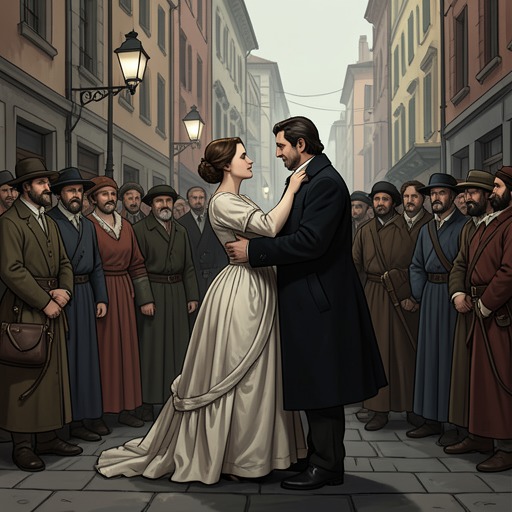
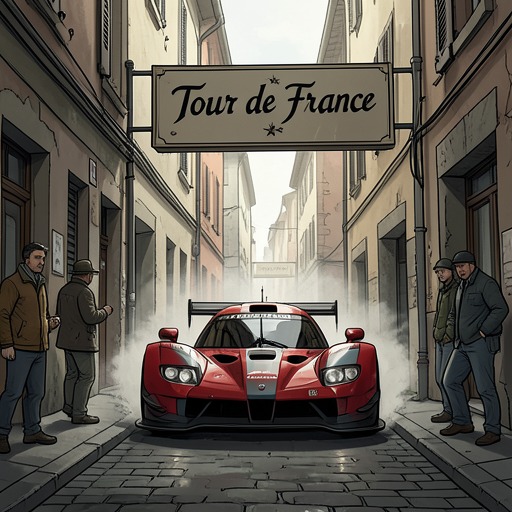
Prologue, before 3 July
The Train in the Wheat
A boy cuts wheat beside an old Roman road, imagining himself a lone warrior until movement and a whimpering cry stir the crop ahead. He takes up his shotgun, expecting a dangerous animal, but lowers it when the stalks part and he sees what is there.
The opening plants an image of an unseen presence emerging from concealment, while withholding the identity of the figure in the field. Its significance becomes clear only as the novel’s hidden histories and disguised motives come to light.
3 July, 1:06 p.m.
The Watcher on Rue Verbier
From her balcony, [Marie Lacroix](entity:character-recall-character-marie-lacroix-ec66d40362b3) watches the street below as a bald man in a white suit behaves strangely: he ties an imaginary shoelace, studies the Tour posters, and slips behind a circular billboard to watch the avenue. He then jogs toward a living-statue performer, collides with a bearded young man carrying a rucksack, and hurries on.
Marie sees the white-suited stranger join the Muslim congregation praying outside the [Rue Verbier prayer room](entity:location-recall-location-rue-verbier-0979bd988cb2). An elderly woman with a shopping trolley curses the worshippers and clips his elbow as she squeezes past. When the congregation rises after prayers, he alone remains face down and motionless.
3 July, 2:18 p.m.
Darac Gets the Call
Captain [Paul Darac](entity:character-recall-character-paul-darac-680b52b3a5cc) heads home through [Nice](entity:location-recall-location-902035e0d0ed)’s Old Town after a late breakfast, still replaying a successful night playing jazz. His colleague calls him to [Rue Verbier](entity:location-recall-location-rue-verbier-d22c1315b4c5), where a man has died during the outdoor prayer service, and Darac abandons his food and heads for the scene.
The death immediately threatens to become politically explosive: a non-Muslim has apparently been killed among Muslim worshippers, while crowds and news crews gather behind the police cordon. Darac arrives to find the investigation already framed as a sensitive crisis.
3 July, about 2:33 p.m.
Frènes Tries to Remove Darac
Public prosecutor [Jules Frènes](entity:character-recall-character-jules-fr-nes-b2e15a01cb68) tells Darac that he should be kept away from the investigation, accusing him of being irreverent toward faith and warning that clumsy policing could ignite unrest. Darac challenges the political calculation behind the order and points out that the examining magistrate cannot simply sideline him without his commissioner’s agreement.
[Bonbon](entity:character-recall-character-bonbon-fca5e7ebcff2) interrupts with a crucial correction: the dead man was not Muslim but had copied the congregation. With the immediate religious panic weakened, [Frènes](entity:character-recall-character-fr-nes-b07390a201d9) reluctantly allows Darac to continue, while insisting that every step be taken by the book.
3 July, shortly after 2:33 p.m.
A Body Without a Struggle
Darac and [Granot](entity:character-recall-character-granot-b0c2ffa5b401) inspect the body with forensic pathologist [Deanna Bianchi](entity:character-recall-character-deanna-bianchi-6b7e0696ceb2). The dead man is identified as [Emil Florian](entity:character-recall-character-emil-florian-31d43b81bb85), a teacher at [Lycée Mossette](entity:location-recall-location-lyc-e-mossette-fb1b1592747b). He is dressed in a white suit, barefoot, and posed as if in prayer, with his forehead on an unused pizza box.
Bianchi finds no obvious wounds or signs of a struggle. Bloodshot eyes and the absence of vomiting or bleeding point toward a lethal paralytic poison rather than a visible assault. A small abrasion on Florian’s right arm may conceal a fine injection mark, and traces between his toes suggest he had washed his feet before joining the congregation.
3 July, about 2:55 p.m.
The Key Under the Mat
As the morgue team lifts Florian, a key is found protruding from beneath one of the cardboard prayer mats. Darac notes the clue but cannot yet tell what it opens or why Florian was trying to conceal it.
The discovery turns the crime scene into more than a public killing: Florian may have been hiding something connected to his life outside the prayer service. The key will eventually connect the murder to a hidden location and to the crimes surrounding him.
3 July, about 2:55 p.m.
A Patient Trapped in His Body
In an intensive-care ward, a conscious man lies paralysed and dependent on a ventilator, able to answer only by blinking. He obsessively watches a display fixed at [21.2 degrees](entity:expression-recall-expression-21-2-degrees-3d53134d5155) and longs for a television so he can follow the Tour de France, but a nurse mistakes his excited repeated blinks for a refusal.
The patient can hear and understand the staff, including their careless jokes, yet cannot make himself understood. His helplessness and fixation on the race establish an intimate parallel to the novel’s other concealed stories; the identity of the patient and his connection to the plot are initially withheld.
3 July, late afternoon
The Imam’s Cooperation
Darac questions Imam [Abdel Asiz](entity:character-recall-character-abdel-asiz-c4c470ed7540), who is courteous, politically astute, and eager to secure a mosque for the congregation. He says the worshippers stayed behind at his request, but admits that he was inside the prayer room and cannot vouch for those praying outside.
Darac then speaks to [Slimane Bahtoum](entity:character-recall-character-slimane-bahtoum-74ef85b1f6cd), who insists he never touched the dead man and offers to submit to tests. Darac notices the young man’s tight cargo trousers, an illogical choice for repeated prostration, and suspects that Slimane is concealing more than simple nervousness.
3 July, shortly after 3 p.m.
The Cousins’ Switch
Outside the prayer room, Darac pressures Slimane and concludes that the young man was not the person who prayed beside Florian. Slimane breaks down and claims an old woman killed Florian, then a second young man rushes into the scene and embraces him.
The newcomer, [Mansoor Narooq](entity:character-recall-character-mansoor-narooq-6dc878c0cb5f), is Slimane’s cousin. Darac realizes the cousins switched places after the death: Mansoor had been next to Florian, then asked Slimane to take his place so police would not check his immigration status. Darac detains both cousins and [Hamid Toulé](entity:character-recall-character-hamid-toul-7f28660a6c0f), suspecting Toulé knew about the deception.
3 July, afternoon
Agnès Sends Her Father to Monaco
At the Caserne, [Agnès Dantier](entity:character-recall-character-agn-s-dantier-da0806f8b932) avoids a security briefing for the Tour by arranging for her elderly father, retired commissioner [Vincent Dantier](entity:character-recall-character-vincent-dantier-8e5c077d62da), to attend in her place. She also asks [Granot](entity:character-recall-character-granot-b0c2ffa5b401) to accompany him, knowing his enthusiasm for cycling will make the outing a treat.
As Agnès leaves work, she feels watched for the third time in several days. She looks around but sees no one and dismisses the unease as fatigue, a decision that leaves her vulnerable to the danger already approaching.
3 July, about 4:20 p.m.
The Tour Ultimatum
At the [Monaco Conference Centre](entity:location-recall-location-f8fb43377d8c), security officials receive a ransom-style threat from a group calling itself the [Sons and Daughters of the Just Cause](entity:organization-recall-organization-sons-and-daughte-0cb4a38f8e64). It promises a “bloody harvest” in [Nice](entity:location-recall-location-902035e0d0ed) unless France meets demands that include severing ties with Israel, releasing a Guantanamo detainee, easing restrictions on Muslim dress, and building a mosque in Nice.
Commandant [Georges Lanvalle](entity:character-recall-character-georges-lanvalle-4a27bb2044f1) argues that the threat is not credible: the named detainee appears not to exist, no such organization is known, and the cut-and-paste message looks amateurish. The Tour stage through Nice will go ahead, though authorities will quietly increase precautions.
3 July, late afternoon
Mansoor Reveals His Status
Darac questions Mansoor, who admits he is staying in France illegally and explains that he arranged the cousin switch because he feared routine identity checks. He says he had never seen Florian before the prayer service and denies killing him.
Mansoor believes the old woman’s trolley struck Florian by coincidence and insists she barely touched him. Darac is not convinced by every detail, but the account supports the idea that the cousins’ deception was about immigration, not murder.
3 July, late afternoon
The Paralytic and the Sugar
Bianchi tells Darac that Florian has a needle puncture hidden by an abrasion on his arm and that sugar between his toes matches traces of [GHB](entity:object-recall-object-ghb-b306619858a2) in his Evian bottle. The sugar was likely added to disguise the drug’s salty taste, implying the bottle was prepared for someone else.
Darac’s investigation shifts from a possible religiously motivated murder toward drug-facilitated sexual assault. He and his officers consider whether Florian was a perpetrator, a supplier, or an innocent man who had found the bottle, while the injection evidence points to a deliberate killing.
3 July, early evening
Manou’s Number
Erica examines the confiscated phones and finds that Florian had repeatedly called a number saved as “Manou.” Neither cousin’s phone number matches it, which prevents Darac from treating the cousins as Florian’s closest associate.
The number gives the team a new lead. It also becomes urgent when Mansoor hears his own phone in the next room, bolts through an office window, and injures himself in the fall. The incident confirms that he is Manou’s contact, but the phone comparison shows that the contact is someone else.
3 July, evening
The Search for Manou
Darac and Erica search Florian’s apartment, finding no pornography, drug-making equipment, or clear evidence that he assaulted anyone. A service-provider response identifies the number saved as Manou as [Imanol Esquebel](entity:character-recall-character-imanol-esquebel-1105c1113292), a young Basque man with a minor assault record who appears in Florian’s intimate photographs.
Darac and [Bonbon](entity:character-recall-character-bonbon-fca5e7ebcff2) head to Esquebel’s apartment in [La Masarella](entity:location-recall-location-la-masarella-d15b01f7cc4c). They find [GHB](entity:object-recall-object-ghb-b306619858a2) hidden there and arrest him, but he denies having spoken to Florian recently and is evasive about his work and possessions.
3 July, evening
The Security Briefing Ends
Agnès returns to the Caserne and briefs the team on the threat. Intelligence officials believe it may be an anti-Muslim attempt to derail the proposed mosque, rather than a genuine jihadist operation, while the police prepare extra resources as a precaution.
Agnès argues that a major criminal operation would be foolish on the day the Tour brings more forces into the region. Darac wonders whether the whole alert might be a government exercise, but the team has no evidence that it is. Meanwhile, he and Agnès share a brief, unexpectedly intimate moment when he massages her aching foot.
3 July, just before midnight
The Abduction Notes
Agnès and Vincent return separately to their homes, but neither answers when Darac tries to reach them. At Agnès’s apartment, Darac and [Frankie](entity:character-recall-character-frankie-03cf3cfc14e6) find no body, only a message assembled from newspaper clippings on her pillow. The note says that the authorities have ignored the group’s cries.
The same threat has reached Vincent: he too has been taken, and a neighbour reports a white van outside his house. Darac concludes that the abductions, not the political ultimatum, are the real crime and that the captors are likely pursuing a personal vendetta.
3 July, between about 8:30 and 9:30 p.m.
Agnès and Vincent Taken
The kidnappers use a white long-wheelbase van to seize Vincent and later Agnès. At [La Marguerite](entity:location-recall-location-la-marguerite-3efa6b2d7074), a surveillance camera appears to show the garage empty during the crucial interval, while another camera shows Agnès arriving and walking away from her car.
Darac’s team discovers that the image blips and refocuses at the time of the abduction. He reasons that the kidnappers photographed the camera’s view in advance, then held the photograph in front of the lens while taking Agnès, creating a simple but effective blind spot.
4 July, before dawn
The Dantiers’ Captivity
Agnès wakes in a dark van among naked mannequins and finds her father nearby. Both have been shaved, stripped, chained to the vehicle, and left without food or water. She fights to keep Vincent hopeful, insisting that the Brigade will find them and using conversation to keep their minds working.
They try to identify who might hate them enough to carry out the abduction. Agnès sees that the kidnappers are trying to degrade and terrorize them, but she does not yet know why. Vincent is increasingly weakened, and the pair have no way to contact the police or escape their restraints.
4 July, early morning
The Old Woman’s House
Darac continues investigating [Corinne Delage](entity:character-recall-character-corinne-delage-4e9597774584) while the team searches for the Dantiers. Her records show that she is a solitary former florist with a history of petty theft and a conviction for poisoning a neighbour’s dog. Her finances also reveal that she paid cash for the van, though the exact sum appears to have been supplied by someone else.
At her Rue Vaulesne home, Darac finds personal papers, family photographs, and a mezuzah whose repeated removal and reattachment suggest uncertainty about her Jewish identity. A letter from her adoptive mother describes the child Corinne as having wandered in “like a little lost lamb,” and the clue directs Darac toward the wartime deportations.
4 July, morning
Florian’s Secret Room
Darac and [Granot](entity:character-recall-character-granot-b0c2ffa5b401) visit [Peerless Taxis](entity:location-recall-location-peerless-taxis-6ae5a5161434), where they search the lockers at Manou’s workplace. They find a key matching the one Florian tried to hide at [Rue Verbier](entity:location-recall-location-rue-verbier-d22c1315b4c5), confirming that Florian and Manou shared access to a secret place.
The team decides not to force a confession. Instead, it plans to release Manou under surveillance and let him lead the police to the room. Erica modifies his phone so it can be tracked even when switched off, and [Frankie](entity:character-recall-character-frankie-03cf3cfc14e6) agrees to direct the operation.
4 July, late morning
Astrid Identifies the Attack
Darac and [Frankie](entity:character-recall-character-frankie-03cf3cfc14e6) interview [Astrid Pireque](entity:character-recall-character-astrid-pireque-5b7464b5267b), the living statue who performed near [Rue Verbier](entity:location-recall-location-rue-verbier-d22c1315b4c5). She remembers Florian running into a bearded man carrying a heavily packed rucksack, and says that the man had watched her act unusually long without tipping. She also recalls seeing Manou in her crowds on other occasions.
[Astrid](entity:character-recall-character-astrid-82eaaa56b07c) later remembers a small, elderly woman in a flowered dress hurrying after the bearded man. She positively identifies the woman as Delage but says she never saw her close to Florian. The detail returns Delage to the murder inquiry and makes her involvement in the wider conspiracy increasingly likely.
4 July, around noon
The Second Abduction
Darac and [Frankie](entity:character-recall-character-frankie-03cf3cfc14e6) discover that someone placed Agnès’s note hours before the abduction, using another camera blind spot. At the same time, they learn that [Jacques Sevran](entity:character-recall-character-jacques-sevran-b43cc56ef796) has been suspended and arrested, though the reason is unclear.
The evidence from the garage, the white van, and the timing strengthens Darac’s belief that the written terrorist threat is camouflage for a personal crime. His team is now racing against a deadline to find the Dantiers before their captors kill them.
Night of 4–5 July
The Secret Room Raid
The tracked phone leads Manou to a concealed room near Rue Monteverdi. [Frankie](entity:character-recall-character-frankie-03cf3cfc14e6)’s team follows him inside and finds him with André Volpini, the principal of [Lycée Mossette](entity:location-recall-location-lyc-e-mossette-fb1b1592747b), and a drugged teenage girl. The location contains evidence of repeated sexual assaults.
Volpini is arrested and confesses that he and several associates had been drugging and raping girls for eighteen months. Manou admits to driving victims but denies participating in the assaults; Volpini confirms that he served as the driver. Florian had been expected to join Volpini on the day he died, and the secret room connects the murder to a larger abuse operation.
5 July, morning
The Abduction Trail Turns
Darac brings the team together to compare the facts about Delage, the van, the hidden key, and the wartime records. Her adoptive history points to a child who escaped the [1943](entity:time-recall-time-1943-057a4d28df5c) deportation of a Jewish family, and Darac believes she may have been the lost child from the train.
The team checks the lists of deportees and learns that the Djourescu family was arrested by the [Gestapo](entity:organization-recall-organization-94416ae64d32) in October 1943. The records show the family’s little girl, Olivie, disappeared before reaching Drancy, while the family’s identity and fate may explain why the abductions are tied to [Vincent Dantier](entity:character-recall-character-vincent-dantier-8e5c077d62da)’s past.
5 July, late morning
The Rescue Plan Begins
Darac and [Frankie](entity:character-recall-character-frankie-03cf3cfc14e6) question [Albertine Laseige](entity:character-recall-character-albertine-laseige-4693ecc2a779), who lived in the Djourescus’ apartment block during the occupation. She confirms that the family had two babies: a stillborn boy born to [Louise Florian](entity:character-recall-character-louise-florian-eb6830af95fb) and a healthy boy born to [Elena Djourescu](entity:character-recall-character-elena-djourescu-9dc23a2b5465).
When the [Gestapo](entity:organization-recall-organization-94416ae64d32) came, Adam carried the living baby to the Florians and returned with a lifeless bundle. The Djourescus had exchanged their son for the stillborn child in an attempt to save him. The surviving boy was raised as [Jean Florian](entity:character-recall-character-jean-florian-e41fec808772), making Emil’s older brother the biological son of Adam and Elena Djourescu—and a possible key to the present revenge.
5 July, around midday
Vincent’s Number
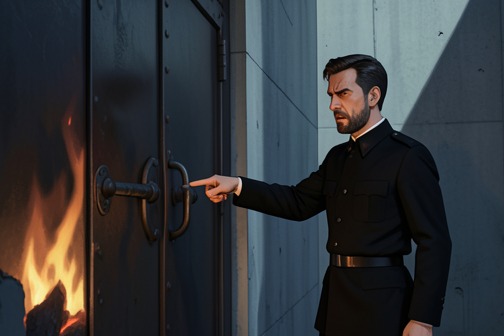
Old records show that [Vincent Dantier](entity:character-recall-character-vincent-dantier-8e5c077d62da) and [Adam Djourescu](entity:character-recall-character-adam-djourescu-f771546a216e) served together in the wartime police. A report identifies an unnamed informant by the number 287; Darac recognizes the number from a personal photograph showing Vincent’s locker. The implication is that Vincent informed on his colleague, helping the [Gestapo](entity:organization-recall-organization-94416ae64d32) arrest the Djourescus.
The revelation gives the kidnappers a specific motive: retaliation for a betrayal that sent Adam, Elena, and their daughter toward Auschwitz. The team identifies [David Jarret](entity:character-recall-character-david-jarret-759ea54cd923), a [Garde Républicaine](entity:organization-recall-organization-garde-r-publicai-5e361ee84db3) officer, as the son of [Jean Florian](entity:character-recall-character-jean-florian-e41fec808772) and grandson of Adam and Elena. He has learned the family history and is now acting on it.
5 July, around 1:30 p.m.
The Tour Attack
As the Tour stage rolls through [Nice](entity:location-recall-location-902035e0d0ed), [David Jarret](entity:character-recall-character-david-jarret-759ea54cd923) uses the crowd and his [Garde Républicaine](entity:organization-recall-organization-garde-r-publicai-5e361ee84db3) position to move freely. [Astrid](entity:character-recall-character-astrid-82eaaa56b07c) spots him near the Negresco and recognizes the bearded man from the earlier collision, but Jarret injects her with a paralytic while posing the attack as part of her street-statue act.
Astrid manages to call Darac before losing control. A helicopter takes her to hospital, where doctors administer treatment in time to save her. The attack confirms Jarret is the killer and shows that he is prepared to silence witnesses while pursuing his revenge.
5 July, early afternoon
Jarret’s Identity Confirmed
Darac’s team links Jarret to the wartime files and confirms that he has left his post during the Tour. Police search the route, review broadcast footage, and ask the [Gendarmerie](entity:organization-recall-organization-gendarmerie-96e9438d91b7) for information, while Darac realizes Jarret’s target is probably not the race itself but the kidnapped Dantiers.
The team contacts [Jean Florian](entity:character-recall-character-jean-florian-e41fec808772) in intensive care and learns that he can communicate only by blinking. He confirms the family story: Emil revealed that Jean was adopted from the Djourescus, and Jean passed the revelation to his estranged son, David. Jean had wanted reconciliation, not revenge, but his disclosure gave David the knowledge that led to the kidnappings.
5 July, afternoon
Agnès Recognizes Delage
In the van, Agnès hears a woman return and recognizes [Corinne Delage](entity:character-recall-character-corinne-delage-4e9597774584)’s voice. Delage arrives with a uniformed man, who proves to be [David Jarret](entity:character-recall-character-david-jarret-759ea54cd923). He says that he and Delage planned the attack and that she knew Florian’s routine.
Jarret and Delage reveal that they have chosen the Dantiers as targets to punish Vincent for the betrayal of the Djourescus. They taunt their captives, with Delage eager to intensify the humiliation and Jarret insisting that Vincent explain what he did. Agnès still lacks the full story, but the kidnappers’ motive is finally in the open.
7月5日,下午
文森特的供述
Jare accused Vincent of selling Adam Joreșcu for personal promotion. Vincent initially denied it, then admitted that he made the decision on his own and helped send Adam's family to the Nazis. He said he wanted to outdo his more successful colleague at that time
7月5日,下午稍晚
排气软管
Jale and Delaheat left the bound Dantie father and daughter in the van, and directed the exhaust into the cabin, attempting to kill them. Daraque followed the clue to a row of storage rooms below the railway, and saw water under a door, realizing the hostages might be
7月5日,晚上
营救之后
Dante and his daughter survived the attempted murder, and the injured Corine Delage was detained. David Jarre died in the gunfight with Dalac. The immediate threat has been removed, but Agnes and Vincent will still suffer long-term physical and psychological trauma
7月5日,深夜
达拉克给父亲打电话
After the rescue operation, Daraque returned to the rooftop terrace with his injured arm, reflecting on Agnes, Vincent, and the burden of the truth that his parents were unforgivable. Music reminded him that he had been avoiding a difficult conversation with his father. He called his father and his
7月9日上午11时
阿涅丝面对真相
A few days later, Darrac visited the hospital to see Agnes. Her body was recovering, but she was deeply affected by her father's confession and the discovery that Jean Florent is her half-brother. She would not pretend to betray someone who could easily be overlooked, but she
7月3日至5日,调查期间
分手短信
During the progress of the case, the relationship between Daraque and Antherine reached its end. She sent a text message telling him she had decided not to return home; he read a few sentences and understood that she was leaving him. He continued working, but the loss was like an un
7月9日,下午
勋章与竞猜彩票
Dalarck's investigative conduct put him facing a disciplinary hearing regarding his treatment of Freyne and his investigative methods. However, he would also be awarded the Police Honor Medal, with institutional punishment and public recognition coexisting, creating a rather awkward situation