Divided Jerusalem
JudasDivided Jerusalem is not merely a city split on a map: it is a landscape of walls, mines, warning signs, and interrupted routes that governs where people can go and what they can see. In the winter of 1959–1960, the frontier remains a daily presence ten years after the war that divided the city, making political history part of the characters’ ordinary urban experience. For Shmuel Ash, its dangers become entangled with heartbreak, aimlessness, and the uncertain search for warmth and direction.
A city marked by war
The novel’s opening places the story in the winter of late 1959 and early 1960, noting that buildings still bear signs of the war that divided Jerusalem a decade earlier. The boundary is therefore not presented as a settled event safely confined to the past. It persists in the city’s fabric, where the visible aftermath of war sits alongside domestic interiors, familiar streets, and the quiet sounds of evening. The division gives the setting a temporal doubleness: the present is lived among traces of a conflict that remains consequential.
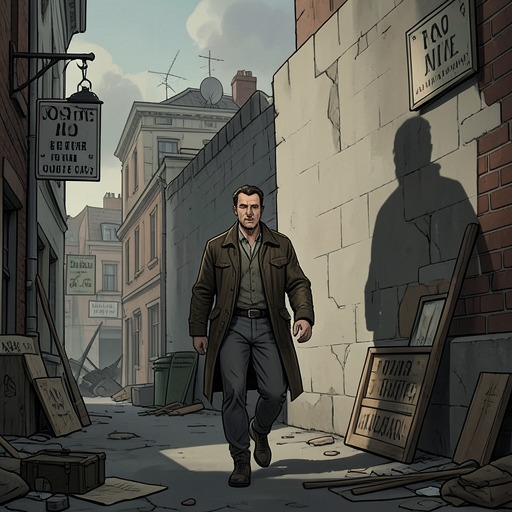
The frontier is described as an extensive, fortified line. On the Israeli side, Shmuel encounters a concrete wall separating it from Jordanian-controlled Jerusalem, coils of rusted barbed wire, trenches, and minefields. Signs warn him to stop, identify the border, announce mines and no-man’s-land, and caution that he is approaching an area exposed to enemy snipers. Their blunt sequence turns the boundary into a series of immediate physical threats. Shmuel reads them distractedly, as though they were items on a menu, a comparison that makes his disorientation visible without diminishing the danger around him.
The geography is also unevenly accessible. Shmuel nearly collides with the concrete barrier during his wanderings, and the city’s margins repeatedly draw him toward places he does not know. Jerusalem’s division is thus experienced not simply as a line separating two political jurisdictions but as a limit encountered by a pedestrian: a wall he can almost run into, a warning he must pass, and a dangerous zone into which a wrong turn could lead.
The border in Shmuel’s wanderings
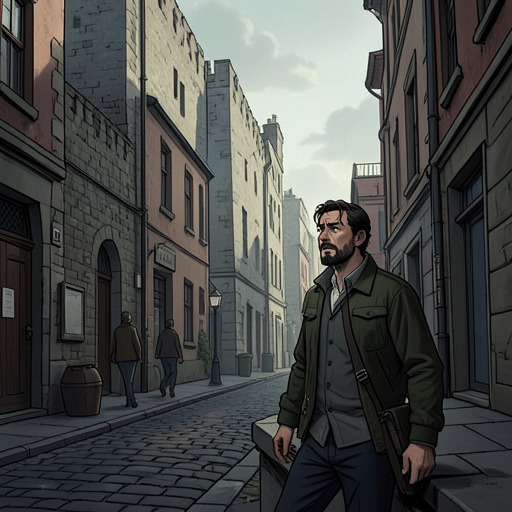
After leaving university, Shmuel spends long stretches walking through rain and cold, unsettled by romantic disappointment, a stalled research project, and his family’s financial collapse. He stops outside the iron gate of the building where Yardena once lived and drifts through unfamiliar neighborhoods. His route brings him close to the frontier more than once, where the signs and barriers interrupt his otherwise aimless motion. In this period, the divided city mirrors his own lack of a destination, though the analogy remains grounded in the concrete danger of the border rather than replacing it.
His wanderings have a physical cost. Shmuel returns to bed exhausted and cold, sleeps until the next evening, then sets out again in clothes and a coat that have not dried since the previous day. His route can take him as far as Talpiot and Arnona; he turns back only when the gate of Kibbutz Ramat Rahel and a suspicious guard’s flashlight make him react to his surroundings. The frontier belongs to this broader pattern of movement toward the city’s edges and abrupt retreat from them. Shmuel’s vulnerability is personal, but the landscape gives that vulnerability a particular form: he moves through a city where the ordinary act of wandering can bring him within reach of mines or enemy fire.
The division also enters his dreams. In one, Shmuel shows Stalin the corner of the Western Wall, trapped beyond the frontier in Jordanian territory. The image brings the boundary into the dream’s confused negotiation of Jewish history, political loyalty, and religious questions. Shmuel cannot explain to Stalin why Jews rejected Jesus or why they continue to turn away from him; Stalin calls him Judas. The dream does not resolve these questions. Instead, it places a contested sacred landmark on the far side of a modern political line, making the city’s division part of Shmuel’s troubled imaginative world.
Streets, walls, and inaccessible spaces
The border shapes the city even where Shmuel is not standing directly before it. Jerusalem appears quiet and reflective, with church bells sounding at intervals and a west wind moving through the cypresses. Then an occasional shot from a bored Jordanian sniper breaks the silence, aimed toward the fields of mines or no-man’s-land. The solitary gunfire makes the quiet feel precarious: it does not erase the stillness but exposes the violence contained within it.
High stone walls reinforce the sense of a city divided into spaces that cannot be entered or understood from the street. Their tops glitter with fragments of glass, sometimes reinforced with rusting coils of barbed wire. Passing the wall around a leper colony in Talbiya, Shmuel wonders what life is like behind it and compares it with his own life of seclusion in the low-ceilinged attic. That comparison links two forms of enclosure without making them identical: one is part of the city’s built landscape, while the other is Shmuel’s isolated domestic existence.
From his attic window, Shmuel discovers an old rainwater cistern covered with a rusted metal lid in the courtyard. Such cisterns had been dug in the courtyards of old Jerusalem to collect rainwater before the British brought a piped water network to the city. In 1948, the old reservoirs helped Jerusalem’s Jewish inhabitants survive the Arab Legion’s siege after water pumps at Latrun and Rosh Haayin were blown up. The cistern turns the city’s past into a material presence in the present: a domestic feature whose earlier use belonged to a time of siege and threatened survival. The same chapter of history prompts Shmuel to wonder whether Shaltiel Abravanel had still been among the leaders of the Jewish community during the Arab invasion, when Ben-Gurion expelled him from the leadership, and what became of him afterward. The divided city thus opens onto questions about political history that Shmuel resolves to investigate in the National Library.
The frontier on the night journey
During a nighttime walk with Atalia, the pair pass the Jewish Agency building, the King David Hotel, the Montefiore windmill, and Mishkenot Sha’ananim before descending through Yemin Moshe. The neighborhood is depicted as poor, with low stone houses, tiled roofs or flat rooftops, and small courtyards containing old iron-covered wells. The houses are dark, and a single pale streetlamp lays a thin wash of yellow light over the lanes. A stray dog follows Shmuel and Atalia for a time, but stops when they begin climbing toward Mount Zion, a projection of Israeli territory surrounded on three sides by Jordanian territory. It gives a small, visible measure of how the frontier interrupts even their shared walk.
At the foot of the Old City walls, rusted barbed wire marks the boundary of mined no-man’s-land between Israeli and Jordanian Jerusalem. From there, Shmuel and Atalia climb the steep road toward Mount Zion. The route brings them close to the frontier’s armed geography: the Old City walls loom beside them, and Shmuel fears losing Atalia in the darkness or straying into places exposed to enemy machine-gun positions. His asthma and exhaustion make the ascent difficult, but the danger is not only bodily fatigue; the divided terrain gives the darkness a political edge.
Their walk reaches dawn without becoming the sunrise outing they may have imagined. As light begins to appear over the Moab mountains, the narrative leaves uncertain whether there was a couple they intended to follow at all, or whether Atalia invented them. A veteran soldier who had smoked at the entrance to the Tomb of David has gone. Atalia asks Shmuel to wait a little longer, then tells him to go home while she remains alone before going to work. The frontier landscape provides the setting for this uncertain, incomplete parting: the scene moves through a city where access, danger, and separation are never far apart.
Violence within the divided city
The danger associated with the boundary is not only atmospheric. On another winter night, Shmuel hears a dull shot followed by a short, sharper burst of gunfire nearby. He cannot tell where the shots came from. Jerusalem is surrounded on three sides by Jordanian Jerusalem, and the frontier is lined with fortified trenches, barbed wire, concrete walls, and minefields. Jordanian snipers sometimes hit passersby; at other times, positions on both sides exchange fire for more than half an hour. The brief sounds in the night belong to a recurring condition of the city, not to a clearly witnessed battle with a known beginning or end.
After the burst, winter silence settles again. Shmuel reaches toward a hungry stray cat between garbage bins; the cat approaches cautiously instead of fleeing. The moment places tentative contact beside recent gunfire, without suggesting that one cancels the other. Across these scenes, Divided Jerusalem is both a political arrangement and a sensory fact: walls constrain routes, warning signs make danger legible, distant shots fracture quiet, and the possibility of crossing into exposed ground remains close to ordinary life. Its significance lies in that persistence. A past war continues to determine the shape of the streets and the limits of movement, while Shmuel’s solitary walks make those limits felt one encounter at a time.