Political repression under Stalinism
JudasPolitical repression under Stalinism is the historical and moral shock that breaks Shmuel Ash’s socialist circle and exposes the danger of treating a political ideal as identical with the regime that claims to realize it. The novel sets the circle’s dispute over Stalin beside arguments about force, national sovereignty, and Arab-Jewish coexistence, making the crisis a test of how political movements respond when their promises of justice collide with lived consequences.
The socialist circle’s rupture
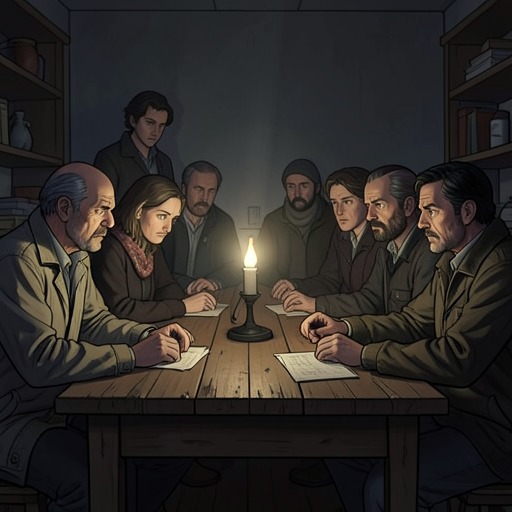
The circle met on Wednesday evenings in a soot-dark café in the back streets of Yegia Kapaim. Its members—artisans, plumbers, electricians, painters, and printers—regarded the café as roughly proletarian, though the workers who played backgammon there generally kept their distance from the group’s table. Occasional exchanges across the room made the boundary permeable without erasing it: the circle could imagine itself among working people, but did not simply share their social space.
After the Soviet Communist Party’s twentieth session addressed Stalin’s terror regime, nearly all the members accepted the criticisms it had made. A more intransigent faction demanded a deeper reassessment—not only of Stalin, but of the foundations of the dictatorship of the proletariat as Lenin had conceived it. Two members invoked the young Marx to challenge the doctrinal authority of the mature Marx. When Shmuel tried to hold the group together, four of its six members announced a split and the formation of an independent cell. Both women in the group joined the dissidents, a choice that made the division especially consequential for Shmuel.
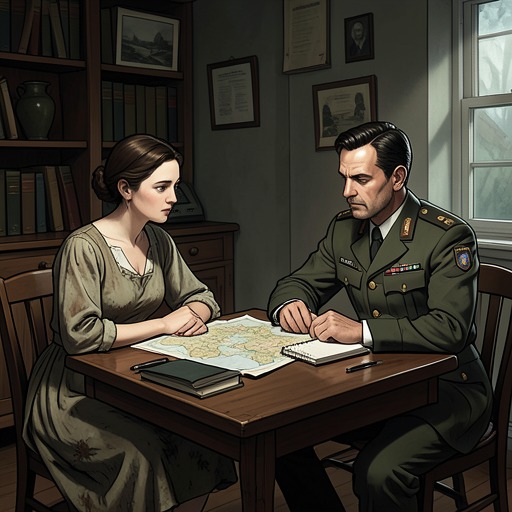
The controversy was not an abstract disagreement detached from his life. Shmuel told Gershom Wald that the wider socialist movement had been badly shaken by the revelations about Stalin’s regime, and that the controversy had distanced him from his friends—more precisely, he had distanced himself from them. To avoid Wald’s questions about love and loneliness, he recounted the circle’s weekly meetings and its recent dissolution, then turned to Lenin’s legacy and what Stalin had done with it. The political schism thus also registers a personal separation: the movement that had organized Shmuel’s hopes no longer gave him an untroubled community.
The ideal and the regime
Shmuel resists the conclusion that the Soviet regime’s corruption must invalidate social justice itself. He asks whether the party’s departure from its path requires abandoning the hope of justice, just as the Inquisition’s abuses do not, in his analogy, settle the worth of Jesus. His comparison is not an endorsement of Stalinism; it is an attempt to keep an ideal distinct from institutions that invoke it while betraying it. The unresolved question is whether that distinction can survive the damage done in the ideal’s name.
A dream gives the political crisis a more intimate, disordered form. Shmuel finds himself in the café’s back room while Stalin orders Professor Gustav Yom-Tov Eisenschloss to relieve Shmuel’s father’s financial troubles. From a distant lookout on the roof of the Monastery of the Dormition on Mount Zion, Shmuel points out the corner of the Western Wall, trapped on the Jordanian side of the border. He cannot explain to Stalin why the Jews rejected Jesus or continue to turn away from him. Stalin calls him Judas. The dream briefly brings in Nesher Shereshevski, who hands Stalin a whimpering puppy in a metal box; Shmuel wakes with the sense that his convoluted explanations have only intensified Stalin’s mockery and suspicion. Soviet authority, the fracture of Shmuel’s friendships, and the novel’s recurring association of dissent with betrayal converge in this dream without yielding a stable resolution.
Force, sovereignty, and justice
The novel places Shmuel’s disillusionment with Soviet politics beside an argument about Israel’s power and its relations with the Arabs. Shmuel rejects the assumption that Arab hostility is inexplicable: he describes Arabs as people who had lost land, fields, villages, cities, ancestral graves, and their children’s inheritance to newcomers. The account challenges the self-justifying story that Jewish settlement was simply a project of rebuilding and redemption, and asks what people would welcome the sudden arrival of hundreds of thousands—and later millions—of foreigners claiming the land on the authority of sacred books.
Gershom Wald recalls that Shaltiel Abravanel had tried in 1948 to persuade David Ben-Gurion that an agreement with the Arabs might still be possible as the British departed, if the Zionist leadership relinquished the project of a Jewish state in favor of a Jewish-Arab condominium. Abravanel was expelled from the Zionist Executive and the Jewish Agency leadership. Wald admits that he himself had supported Ben-Gurion’s hard realism rather than Abravanel’s ideas. Shmuel, in turn, criticizes Ben-Gurion’s later national leadership for surrounding statehood with empty biblical language about restoration and prophecy. The debate echoes the socialist crisis: whether fidelity to an ideal requires defending the institution that claims it, or challenging the institution when its course contradicts the ideal.
That challenge is also directed at faith in military strength. Shmuel argues that force can make an enemy a slave, but cannot turn an enemy into an ally, a fanatic into a tolerant person, or someone thirsty for revenge into a friend. He does not deny the need for military power: it may, at any given moment, keep Israel from annihilation. But it can only prevent disaster temporarily; it cannot repair or solve the underlying conflict. The distinction sharpens the novel’s political argument: protection from immediate destruction is not the same as reconciliation or justice.
The cost of dissent
Abravanel’s opposition to the 1947 partition plan and to Israeli independence brings the meaning of political dissent into public view. A report in Davar dated December 21, 1947, says that he had been removed from his posts the previous day after disagreements with his colleagues. He declined to explain his dismissal to the reporter, but the paper attributed to him a warning that Ben-Gurion’s chosen course would lead inevitably to a bloody war between the two peoples, with the survival of the roughly six hundred thousand Jews in Eretz Israel at stake. Abravanel maintained that there was still some room for a historic compromise. He had served near the top of the two institutions for almost nine years; the report presents his removal not as an incidental dispute but as the exclusion of a dissenting political position.
Wald later gives the position more detail. Abravanel thought that a temporary international mandate or an interim government under American supervision could replace the collapsing British Mandate. He believed that allowing roughly one hundred thousand Holocaust survivors displaced in European transit camps to immigrate could address their immediate plight without declaring a Jewish state. A pause, he argued, might give the Arabs time to absorb the Jewish presence. His view rested on conversations with Arab friends: he believed Arab fears centered not only on the existing Zionist settlement but on what they perceived as Jewish superiority in education, technology, ingenuity, and motivation, and on the possibility that this would lead to territorial control. The novel presents this as Abravanel’s analysis, not as an uncontested account, setting his reading of Arab fear against Shmuel’s skepticism and the competing urgency of Jewish survival.
Abravanel predicted that declaring an independent Jewish state after the British departure would bring a bloody war with the Arab world, perhaps the Muslim world more broadly. Even if the Jews won successive rounds, he warned, those victories would deepen Arab fear and make the conflict last for generations. The prediction is framed through Wald’s recollection, spoken before Mija’s death in the Jerusalem mountains on April 2. It carries the weight of hindsight: the political argument about force and national independence is inseparable from the loss through which Wald remembers it.
The cost of dissent is also expressed through the word traitor. Wald says that Abravanel was called one because he maintained friendships with Arabs, welcomed Arab journalists, politicians, union leaders, and professors into his home, and continued opposing a Jewish state during the 1947–48 fighting. Shmuel’s own circle has already divided over Stalinism, while Shmuel’s political and intellectual commitments make betrayal a recurring accusation in his life. He argues that those who dare to change are often branded traitors by people who fear change. In the novel, the label does not establish whether a dissenter is right; it shows how a community can turn disagreement into exclusion, and how the charge of betrayal may attach precisely to attempts to imagine another political future.
Memory, silence, and aftermath
The political argument persists after the immediate crisis has passed, but it does not produce reconciliation. Wald recalls that after Mija’s death, he, Abravanel, and Atalia lived together in isolation. He and Abravanel had once disputed everything, but the death silenced their arguments. Abravanel, who had lost his Arab friends across new borders and had no Jewish friends left, died alone two years later. In Wald’s account, the household’s silence follows both bereavement and political defeat: the people and ideas excluded by the new boundaries are absent from the room, while those who remain can no longer sustain their former debate.
The novel also connects the language of betrayal to antisemitism. Wald recounts an encounter from his youth in which a young nun, seeing his Hebrew newspaper and learning he was Jewish, asked how Jews could have done that to Jesus. He reflects that Judas’s name has become synonymous with betrayal and, for millions of Christians, with the Jew. This episode does not equate Soviet repression with Christian anti-Jewish prejudice; rather, it places the accusation of betrayal in a broader history of collective blame. Shmuel’s inability in his dream to explain Jewish rejection of Jesus, and Stalin’s naming him Judas, make the inherited accusation recur within a different political crisis.
The circle’s split is therefore more than a local organizational failure. It begins when political violence forces adherents to judge a movement by what its institutions have done, and continues in the novel’s debates about statehood, military force, dissent, and exclusion. Shmuel’s effort to preserve the possibility of justice without excusing the regime that betrayed it remains deliberately unresolved: the text grants neither political power nor moral conviction the ability, by itself, to turn opponents into allies.