Conflict between Israel and the Arab states
JudasThe conflict between Israel and the Arab states is a central political argument in the novel, not merely a sequence of military confrontations. It is framed through competing answers to a fundamental problem: how can Jews secure a home in the land without dispossessing or permanently alienating its Arab inhabitants? Shmuel Ash gives voice to the claims of Arab dispossession and the dangers of Israeli reliance on force; Gershom Wald defends the necessity of military protection; and the proposals of Shaltiel Abravanel offer a rejected alternative based on compromise and shared political arrangements. Their debate leaves a stark distinction between force that can avert immediate destruction and political action that might resolve the conflict.
Land, legitimacy, and competing claims
Shmuel challenges the assumption that Arabs should welcome Israel. He asks Wald to consider the conflict from the standpoint of people who saw strangers arrive and take their land, fields, villages, cities, ancestral graves, and their children’s inheritance. Jewish explanations of return and ancestral rights, he argues, do not make such a sudden arrival acceptable to another people. His account insists that Arab opposition cannot be reduced to irrational hostility: it is bound to concrete losses and to the experience of a population arriving with claims grounded in its own sacred books.
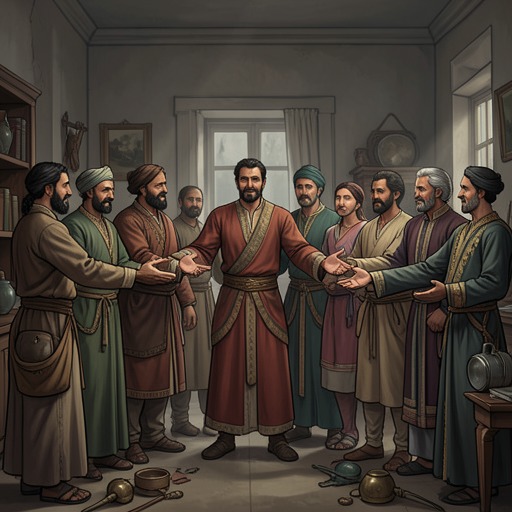
Wald’s account of Abravanel’s thinking supplies a complementary, though not identical, analysis of Arab fear. After years of conversation with Arab friends in the region and neighboring countries, Abravanel concluded that they feared not only the existing Zionist communities but also what they perceived as Jewish advantages in education, technology, ingenuity, and motivation. In his view, this fear concerned the possibility that a small Zionist presence might grow into a power capable of dominating the wider Arab world. Wald recalls Abravanel’s image of a hidden predatory giant within the small Zionist beginning: the political fear was directed as much at anticipated expansion as at the communities already present.
Abravanel’s proposed response was to slow the political process and make room for the Arab population to accommodate Jewish presence over time. As Wald recounts it, Abravanel favored replacing the departing British Mandate with an international mandate or a provisional government under American supervision rather than immediately declaring an independent Jewish state. He believed that a further immigration of one hundred thousand Holocaust survivors might be permitted, raising the Jewish population from about 650,000 to three-quarters of a million and addressing the plight of displaced Jews. After that, he argued, immigration and political demands should pause for ten or twenty years, allowing Arabs to adjust to the Jewish presence without the conspicuous demand for a Hebrew state. The proposal treated time and restraint as political resources, rather than assuming that sovereignty had to be asserted at once.
Statehood, war, and the rejected alternative
Abravanel warned that declaring an independent Jewish state at the end of the British Mandate would bring a bloody war with the Arab world, perhaps with the Muslim world more broadly. He expected that even Jewish victories in successive rounds would deepen Arab fear and produce a conflict lasting generations. In his analysis, military success would not settle the underlying dispute: each victory could reinforce the perception that Jewish power was expansive and dangerous. Wald remembers hearing these warnings in the library before the loss of his only son in the Jerusalem mountains on April 2, a personal catastrophe that gave the political argument a lasting and intimate weight.
The historical disagreement became an institutional rupture. In 1947, Abravanel was removed from the Zionist Executive and the leadership of the Jewish Agency after disagreements with colleagues. A contemporary newspaper report, as Shmuel discovers in a back-page notice, says Abravanel believed the chosen course led inexorably to a bloody war between the two peoples, with the survival of 600,000 Jews in Eretz Israel at stake. He maintained that a historical compromise remained possible. Wald later admits that he himself had sided with Ben-Gurion’s uncompromising realism rather than Abravanel’s proposals. The conflict is thus also a dispute within the Jewish leadership over whether security required immediate statehood and armed resistance, or whether those choices would make coexistence unattainable.
Shmuel’s challenge to Wald brings the costs of state-building into the open. He condemns the alliance Israel made during the Sinai campaign with France and Britain, seeing it as an alignment with declining colonial powers that deepened Arab hatred and confirmed the impression that Israel served world imperialism. He also argues that the country’s biblical rhetoric of restoration and fulfilled prophecy can obscure the political consequences of its actions. Wald resists the idea that Arab hostility began with that campaign, but their discussion reveals the persistent disagreement over whether Israeli policy creates hostility, responds to it, or does both.
Security and the limits of force
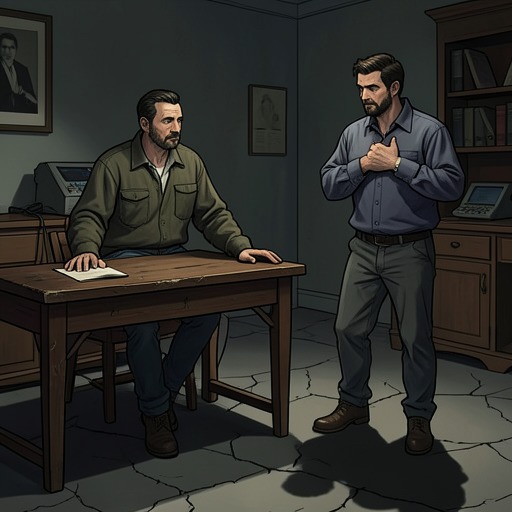
Shmuel’s account of the “eleventh soldier” gives the dispute a precise strategic shape. Recalling an article about Finland’s war with the Soviet Union, he recounts the claim that each Finnish soldier might be worth ten Soviet soldiers, and the president’s unanswered concern about what would happen if the enemy sent an eleventh. Shmuel applies that dilemma to Israel: during the War of Independence, fewer than 80,000 soldiers from five Arab armies fought against 120,000 Jewish men and women mobilized from a population of 600,000. He asks what Israel would do if a future Arab army numbered half a million, one million, or two million, especially as Nasser received substantial Soviet arms and spoke openly of another confrontation. The numerical comparison turns triumphal confidence into a question about whether superiority can last.
Wald accepts the force of the warning but answers from the standpoint of immediate survival. If the eleventh soldier appeared, he says, Israel would have to repel him; otherwise it could not remain. He does not regard military power as dispensable. Rather, he distinguishes what it can do from what it cannot: force can conquer territory, enslave an enemy, or prevent an impending annihilation, but it cannot make an enemy an ally, a fanatic tolerant, or a person seeking vengeance into a friend. In Wald’s formulation, Israel’s military strength separates it from death in the present, yet can only avert disaster temporarily; it cannot repair or resolve the political antagonism.
That distinction sharpens the disagreement rather than ending it. Wald’s defense of deterrence answers the immediate question of how a vulnerable state can survive, while Shmuel’s and Abravanel’s arguments ask whether survival secured through force can become a stable peace. Wald himself raises the personal cost of the distinction by asking whether his only son died merely to delay a disaster that, in Shmuel’s view, could not ultimately be avoided. Military necessity and political insufficiency remain side by side: the force that protects the state may also leave the causes of conflict intact.
Memory, political language, and aftermath
The characters’ arguments are shaped by the memory of the 1948 war and by the different meanings they assign to it. Shmuel rejects the claim that Jews then had no choice but to fight, telling Wald that they were not simply trapped between a sword and a wall; they were themselves the sword and the wall. Wald counters that survival could not be secured by hopeful words or by expecting Arabs to accept partition, and recalls that international support and weapons did not remove the need to defend the Jewish community. Their exchange makes the metaphor of necessity contested: one side emphasizes existential danger, the other insists that the language of helplessness can erase the violence experienced by Arabs.
For Wald, the argument is inseparable from the son he lost. He recalls that Abravanel had opposed the war and urged young people on both sides to lay down their arms. Wald had instead helped cultivate the conviction that fighting was a sacred duty, invoking earlier Jewish defenders and the national call to answer when summoned. He recognizes himself as part of the voice that sent his son to war. The debate over state security therefore enters the home as guilt and grief, not as an abstract disagreement among political theorists.
Abravanel’s refusal of nationalism also extended beyond the choice between war and compromise. He regarded nation-states as obsolete and predatory, comparing their separation to rows of cages in a zoo; his alternative was a group of communities rather than a sovereign state. Yet his position did not spare him political isolation. His Arab friends were left beyond new borders or expelled from their homes in Katamon, Abu Tor, and Baka, while he had no remaining Jewish friends because he had been branded a traitor. After Mija’s death, Abravanel, Wald, and Atalia lived together for roughly two years in a household marked by silence. Abravanel died alone in the kitchen, his newspaper and overturned coffee beside him. His proposals did not prevent the conflict, and the relationships and community on which his vision depended were broken by its consequences.
The novel preserves the conflict as an unresolved encounter between claims that cannot be dismissed without remainder: Jewish security after centuries of vulnerability, Arab opposition rooted in dispossession and fear of expansion, and the need for a political arrangement that force alone cannot create. Ben-Gurion’s realism, Wald’s insistence on defense, Shmuel’s warnings about power, and Abravanel’s failed compromise do not settle into a single program. Their contrast instead defines the conflict’s enduring stakes: military strength may keep a state alive, but it cannot by itself make its neighbors accept it or transform an enemy into a partner.