The Ash family’s bankruptcy
JudasThe Ash family’s bankruptcy is the economic crisis that ends Shmuel Ash’s financial dependence on his parents and compels him to leave university for paid work. After his father loses an appeal in a long dispute over a small Haifa business, the family can no longer provide the monthly allowance that had sustained Shmuel’s studies. The loss is not merely a change in household finances: it becomes one of the decisive causes of Shmuel’s departure from his course, alongside heartbreak and stalled research, and exposes a widening divide between what his parents want for him and the life he is beginning to lead.
The failed business and lost support
The collapse follows several years of litigation between Shmuel’s father and his former partner in Gaviota S. L., a small Haifa company specializing in cartography and aerial photography. When his father loses the appeal in December, Shmuel’s parents have to stop the monthly payments that had supported him since he began university. The family’s predicament also affects Shmuel’s sister, Miri: her parents have been forced to stop funding her medical studies in Italy, though she continues by working two jobs.
Shmuel’s father takes responsibility in part, telling his son that the company failed because of the partner’s dishonesty but also because of his own stupidity and blindness. His letter stresses that he had previously paid generously for Shmuel’s tuition, lodging, and other expenses, and had also funded Miri’s education. That support had helped make academic continuation seem possible; its abrupt end transforms Shmuel’s studies from a family-funded undertaking into a financial burden he cannot readily carry.
Shmuel’s departure from university
At the beginning of December, the financial crisis helps bring Shmuel’s university career to a halt. He has also suffered a romantic disappointment and reached an impasse in his research, but the need to find a job weighs especially heavily in his decision to leave Jerusalem. He packs without knowing where he will go: retrieving three or four used cardboard boxes from behind the garbage-room enclosure, he carries them up to his rented room in Tel Arza and puts some of his books, clothes, and other belongings into them day by day, in no particular order.
The boxes give physical form to a departure that has begun before Shmuel has a destination. He spends several days wandering through rainy streets late into the night, sometimes stopping before the iron gate of the building where Yardena no longer lives. His loss of financial support thus coincides with emotional and intellectual dislocation. The bankruptcy does not alone explain his departure, but it turns his stalled circumstances into an urgent need to seek employment.
The family’s competing appeals
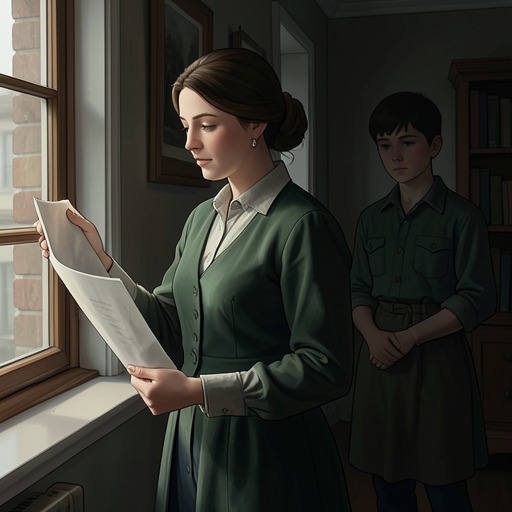
In a letter that reaches him damp from rainwater that entered the mailbox, Shmuel’s father grieves that his son has left his degree and calls it a waste of effort and talent. He recalls that Shmuel earned good marks during his early university years and had received a tentative promise from Professor Gustav Yom-Tov Eisenschloss: with steady work and some original contributions, Shmuel might obtain an assistant’s position after completing his master’s degree. His father asks whether he can combine work with study, take on additional employment, and make up the weeks he has missed. The water has blurred several lines, leaving parts of the appeal unreadable.
His father invokes Miri’s persistence as a practical comparison. Despite losing her parents’ support, she studies medicine while working afternoons in a pharmacy and nights as a telegraph operator at the central post office. He wonders whether Shmuel, who has said his new work takes five or six hours a day and that his employers cover his lodging and meals, could work more and still continue his degree. The appeal reflects both concern for his prospects and the expectation that determination should overcome hardship. His father reminds him of his socialist convictions and calls him a worker, even as he urges him back toward the academic path he has abandoned.
The letter also shows that the family’s financial collapse has not erased every possibility of help. Shmuel’s mother adds a postscript in which she says she is enclosing one hundred pounds without her husband’s knowledge; it is all she can spare. She joins his father in urging him to resume his studies, while expressing anxiety about his silence and asking him to write. Her private gift is modest beside the support the family once provided, but it makes clear that the loss of regular funding is not the same as a lack of familial concern.
What the crisis cannot settle
The parents’ appeals are not solely about money or academic prospects. Shmuel’s father questions his research subject, Jesus in the Eyes of the Jews, and recalls Shmuel’s view that Jesus was of Jewish flesh and blood. From Riga, his father remembers Jews turning their eyes away from images of Christ and finds it difficult to understand his son’s interest in approaching Jesus differently, given the persecution and suffering carried out in his name. He says he respects Shmuel’s decision even though he does not understand it, just as he respects his volunteer work in a socialist group while rejecting socialism.
The family’s conflicting responses give the bankruptcy a significance beyond the loss of income. His father reads Shmuel’s withdrawal from university as the destruction of a promising academic future and fears that his son has become estranged from the family; his mother emphasizes missing him and asks why he rarely writes or visits. Shmuel, meanwhile, has already left his course and is making a life elsewhere. The crisis makes his parents’ support newly precarious, but the surviving letter and secret remittance show that care persists alongside disappointment, worry, and disagreement.