Gershom Wald
JudasGershom Wald is a physically disabled, intellectually combative older man whose library becomes both a refuge and a chamber of argument for Shmuel Ash. A widowed son’s father and Shaltiel Abravanel’s former political opponent, he has built his life around books, conversation, and grief that resists consoling formulas. His bond with Shmuel develops from wary examination into tenderness, while his recollections expose the personal cost of political certainty and the unsettled meanings of betrayal, love, and death.
Identity and Introduction
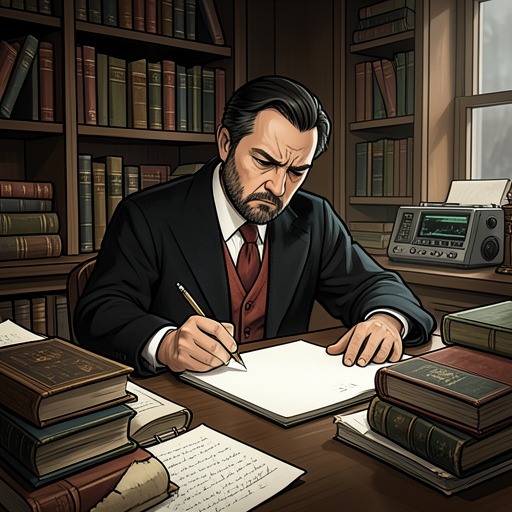
Shmuel first encounters Wald in a high-ceilinged library, where a kerosene stove warms the room and a bent desk lamp isolates piles of books and papers. Wald sits among wheeled carts crowded with reports, files, and thick notebooks, a wool blanket over his shoulders. His body is described in striking, almost sculptural terms: long, broad, crooked, and hunchbacked, with silver hair, heavy brows, an Einstein-like mustache, and one conspicuously open blue eye. The appearance is not a neutral portrait; it makes his face seem capable at once of sardonic intelligence and disapproval. Even while talking on the telephone, he studies the visitor as if trying to read his intentions.
His first exchange establishes a characteristic mixture of theatricality and directness. He calls out his own name, Wald, then asks whether Shmuel is a pioneer from a kibbutz, imagining that he has come down from the Galilee mountains or up from the Negev plains. Shmuel explains that he is from Jerusalem—or Haifa, though he had been studying in Jerusalem and has now stopped. Wald’s comic, probing questions quickly turn the encounter into a test: the young visitor is not simply admitted into a house but drawn into Wald’s habit of challenging assumptions and identities.
Life in the Library
The library is Wald’s domain: a working room of books and papers, telephone conversations, reading, and annotation. He quotes, jokes, mocks, and quotes again, and he enjoys gossip as readily as Shmuel does. Their conversations range from university professors to historical and political questions, but their form is as revealing as their subjects. Wald’s digressions, sharp corrections, and attention to small irritations—such as weak, over-sweet, lukewarm tea—bring lofty argument down to the scale of a shared room and an ordinary afternoon.
Wald lives with substantial physical impairment and initially insists on moving without Shmuel’s help. In the library he makes his way between desk and divan using the strength of his arms and shoulders, refusing assistance. That refusal changes over the following days: he lets Shmuel steady him by the shoulders and arrange the cushions behind his back. When he lies on the divan, Shmuel covers him with a Scottish wool blanket and brings tea with lemon juice, honey, and a dash of brandy. The care is practical and repeated, not a cure or a resolution; it marks a gradual permission for another person to share the work of living with his body.
Wald’s speech can be exuberant, but he also knows when to stop it. When Shmuel reads him an anti-Christian liturgical poem while presenting his abandoned research on Jesus in Jewish eyes, Wald covers his eyes with his broad hand and angrily rejects the recital as foolish insult rather than an answer to the question. He asks for tap water, then silence, and insists that they attend to what can actually be seen. The moment shows both his impatience with inherited polemic and his insistence that scholarship should not confuse a catalogue of slanders with understanding.
Grief, Mija, and Shmuel
Wald’s deepest wound is the death of his son, Mija. He describes him as the father of the grandchild he will never have: an orphan raised in the house without a mother, who died when he was six. Wald says that he raised the boy alone and personally led him to sacrifice. Mija fell on April 2, 1948, in the fighting at Bab al-Wad, on the Tel Aviv–Jerusalem road. The precise date and road make the loss more than a general national memory: it is a particular death that ended a father’s life with his son and, at the same time, his old arguments with Shaltiel.
Shmuel’s response to Wald’s grief is not to redirect or explain it. As Wald grieves, Shmuel finds the old man’s face newly dear to him and wants to absorb some portion of his pain rather than distract him from it. He lays his hand on Wald’s; the older man’s large, warm fingers close around the young man’s cold ones for two or three minutes. The physical contact gives their developing attachment a form that argument alone cannot provide. Wald later admits that, despite himself, he may be growing fond of Shmuel, likening him to a tortoise that has lost its shell along the way.
Wald’s grief also unsettles the language commonly used to honor the dead. He recalls that people say those killed in the 1948 war did not die in vain, and that he once said the same. But Shaltiel’s spirit, he says, now makes the words difficult to repeat. Shaltiel held that every death—of war, accident, illness, or old age, from antiquity to the present—was wholly in vain. Wald does not present this as a position he can comfortably adopt; he presents it as an accusation that has lodged in his throat. His intimacy with Shmuel rests partly on allowing such unresolved claims to remain unresolved.
Shaltiel Abravanel and Political Conflict
Wald’s recollections give Shmuel an account of Shaltiel’s political isolation from close range. Shaltiel was insulted as a traitor and friend of the Arabs, and rumors circulated that he had an Arab grandfather from Bethlehem. Others treated his ideas as madness, not as arguments worthy of reply. Wald admits that he too had forced himself not to discuss the ideas with Shaltiel at one point, because they were so far apart. The silence was not neutral: it left Shaltiel’s convictions largely unanswered even as public denunciation made him a target.
Wald remembers Shaltiel reading Davar each morning and leaving it silently on his desk. Their exchanges narrowed to everyday courtesies—asking someone to open a window, saying thank you, or asking forgiveness—while political distance endured. On the few occasions Shaltiel did speak, he argued that Zionism’s founders had deliberately harnessed generations of Jewish religious and messianic energy for a movement that was secular, pragmatic, and modern. He warned that the golem would one day rebel against its creator: the religious and irrational forces mobilized for contemporary political aims might erupt and devastate what had been built. Wald reports this as Shaltiel’s diagnosis, not as a prophecy he claims to have verified.
Their disagreement became final on the night of April 2. Wald says that he argued with Shaltiel vehemently until that night, when tragedy extinguished the argument forever. He also remembers believing that Shaltiel’s position had no practical chance in the country: in Wald’s judgment, the Arabs would not accept a Jewish presence even if the Jewish state were abandoned, leaving no opening for compromise. Shmuel, recalling his own youth, sets that hardened judgment against memories of Arab clients visiting his father’s cartography office in Hadar HaCarmel and of families sharing food and conversation. The exchange does not erase conflict; it places incompatible political readings beside lived memories and the violence that overtook them.
Scholarship, Affection, and Farewell
Wald encourages Shmuel to continue his research on Jesus and Judas, even though he rejects the reading of Jewish history as a mere collection of defamatory anecdotes. He urges Shmuel to finish the work and perhaps publish books, including one on Judas Iscariot. His own account of Judas turns on a distinction between the familiar kiss and a later crisis of faith: the Temple emissaries needed no identifying gesture, and Jesus went with his captors voluntarily. Wald argues that, if Judas betrayed Jesus, the decisive betrayal came when Jesus died and Judas lost faith, along with the desire to live. Wald then recalls an encounter on a train to Warsaw: a young nun, seeing his Hebrew newspaper and learning he was Jewish, reproached him for what she understood as the Jews’ deed. The memory reveals how the figure of Judas has become entangled with Christian accusations against Jews as a people. Wald’s scholarship is inseparable from the personal experience of being assigned inherited guilt.
Wald also tries, at one point, to warn Shmuel away from falling in love with Atalia, telling him that it is pointless and perhaps already too late. The warning places his concern for the young man alongside his quick recognition of what Shmuel may not yet have admitted. Later, after Shmuel has grown close to him, the old conversations seem to Shmuel to have missed much of what they truly needed to discuss. The change is not a rejection of their intellectual companionship; it marks the depth of the personal bond underneath it.
When Shmuel is preparing to leave, Wald comes to the room where Shmuel has stayed and says that he has already lost one son. He calls the young man nearer, then kisses him on the forehead with cold, strong lips. The farewell neither replaces Mija nor resolves Wald’s bereavement. Instead, it makes explicit what the library’s arguments, shared silences, practical care, and clasped hands have been building: Shmuel has become someone Wald can address through the language of familial loss and affection. Wald’s final gesture closes their winter together with a tenderness that his usual abundance of words cannot supply.