Miri
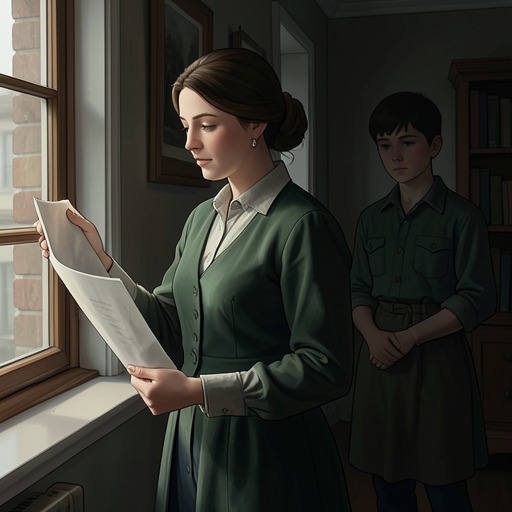
JudasMiri, Shmuel Ash’s older sister, is a medical student in Rome who continues her education through exhausting work after her parents’ business collapses. In her letters, she becomes the most direct voice in Shmuel’s family: she recognizes his loneliness, challenges his withdrawal, and urges him to resume the academic life he abandoned. Their bond is affectionate but difficult, shaped by a childhood of constrained space and limited tenderness, and by Miri’s determination to keep reaching a brother who repeatedly answers intimacy with silence or a lecture.
Identity and Family Background
Miri is five years older than Shmuel. The family’s cramped Haifa apartment placed her in its small bedroom, while Shmuel slept in the passage between the kitchen and the lavatory. The house had little room for privacy: the larger room served as her parents’ living room, dining room, and bedroom, and Shmuel’s bed stood in the traffic of the home. After the family’s earlier dwelling at Kiryat Mutzkin burned, they moved into this two-room flat in Hadar HaCarmel. Miri’s place in the small bedroom and Shmuel’s bed in the hallway give physical form to the unequal, crowded conditions of their childhood.
Miri’s presence in Shmuel’s memories is bound to a rare moment of physical tenderness. When he was hospitalized after a scorpion sting, she bent over him and stroked his forehead and hair. He remembered the touch as something she had never done before and would never do again. In a family where touch was scarce, that brief gesture endured as part of one of his few sweet childhood memories. It also stands against the emotional distance he describes between their parents and his own complicated resentment toward them.
Education, Work, and Independence
In Rome, Miri studies medicine while supporting herself with two jobs: she works afternoons as a pharmacy assistant and nights as a telegraph operator at the central post office. Her earnings barely cover tuition, a room shared with a nervous Belgian student, and a plain diet of bread, milk, vegetables, pasta or rice, and coffee. She has been in Rome for three and a half years, yet says she has scarcely seen the city because study, laboratory work, and paid work consume her days.
Her financial independence follows the collapse of her parents’ company and the loss of their ability to fund her studies. She continues anyway, sleeping only four or five hours a day, and treats persistence as a practical obligation rather than a heroic exception. In her letter to Shmuel, she points to her own workload as evidence that hardship need not end a course of study. Her example carries particular force because their father had also paid for Shmuel’s university education until the family’s bankruptcy.
Miri’s life is not only labor. She has a relationship with Emilio, a divorced Italian literary translator seven or eight years older than she is, and is close to his ten-year-old daughter, Sonia, who calls her Mari. Emilio calls her Miri and sometimes caresses both her and Sonia, placing Miri between them as a point of connection. Because her studies and two jobs keep her occupied, she sees them mainly on weekends. On Sundays she rises at four in the morning to prepare food for the week; later the three spend time together in a park, take a short boat trip, or travel by bus for a picnic among pine trees and ancient ruins. Emilio has offered financial help, but Miri has refused it repeatedly, even becoming angry with him, though she admires his generosity.
Letters to Shmuel
Miri’s letter begins as a practical account of work and money, then turns into an intimate diagnosis of her brother’s isolation. She knows that their father’s failed lawsuit and the collapse of the family company have made Shmuel’s life difficult. From his brief letters, she learns that he has left university and found work and lodging in an old Jerusalem house. She notices what he leaves out: he never uses the word loneliness, yet she reads loneliness in the very texture of his sparse messages.
She recalls him as a child absorbed in his stamp collection or alone on the roof, and recognizes the pattern in his adult correspondence. When she tries to speak to him about himself, she writes, he evades the subject and begins to lecture about David Ben-Gurion or the Crusades. She remembers a trip they took to Tel Aviv when she was sixteen and he was eleven. Asked what he wanted, Shmuel replied that he wanted to find out what anything meant. Miri holds on to that answer, but questions whether the search for truth has become a way for him to avoid living.
Her frustration is inseparable from concern. She wishes she had the money to interrupt her medical studies, return to Israel, visit him in Jerusalem, find him work, and make him take up his studies again. She believes he has lost only a semester and that his academic future remains recoverable. She reminds him that the abandonment disappoints their parents as well as her, and presses him to explain whether the family’s bankruptcy alone caused him to give up. She also wonders whether he is punishing himself, a possibility she cannot resolve from the distance between them.
The letter’s appeal is specific: she asks him to write a real letter rather than another handful of lines saying that all is well, that winter has arrived in Jerusalem, and that he spends his time reading and wandering. Her request exposes the mismatch between his reticence and her effort to maintain a relationship through candor. Miri does not merely ask for news; she asks him to let her know the person his reports conceal.
Sibling Affection and Emotional Distance
Miri’s account of Shmuel combines admiration, irritation, and worry. She once imagined him as a student, scholar, researcher, educator, and eventually a distinguished professor. His withdrawal from university therefore appears to her not as a neutral change of plans but as the abandonment of a future she had pictured for him. Yet she does not reduce him to that lost promise: she remembers his childhood loneliness, his inwardness, and his need to find meaning, even as she insists that those qualities cannot excuse his retreat from life.
Their relationship has its own history of missed connection. As children, they spent a day in Tel Aviv together, but Miri remembers only Shmuel’s answer about wanting to know what life meant. In adulthood she tries to draw him into conversation, while he turns toward historical subjects and extended lectures. Her own letter counters that habit with a sustained account of her daily life, including her work, her affection for Emilio and Sonia, and the financial choices she makes. By telling him about herself, she offers the reciprocal conversation she believes he avoids.
Miri’s bluntness is a form of attachment, not detachment. She calls his silence a source of disappointment, challenges his refusal to accept help, and imagines physically shaking him into action. At the same time, her willingness to interrupt her own plans for his sake reveals how seriously she takes his predicament. The letter preserves both sides of their bond: she cannot make him answer, but she refuses to treat his loneliness as something his brief, composed reports can make disappear.
Narrative Role
Miri is chiefly present through family recollection and her letter, which gives the novel a viewpoint outside Shmuel’s immediate, self-absorbed account of his life. Her correspondence supplies concrete information about her own education, work, living arrangements, and relationships while also exposing how little she knows about the private reality of her brother’s days. The letter’s form makes that gap palpable: its detailed, busy account meets Shmuel’s terse summaries and his habit of redirecting personal conversation toward history and politics.
Her perspective also complicates the meaning of endurance. Miri does not present persistence as ease: medical study is sustained on four or five hours of sleep, two jobs, and a restricted income. Nor does she claim that effort solves every problem. Instead, she asks Shmuel to distinguish hardship from surrender and to reconsider whether withdrawing from study is necessary. Her practical example and emotional appeal together make her one of the novel’s clearest advocates for renewed contact—with work, with family, and with life beyond the search for an abstract answer.