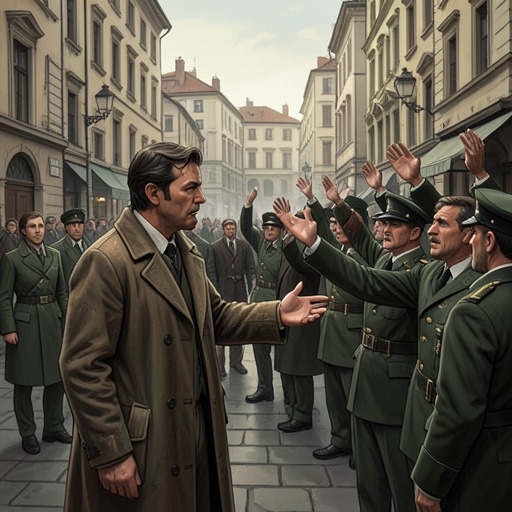
David Ben-Gurion (677054f3)
JudasDavid Ben-Gurion is a central political presence in the novel, though he appears chiefly through other characters’ arguments, recollections, and newspaper research. To Gershom Wald, he is an exceptional statesman who understood that Jewish security could not depend on goodwill or outside protection; to Shmuel Ash, he has become a nationalist leader whose policies threaten to turn conflict into an enduring cycle of violence. The disagreement over Ben-Gurion also gives political form to the novel’s larger tension between self-defense and accommodation, and between secular state-building and the messianic hopes attached to it.
Leadership and Political Standing
In conversations with Shmuel, Wald praises Ben-Gurion’s breadth of vision. Reading the newspaper Davar and explaining the political news, Wald describes Ben-Gurion as unmatched among Jewish leaders and argues that the Jewish people’s separation from other nations should be regarded as a curse rather than a blessing. The praise is not simply personal admiration: it reflects Wald’s belief that national survival requires political judgment attuned to the realities of power.
Wald later gives that judgment a concrete historical basis. He recalls that, after extended conversations in the 1930s with Arab leaders, including friends of Shaltiel Abravanel, Ben-Gurion concluded that what Jews did not secure for themselves would not be handed to them. In Wald’s account, Ben-Gurion recognized that the Arabs would not readily accept Jewish presence, territory-sharing, or shared power, and that no outside force could be counted on to protect the Jewish community if it faced expulsion. Wald places his son Mija’s nighttime weapons practice in the same atmosphere of anticipated danger: the need to prepare was understood by many, even if Wald could not bear to imagine what that meant for his own son.
Ben-Gurion’s authority also appears in his political command. During the period Shmuel studies in Davar, Ben-Gurion is again forming a coalition, with the possible participation of the Marxist-Zionist party among the questions under discussion. Shmuel follows the newspapers back to the weeks before the United Nations partition vote of November 29, becoming absorbed in the articles as though the outcome were still unsettled. Revisiting these reports complicates his view of Wald’s admiration: he recognizes that Wald’s assessment of Ben-Gurion’s historical stature is more multilateral than he had assumed.
The Dispute with Shaltiel Abravanel
Ben-Gurion’s most consequential opposition in the supplied account comes from Shaltiel Abravanel, Atalia’s father. In 1948, Abravanel tried to persuade Ben-Gurion that an agreement with the Arabs might still be possible as the British departed and a joint Arab-Jewish political arrangement was considered. He was prepared to give up the idea of a Jewish state in pursuit of that agreement. The dispute resulted in his removal from the Zionist Executive and the leadership of the Jewish Agency, which Wald describes as the unofficial Jewish government in the closing period of the British Mandate.
A report Shmuel finds in Davar, dated December 21, 1947, provides a contemporary record of the rupture. It says Abravanel had been removed from his positions the previous day because of disagreements with colleagues, and that he declined to explain the dismissal to the reporter. The paper nevertheless reports his view that Ben-Gurion’s chosen course led toward a bloody war between the two peoples, with no certain victor and the lives of 600,000 Jews in Eretz Israel at stake. Abravanel believed there was still room for a historic compromise. The report identifies him as a lawyer and Arabist who had been near the top of the two institutions for almost nine years.
Wald’s later account deepens the contrast between the two men. He says Abravanel did not leave Zionism; rather, he believed its leaders had abandoned their original course and followed Ben-Gurion into dangerous political choices. According to Wald, Abravanel was given twenty-four hours to submit a resignation letter or face formal expulsion. He wrote a reasoned letter, but it was concealed, and newspapers would not publish it. When Atalia later went to the Zionist archive seeking the letter or a copy, officials claimed it had never existed. In the novel, that disappearance makes Abravanel’s defeat more than a political disagreement: his position is also deprived of a public record through which it might be heard.
Nationalism, Retaliation, and Political Theology
Shmuel’s objection to Ben-Gurion is expressed as a change in political character. He contrasts Ben-Gurion’s early identity as a labor leader and popular tribune with his present position at the head of a nationalist, self-righteous state. Shmuel objects to the biblical language of restoration and fulfilled prophecy when it is used to lend grandeur to state policy. In his view, such rhetoric risks making modern political decisions appear sacred and inevitable.
His criticism also focuses on retaliation. Shmuel once drafted an angry letter to Ben-Gurion arguing that his departure from the socialism of his youth had been a tragedy for Israel, and that reprisals were futile and dangerous because violence produces further violence and revenge produces further revenge. He destroyed the unfinished draft. He continued to stage arguments with Ben-Gurion in his imagination, hoping not only to defeat him but also to win his admiration and affection. This private fantasy makes the political opposition intimate as well as ideological: Ben-Gurion is a public leader whom Shmuel challenges, but also an imagined audience whose recognition he desires.
Abravanel’s fears, as Wald remembers them, are cast in explicitly messianic terms. After meeting Ben-Gurion and David Remez at the Jewish Agency, Abravanel described Ben-Gurion as a false messiah who might bring catastrophic bloodshed upon Jews, Arabs, and the wider world. He warned that the oppressed might dream not merely of liberation but of becoming oppressors themselves. Wald says he did not believe this judgment at the time and regarded Abravanel as imagining a utopian paradise opposed to an infernal reality. The novel thus presents the accusation as part of a dispute, not as an uncontested account of Ben-Gurion’s intentions.
Wald’s Defense and Shmuel’s Critique
Wald’s defense of Ben-Gurion rests on political realism. He argues that the Arabs would not willingly accept Jewish presence and that words alone could not secure the future. His assessment is sharpened by hindsight and grief: after Mija’s death, he imagines Abravanel asking whether the losses had been worth the cost. That unasked question haunts Wald, who acknowledges that he and Abravanel had argued intensely until the night of April 2, after which their discussions ended. Their silence followed the death of Mija and the collapse of their former relationship into brief exchanges about practical matters.
Shmuel reads the consequences differently. When Atalia describes the state-centered course as leading toward massacre, deportation, and lasting hatred between the communities, he is disturbed but does not answer with Wald’s familiar defenses. He remembers that Atalia is a war widow and holds back his counterargument. Elsewhere, he warns that without peace the Arabs may eventually defeat the Jews, and that they will not forget either their humiliating defeat in 1948 or the intrigues conducted against them with Britain and France three years earlier. The novel gives this warning to Shmuel, not to an omniscient political narrator: it is his judgment about the likely consequences of unresolved hostility.
The opposing readings remain deliberately in tension. Wald’s account treats Ben-Gurion’s insistence on self-reliance as a response to the absence of dependable alternatives; Shmuel sees the turn toward nationalism and reprisals as a danger to Israel’s future. Abravanel’s proposed compromise, meanwhile, is remembered as a road with little chance of success, even by Wald, who once opposed him. Ben-Gurion’s significance in the novel lies in this unresolved contest: he embodies the forceful political judgment that can secure a state, while the arguments around him ask what that achievement costs, what kinds of rhetoric justify it, and whether security without reconciliation can end the conflict it is meant to survive.