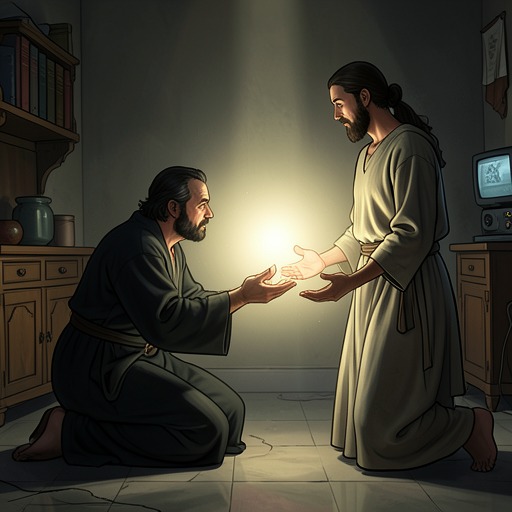
Galahad, Judas
JudasJudas Iscariot is the central figure in Shmuel Ash’s radical, explicitly speculative reinterpretation of the Gospel story: a wealthy Judean sent to infiltrate Jesus’s followers who becomes their most devoted believer and arranges the crucifixion as the stage for a miracle he expects will convert the world. In Shmuel’s account, Judas neither sells Jesus out for money nor intends his death. He engineers the event in the conviction that Jesus will come down alive from the cross; when that hope fails, Judas understands that his own plan has killed the man he loves and takes his own life. The reversal turns the traditional emblem of betrayal into Shmuel’s first, last, and only Christian—and makes the history of Judas’s vilification part of the story’s concern with religious memory and Jewish identity.
Shmuel’s Reconstruction
The account is not presented as established history. It is the argument Shmuel Ash writes into his notebook while researching Jewish portrayals of Jesus, drawing on earlier Jewish readings but offering his own conjecture about Judas. One of those readings, by Rabbi Yehuda Arie of Modena, presents Jesus as a genuine Pharisaic Jew who upheld the Law and never claimed to be divine. Shmuel’s reconstruction takes a different imaginative route: it makes Judas, rather than Jesus, the person who first believes completely in Jesus’s divinity.
In this invented backstory, Judas is a prosperous, educated, sober man from Judea, versed in the Written and Oral Law and associated with Pharisees and priests. Unlike the other apostles, he is neither a Galilean nor a poor fisherman or peasant. Jerusalem’s priestly authorities choose him to join the following of a Galilean wonder-worker and report on the man’s character and whether he poses a danger. Judas disguises himself in rags, goes to Galilee, finds Jesus, and enters the circle as an apparent disciple.
He quickly wins the group’s affection and Jesus’s trust. His intelligence and convincing appearance as a faithful follower make him a confidant and a member of Jesus’s intimate circle; he also becomes treasurer of the Twelve Apostles. Shmuel leaves open whether Judas’s conversion happens suddenly or through a gradual renewal. What matters to the reconstruction is the change itself: the investigator sent to expose Jesus becomes a committed disciple, and the original purpose of his mission gives way to belief.
Belief and the Plan for Jerusalem
Shmuel attributes Judas’s transformation to Jesus’s personal presence and teaching: his humility, humor, warmth toward individuals, moral stature, and striking proverbs, as well as the force of his message. Judas becomes convinced that Jesus is omnipotent and that the world will soon see the light and be redeemed. This belief, rather than disillusionment or greed, drives what follows.
Judas also thinks in terms of public consequence. For the world to recognize Jesus, he concludes, Jesus must leave Galilee and go to Jerusalem, where power is concentrated. There, before the city and a vast audience gathered for Passover, Jesus should undergo an unparalleled trial: be crucified, then descend from the cross alive and stand unharmed before the crowd. The expected witnesses encompass not only ordinary people and priests but Romans, Pharisees, Sadducees, Essenes, Samaritans, the rich and the poor, and pilgrims arriving from surrounding lands. Judas imagines the spectacle inaugurating the kingdom of heaven.
Jesus, in Shmuel’s account, is uncertain about going. The doubts attributed to him include fear that he may not be the chosen man, that the voices guiding him are misleading him, or that he will fail before Jerusalem’s more worldly and less easily astonished inhabitants. In Jerusalem, his fear of death remains human and acute. Judas counters that someone who has performed miracles and raised the dead can surely descend from a cross. The contrast is decisive: Jesus hesitates before the ordeal, while Judas’s confidence in what it will accomplish becomes the force that carries the plan forward.
The Crucifixion as an Engineered Test
Judas arranges the crucifixion not because the Roman authorities consider Jesus unusually dangerous, but despite their lack of interest in him as one among many itinerant prophets and wonder-workers. Nor, in Shmuel’s version, do the priests readily see Jesus as a special threat. Judas must use his connections among Pharisees and priests to change minds and secure the proceedings. The notebook suggests that he may even have paid bribes, though it does not claim certainty about this detail.
The familiar thirty pieces of silver are likewise unsettled rather than treated as a fact that proves betrayal. Shmuel proposes that later enemies of Israel invented the payment, or that Judas himself may have inserted it into the story. The sum would have been the price of an ordinary slave, and the notebook questions why anyone would pay even three pieces to identify a man everyone already knew, who made no attempt to conceal himself. This reconsideration removes financial gain as the motive and redirects attention to Judas’s purpose: bringing Jesus to the cross so that the anticipated miracle can happen in public.
As Jesus suffers on the cross, Judas does not abandon his expectation. He believes the crucified God will rise, free himself from the nails, descend, and proclaim the commandment to love one another. The crucifixion is therefore, in Judas’s mind, both a terrible ordeal and the decisive public demonstration on which the redemption of the world depends. Shmuel pointedly calls Judas its inventor, organizer, director, and producer: he has arranged the circumstances, but mistakes the death he can bring about for the miracle he cannot guarantee.
Death and the Reversal of Betrayal
Jesus dies rather than descending from the cross. Shmuel imagines him still wrestling with uncertainty and attempting to hold on to Judas’s promise even in agony, until he dies as a mortal man. For Judas, this is not a failed transaction but the collapse of the meaning and purpose of his life. He recognizes that he has caused, with his own hands, the death of the person he loves and admires. He leaves and hangs himself.
Shmuel’s closing formulation identifies Judas as the first Christian, the last Christian, and the only Christian. In this account, Judas is first because he is the first person to believe with absolute certainty in Jesus’s divinity; last because his death follows Jesus’s; and unique because he is the disciple whose faith remains fixed on the promised revelation even as the crucifixion unfolds. The title does not erase the catastrophe: his devotion is inseparable from a plan that ends in the death of Jesus and his own suicide.
Shmuel sets this reconstruction against the long Christian memory that identifies Judas with betrayal and, by extension, makes him the figure who represents the Jewish people. In the notebook, he stresses the irony that Jesus and all the apostles were Jews, but Judas alone became indelibly marked in popular Christian consciousness as the Jew. When the Temple guards come to arrest Jesus, the other apostles scatter in fear. Judas, Shmuel notes, does not deny Jesus as Peter does; he remains with the story of his teacher to the end. Shmuel even imagines that the kiss may have been meant to strengthen Jesus, while keeping the gesture uncertain rather than claiming to know its purpose.
Silence, Memory, and Shmuel’s Claim
The Jewish writings Shmuel surveys repeatedly engage Jesus, but often say little or nothing about Judas. Josephus survives in two markedly different accounts: one version describes Jesus in language that appears Christian and may have been altered by later Christian hands, while another, preserved by the tenth-century Christian writer Agapius, reports his followers’ beliefs without affirming Jesus’s messiahship or resurrection as fact. Rabbinic passages and medieval polemics, meanwhile, include hostile or mocking portrayals of Jesus; some Talmudic passages were removed from most printed editions because Jews feared the consequences if Christian neighbors read them. Within this record of argument, accommodation, and censorship, Shmuel finds a striking omission: Jewish authors who disputed Christian claims about Jesus generally avoided Judas.
His notebook gives that silence a history of its own. Even polemicists who presented Jesus as a Jew, a magician, or the son of a Roman soldier passed over Judas, Shmuel writes, perhaps from shame or fear of reopening a figure burdened by generations of hatred. He recalls familiar Last Supper paintings that render Judas as a grotesque, covetous outsider, then turns that inherited image against itself: how could a man supposedly moved only by payment hang himself immediately after Jesus’s death? Shmuel finds no Jewish text in his research that attempts to defend Judas, despite the role his story assigns him in the crucifixion and the founding of Christianity.
This is Shmuel’s reinterpretation, not a historical correction supplied by the novel. Its force comes from turning the stock evidence of treachery—the kiss, the arrest, the cross, the silver—into elements of a disastrous act of faith. Judas’s devotion does not save Jesus, and his intended revelation never arrives; instead, his death becomes the final measure of his conviction. The notebook’s counter-story asks readers to see how a tradition can make one man the embodiment of Jewish betrayal while leaving unasked whether his actions, however catastrophic, might have begun in love.