Mija Wald
JudasMija Wald is the only son of Gershom Wald and the husband of Atalia Abravanel, a combatant whose death on the road to Jerusalem leaves a wound that reorganizes the lives of his father, his wife, and Shaltiel Abravanel. The story makes his fate both intimate and political: a man medically unfit for combat is driven toward war by the very patriotic language his father helped teach him, while the family that survives him cannot escape the consequences of that choice.
Identity and Background
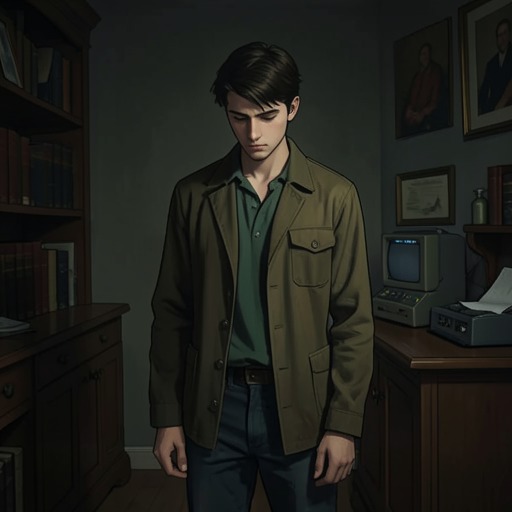
Mija is thirty-seven when he dies, nearly a professor and, in his father’s estimation, no longer a boy. As a child, an illness led to the removal of one of his kidneys. That history did not prevent him from seeking military service: in late 1947, during the confusion preceding the war, he deceived the recruitment committee, whose members were reportedly willing to be deceived. His physical vulnerability stands in stark contrast to the martial expectations that surround him.
He is Gershom Wald’s only son and the father of the grandchild Gershom will never have. He has married Atalia, Shaltiel’s daughter, and is close enough to the center of both households that his death binds their grief together. Yet the account does not give Mija an extended speaking voice or a separate interior narrative. His character emerges through the memories, regrets, and silences of those who remain.
The Choice to Fight
Mija’s enlistment is contested even within his family. Atalia tells him not to go and ridicules the prospect of his rushing out to play soldiers; she regards men as ridiculous, unable to outgrow adolescence. Shaltiel also makes Mija promise not to fight. He believes the war is madness promoted by David Ben-Gurion and shared by both peoples, and argues that young people on both sides should lay down their weapons rather than kill one another.
Gershom, by contrast, had helped form the culture that made Mija’s departure seem necessary. He recalls educating his son through stories of the defenders of Tel Hai, Wingate’s night squads, the Jewish police special forces, and the Maccabees, all presented as models whose spirit had to be revived. Teachers, classmates, and the wider country reinforced that lesson. The young people of the period repeated the call that a voice had summoned them and they had gone; Gershom recognizes himself as part of that voice. He later wonders whether Mija might not have gone if his father had not described the war as sacred and trained him for it.
Mija’s decision therefore cannot be reduced either to private bravery or to an individual mistake. Atalia and Shaltiel try to stop him, while Gershom’s earlier convictions and the national atmosphere encourage the very action he later mourns. The family’s conflict over the war becomes inseparable from the question of responsibility: Gershom’s sorrow includes the knowledge that the voices sending Mija to battle were not only outside the home.
Death at Bab al-Wad
On April 2, 1948, Mija accompanies an armed convoy bound for Jerusalem along the Tel Aviv–Jerusalem road through Bab al-Wad. The route winds through a deep ravine, where Arab fighters fire on convoys from the mountains on both sides. As evening approaches, the convoy commanders fear being trapped on the narrow road after dark. Some fighters leave the armored trucks to clear a stone barricade; Mija is among those sent up the hillside to attack sniper positions with homemade hand grenades.
The attack is repelled. At night, the fighters retreat carrying their dead and wounded, but Mija is not among those brought back. Only as the convoy nears Jerusalem does someone notice he is missing. At dawn the next day, a platoon, including close friends mostly ten or fifteen years younger than Mija, searches the slopes and finds him. The account leaves his final hours uncertain: he may have lain alone, wounded and calling for help, or tried to crawl toward the road; the Arab fighters may instead have found him after the others withdrew. Atalia later recounts that his body had been mutilated. She insists that the precise order of the violence cannot be known, an unresolved question that continues to occupy her imagination.
The loss is reported in different forms by the survivors. Gershom gives the date and battle in a few broken sentences, naming Mija as the son he himself led to sacrifice. Atalia tells the fuller account years later, including the circumstances of the search and the unanswered questions left by the condition of the body. These accounts converge on the same absence but expose different dimensions of it: the father’s guilt over the forces that sent his son, and the wife’s recurring vision of what happened after the fighting.
Grief and the Household Aftermath
Atalia learns the details not directly from the people who found Mija but by chance. About a year after his death, one of his companions dies in a workplace accident in Galilee, and his diary comes into her possession. In fewer than ten words, it records how Mija was found among the rocks. Atalia says that she sees the image continually, with her eyes closed or open, by day and by night. The brief written record becomes the source of a trauma that expands far beyond its few words.
For Gershom, grief is joined to remorse. He says that he raised Mija alone after the boy’s mother died when he was six, and that he himself led his son to sacrifice. In his later recollection, he had imagined Shaltiel asking whether the war had been worth Mija’s life, a question Shaltiel never actually put to him. Even without being spoken, it wounds Gershom and marks the silence between the two men. He calls himself a dead man who continues to talk, while Mija’s absence becomes the measure of what has vanished from the household.
Mija’s death also ends the possibility of a shared future for the family. Gershom describes him as the father of the grandson he will never have. After Mija is killed, Atalia, Gershom, and Shaltiel live together in the house, but the old arguments between the two older men cease. They do not resume their disputes; grief knots their speech, and silence settles over all three. Atalia cares for them while working several hours a day at a real-estate office on Straus Street. In Gershom’s image, the three survivors live together like people shut inside a submarine.
Shaltiel dies alone in the kitchen two years after Mija. Gershom describes finding him collapsed over his coffee and newspaper, his glasses broken and the coffee spilled across the table and floor. Atalia’s later account situates this death within the years of isolation that followed Mija’s: Shaltiel’s Arab friends were displaced or left beyond new borders, and his Jewish friends had turned against him as a traitor. The house thus holds two connected losses, though Mija’s death is the event that first silences the household and makes its later seclusion possible.
Memory and Narrative Significance
Twelve years after the battle, Shmuel Ash leaves Jerusalem by bus and sees the wooded hills near Sha'ar HaGai, where Mija had lain dying. The spring landscape outside the city contrasts with the barricades, barbed wire, minefields, and nightly gunfire associated with divided Jerusalem. Shmuel thinks that Mija’s death gave him the winter he spent in Mija’s home with Gershom and Atalia, a gift he feels he wasted despite having time and solitude. The journey turns Mija’s absence into a direct measure of Shmuel’s own time in the household.
Mija’s role in the narrative is defined by this afterlife of memory rather than by a long account of his actions before the battle. His death is at once a particular military loss, the consequence of a family’s conflicting convictions, and the point around which a household contracts into silence. Gershom’s regret, Atalia’s repeated visions, and Shmuel’s reflection on the winter he was given keep Mija present not as a resolved memory but as an absence that continues to shape the living.