Shmuel Ash
JudasShmuel Ash is an awkward, tender-hearted student and aspiring historian whose private defeats lead him from university into a caretaker’s room in Jerusalem, where his research on Jesus and the Jews turns into a daring defense of Judas Iscariot. His intellectual journey runs alongside a more intimate education in dependence, grief, political compromise, and the difficulty of acting on beliefs: by the time he leaves for the Negev, he has begun to see the cracks in revolutionary certainty, but has not discovered what he was seeking.
Identity and Background
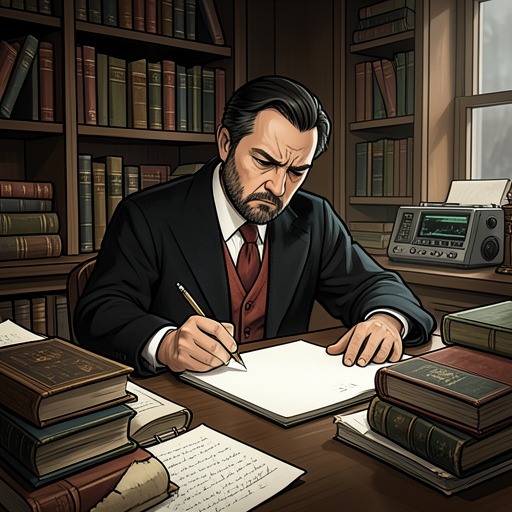
At about twenty-five, Shmuel is a large, bearded, asthmatic young man, shy and emotionally susceptible. His shoulders and neck are broad, his fingers short and thick, and his unruly beard joins the curls on his head and chest. He looks perpetually overheated, but close up his skin smells faintly of talcum powder rather than sweat. He is quick to become absorbed in an ingenious or paradoxical idea, and just as quick to tire and lose heart. The description makes his body and temperament part of the same contrast: imposing in outline, sensitive and easily discouraged in practice.
His family comes from Haifa and, as he explains when applying for the advertised companion’s position, consists of civil servants and surveyors. He is not religious, but studied History and the Science of Religions in Jerusalem. As a child he grew up in a cramped family flat in Hadar HaCarmel after the barrack where the family had lived in Kiryat Motzkin burned down. The two-room apartment left no room of his own: his bed stood in the passage between the kitchen and the bathroom, while a small brown-painted box served as wardrobe, desk, and bedside table. His sister Miri, five years older, had the small bedroom.
At eleven, Shmuel was thin and stooped, with large, astonished eyes, spindly legs, and perpetually bruised knees. He kept a collection of stamps and entertained a few timid school friends with explanations of their value and countries of origin. He especially liked stamps from vanished states, including Ubangi-Shari, Austria-Hungary, and Bohemia and Moravia; their disappearance led him into long accounts of the wars and revolutions that had erased them from maps. Even as a boy, he could talk at length but struggled to listen for more than a few sentences. After military service he grew his unruly hair and beard, which he disliked but believed concealed something about himself of which he should be ashamed.
Academic and Political Disillusionment
Shmuel leaves his university studies in early December, driven by several failures at once. His father’s financial ruin means the family can no longer support him; his romantic relationship has failed; and the research project he had begun with enthusiasm has stalled. The ending of his studies is thus both practical and intellectual: he needs paid work, but the project that had given his academic life direction has also lost its promise.
His master’s work, Jesus in the Eyes of the Jews, began with what seemed to him a brilliant, electrifying insight. When he followed the sources, however, he found that his central idea had already appeared in a footnote published in the early 1930s by his teacher, Gustav Yom-Tov Eisenschloss. About three weeks before Yardena’s wedding, Shmuel definitively abandons the thesis. The discovery does not extinguish his interest in Jesus; instead, it changes the form of that interest, from a university project into a more speculative inquiry conducted through reading, conversation, and notebooks.
His political commitments are also shaken by internal division. The socialist-renewal circle meets on Wednesday evenings in a low-ceilinged, blackened café in the back streets of Yegia Kapaim. Artisans, plumbers, electricians, painters, and typesetters play backgammon there, lending the group a sense of working-class proximity, although the workers generally keep to their own table. After the Soviet Communist Party’s twentieth congress condemned Stalin’s terror, almost all the circle’s members accept the criticism. A determined minority goes further, demanding that the group reconsider not only its allegiance to Stalin but also the foundations of the dictatorship of the proletariat as conceived by Lenin. Two members invoke the young Marx against the later Marx’s hardened doctrine. Shmuel tries to stop the group from disintegrating, but four of its six members announce a split and form an independent cell. The two women in the circle are among the dissenters, and their departure makes the break especially consequential for him.
Research on Jesus and the Reinterpretation of Judas
Shmuel’s research unfolds against a record of Jewish writing about Jesus that is neither uniform nor simple. He studies the two versions associated with Flavius Josephus: the passage in Jewish Antiquities that calls Jesus the Messiah and refers to his resurrection, which Gustav Yom-Tov Eisenschloss considers a Christian interpolation, and the account attributed to Agapius, which presents Josephus as describing what Jesus’ followers believed rather than affirming the claims himself. Shmuel also encounters hostile or ambiguous allusions in rabbinic texts, including Talmudic passages that depict Jesus as a misguided student, a sorcerer, or a libertine. Those passages were later removed from nearly all printed versions, reflecting Jewish fear of the consequences if Christian neighbors read them.
The historical record also includes Jewish works of polemic. An anonymous Arabic text from around the ninth century, later translated into Hebrew as The Book of Nestor the Priest, attacks Christian doctrine by pointing to contradictions in the Gospels, rejecting the Trinity and denying Jesus’ divinity. Its arguments pull in conflicting directions: it presents Jesus as a thoroughly Jewish, pious man who did not intend to found a new religion, while also using degrading insinuations about his birth and mocking his suffering and death. Medieval Jewish responses could be different in tone. Rabbi Gershom ha-Cohen called insults against Jesus foolish and empty words that an educated person would be ashamed to utter, even though his own book challenged the New Testament. In The Kuzari, Yehuda ha-Levi gives a Christian sage a coherent account of Jesus’ life and beliefs without ridicule. Maimonides, meanwhile, calls Jesus a false prophet but sees Christianity as a stage in humanity’s movement from paganism toward belief in the God of Israel.
Shmuel’s own interpretation takes shape through these readings. Rabbi Yehuda Arie of Modena argues that Jesus was a Pharisee who remained within Jewish faith and never claimed to be divine; in Shmuel’s account, the later elevation of Jesus into a deity belongs to his followers after his death. Reading this material late at night, Shmuel becomes so absorbed that he nearly forgets an appointment. He then writes his own theory: Judas Iscariot, a wealthy and educated Judean with knowledge of the Written and Oral Law, was chosen by Jerusalem’s priestly authorities to join Jesus’ followers and report on him. Unlike the other apostles, whom Shmuel imagines as Galilean fishermen and peasants, Judas is an informed observer sent to assess whether the popular wonder-worker poses a danger. He disguises himself in rags, attaches himself to the group, and wins the affection of its members and of Jesus. Shmuel’s emerging hypothesis reverses the conventional account of the disciple’s motive and begins to recast Judas as central to the story of Christianity.
Shmuel also treats the silence around Judas in Jewish writing as meaningful. On a winter night in his attic, drinking inexpensive vodka as rain falls outside, he records that Jewish writers who disputed Christian claims about Jesus still avoided Judas. Even authors who argued that Jesus was born and died a Jew, or portrayed him as a magician or impostor, said nothing about the disciple. Shmuel suggests that the silence may reflect shame, repudiation, or fear of reopening a figure burdened by generations of hatred. He contrasts that absence with the familiar Christian image of Judas as a deformed, reptilian presence among the beautiful diners in Last Supper paintings. His research does not simply reverse a verdict; it asks why a community’s history has left one character unspoken while another is continually condemned.
Work, Care, and Relationships
The practical crisis that interrupts Shmuel’s studies sends him to Jerusalem in search of employment. He answers an advertisement for a companion found on the noticeboard at the Kaplan Foundation’s student cafeteria. Introducing himself, he explains that he studies religion without being a believer and describes his interest in Jesus, Judas, and the Jewish world that rejected Jesus. He presents the subject as connected to the fate of champions of social justice in recent decades, though the explanation grows hesitant and he worries that he is imposing on his listener. His intellectual life is therefore not separate from the circumstances that bring him to the house: the research helps him explain both what he is seeking and why the job seems suited to him.
The financial collapse of his family remains a source of guilt and estrangement. His mother writes that his father’s ruin has nearly broken his heart and that he has become an old man who scarcely speaks. Since Shmuel left his studies, his father feels betrayed. Miri has also complained that Shmuel has not written for weeks. His mother slips one hundred pounds into the envelope without his father’s knowledge and joins his father’s plea that he return to his education. Her letter makes clear that Shmuel’s departure is not simply a solitary adventure: his absence has deepened his family’s distress, even as their money problems helped force him to seek work.
In conversation with Atalia, Shmuel gives a more direct account of why he came to the house. Yardena left him and married her former boyfriend; his father’s financial ruin made further study impossible; and his research had been at a standstill for months. Yet the intellectual question remains alive: he cannot stop wondering what Jews and the world might have been like had the Jews not rejected Jesus. He thinks about the apparent payment of thirty pieces of silver for Jesus’ delivery to the Romans and stresses how small a sum it was—roughly the price of an ordinary slave—especially for a wealthy man like Judas, who he believes owned land and estates in Kerioth. His questions are not only historical: they challenge the familiar explanation that greed alone could account for Judas’ act.
Shmuel’s own response to Jesus is personal and paradoxical. He tells Atalia that he is an atheist and cannot believe in Jesus as God or the Son of God. The death of three-and-a-half-year-old Yosi Siton, killed by a car while chasing his green ball on Azza Street, is sufficient evidence for Shmuel that God does not exist. Yet he says he loves Jesus and has loved his words since reading the New Testament at fifteen. He recalls sayings about inner darkness, grief unto death, the dead burying the dead, and salt losing its savor. He also believes Judas was the most faithful and devoted of Jesus’ disciples and never betrayed him; in Shmuel’s view, Judas did the opposite, seeking to make Jesus’ greatness known to the world. He offers to explain the theory another time and asks Atalia to meet somewhere quiet so they can talk.
That invitation carries both intellectual and emotional hope. Shmuel is attracted to Atalia, but the text also shows how uncertain and self-conscious he is in her presence: after speaking, he notices her crossed legs and nylon stockings, imagines what might be beneath her skirt, and hunches in his chair so she will not notice his arousal. Atalia, meanwhile, recognizes that Shmuel’s work with Gershom suits his affinity for words. She explains that after the death of his son, Gershom has little left but words, and asks whether Shmuel finds anything worthwhile in the old man’s continual talk. Their relation is formed through paid companionship and care, but also through the exchange of ideas and the practical intimacy of the household.
Political Reflection and Departure
Shmuel’s work at the house brings him into extended conversations with Gershom about Israel’s past and the choices its founders made. He listens to contrasting explanations of the departure of most of Haifa’s Arab population: a fear among Arab residents that Jews intended to kill them, stories associated with the killing of inhabitants at Deir Yassin, and the later emptying of much of Haifa. Gershom recalls walking through Arab districts now occupied by Jewish immigrants and through the lanes where Arab residents remained, asking whether what happened had to happen. Shmuel also recounts his father’s view that there was no escape from a total war between populations, in which whole communities were displaced, and his mother’s insistence that British policy was responsible for setting one people against another by promising the same land twice.
These accounts complicate Shmuel’s earlier revolutionary idealism. He describes Shaltiel Abravanel as a man who, like David Ben-Gurion, had great dreams, though Atalia once said that her father belonged neither to his time nor to another time: perhaps he was too early or too late, but out of step with his age. Shmuel tells Gershom that their nighttime conversations have taught him to doubt. He sometimes sees cracks in the arguments that once seemed whole, and suspects that he may never be a true revolutionary, only a café revolutionary. The phrase marks neither a clean conversion nor a settled political position; it registers the distance between revolutionary language and the compromised history he is learning to examine.
When Atalia invites him to dinner at the Fink, Shmuel prepares warm porridge for Gershom, sprinkling it with sugar and cinnamon, and makes himself bread with butter and cheese despite Atalia’s instruction not to eat before their outing. Care is shown here in exact, ordinary tasks rather than declarations: he protects Gershom’s shirt with a checked kitchen cloth, feeds him, and makes sure the old man can eat comfortably. His responsibilities in the house include such routine acts alongside conversation and companionship.
After injuring his foot, Shmuel spends a short time using crutches and then gradually manages with a fox-headed cane he found under the attic bed when he arrived. A few days later he can carry Gershom a glass of tea every hour or two, feed the colored fish, switch on the lamp at night, and wash cups in the kitchen. The return of these routines looks like a restoration of ordinary life, but Shmuel understands that his time in the house is ending. The injury has bought him a brief reprieve, perhaps a week at most; neither he nor Atalia discusses his return to the attic. Her sometimes affectionate, teasing smile seems to tell him not to grieve, while the possibility of being asked to leave remains unspoken.
At three in the afternoon, Shmuel finally leaves Jerusalem on an Egged bus bound for Beersheba. He is heading toward the new settlement being built at the edge of the Mitzpe Ramon crater, a place about which he had heard only months earlier. He imagines finding work as a night watchman at the construction site, a caretaker at the public school, or even a librarian or library assistant in the small library he assumes must be built there. Once he has found somewhere to sleep, he plans to write to his parents and Miri, and perhaps to Yardena and the alley of Rabbi Elbaz, although he has no idea what to say. He hopes the new place will eventually help him discover what he has been looking for.
His departure is deliberately provisional rather than triumphant. Alone at the back of the bus, he keeps his heavy pack between his legs because it will not fit in the overhead rack. Only the fox-headed cane fits above him, beside the coat and shapka hat he already knows he will forget when he gets off. The small practical certainty of that forgotten luggage sits beside the larger uncertainty of his destination. Shmuel leaves with plans for work and letters, but without a settled intellectual or political conclusion; his journey ends the Jerusalem episode without resolving the questions that propelled it.