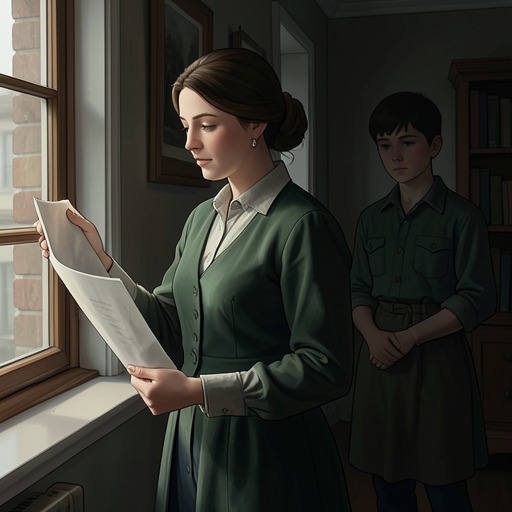
Shmuel Ash's loneliness and heartbreak
JudasShmuel Ash’s loneliness and heartbreak are shaped by two losses: the affection he cannot find in his childhood home and the adult relationship that ends when Yardena leaves him to marry Nesher Shereshevski. He tries to make solitude a deliberate refuge, but his response to Atalia’s kindness, his childhood fantasies of being mourned, and his attachment to the household below his attic show how urgently he wants to be noticed and held in mind. His isolation is less an escape from others than a painful, unsettled dependence on them.
Childhood and the hunger to be mourned
An early encounter with death gives Shmuel a glimpse of the tenderness missing from his family life. After a scorpion sting sends him to a doctor, he imagines his parents grieving over his grave and regretting how they have treated him. Even as the pain begins to subside, he feels a small disappointment when he tells them that nobody dies from a scorpion bite: the imagined funeral had promised a kind of attention he does not expect to receive while alive. His sister Miri touches his forehead and hair as he lies in bed, a rare physical tenderness that he remembers precisely because it is unlike the usual reserve at home.
The household provides for Shmuel materially, but affection is scarce. His parents rarely touch, speak mostly about practical matters, and inhabit a distance that he remembers as already established when he was two or three. He cannot explain the resentment he senses in his mother or the tense bitterness he associates with his father; neither does he want to uncover its cause. He is ashamed of their restrained, embittered lives and angry with them, while also reproaching himself for that anger. The family’s emotional climate leaves him feeling like an undercover spy among people to whom he is nevertheless bound.
To escape the parents he has, Shmuel invents others: loving, strong, clever, affectionate people whose education and social standing would command his admiration. This private replacement does not dissolve his attachment to his real family; instead, he experiences his fantasies as a betrayal of them. His sister’s teasing stories about his being adopted sharpen the mixture of estrangement and belonging. Their father corrects her with competing versions of where they found him, while their mother offers a gentler account in which the family simply found one another by chance. Shmuel remains caught between wishing he had been born elsewhere and feeling guilty for wishing it.
Yardena’s departure and chosen isolation
In adulthood, the end of Shmuel’s relationship with Yardena compounds this older loneliness. She leaves him and marries Nesher Shereshevski; he is still suffering from the abandonment months later. At the same time, his father loses a lawsuit and the family business collapses, leaving the family unable to continue paying for his university studies. Shmuel gives up his studies and moves into the old Jerusalem house where he works for Gershom Wald. The change of residence and work is not simply a new beginning: it follows romantic loss, financial ruin, and a stalled writing project.
Shmuel tells Atalia that he came to the house because his girlfriend left him, his family could no longer fund his studies, and he had been stuck for months on the work he had started writing. He also describes his continuing questions about how the world and the Jews might have been different had they not rejected Jesus, and about Judas Iscariot’s decision to deliver Jesus to the Romans for thirty silver coins. The historical questions give him a subject to speak about, but they do not answer the personal question of how to live after Yardena’s departure. His sister sees that he often evades talking about himself by turning to Ben-Gurion or the Crusades and delivering a lecture instead.
The idea of withdrawing becomes a kind of resolve. Walking alone through the city, Shmuel tells himself that he has been isolating since Yardena married Nesher Shereshevski and since he left his studies, and that he has held firm to this decision. Yet his attention keeps returning to the people in the house: even when he is shut in his attic, he recognizes that his heart is downstairs in the kitchen or at Atalia’s closed door. The contrast exposes the limit of his chosen solitude. He can remove himself physically, but he cannot make himself indifferent to the possibility of being wanted.
Atalia and the reprieve of closeness
Atalia’s proposal to meet at three in the morning for a walk lifts Shmuel’s spirits. After sitting in the kitchen, he worries that questions about her father or husband might anger her and drive her away, and wonders whether she is fond of him, merely pitying him, or treating him as she treated previous lodgers. Then the uncertainty gives way to a sudden joy. For the first time in months, the sharpness of his pain over Yardena’s abandonment seems to lessen. He feels calmer and almost manly, and answers aloud that he will meet Atalia at three.
The reprieve is revealing partly because it is so fragile. Shmuel leaves for dinner carrying his fox-headed cane, but becomes anxious that he cannot remember where Atalia told him to wait, or whether they are meant to leave the house at three or arrive at Mount Zion then. His excitement does not erase his fear of misunderstanding or losing the connection. Even before the walk takes place, his mind turns the invitation into a test of whether they are close at all.
Later, Atalia names the loneliness they share. When she asks whether there are no young women left in Jerusalem, Shmuel protests that he is old too, then says that both of them are a little lonely. Atalia counters that he came to the house because he wanted solitude. Shmuel’s answer complicates the claim: he came after being left, after his father’s financial defeat, and after his own work had stalled. His isolation is a response to circumstances as much as a chosen posture, and his admission to Atalia makes those causes speakable between them.
A household organized around loss
The house in which Shmuel seeks refuge is itself shaped by bereavement and distance. Gershom Wald recalls that his son Mija was orphaned young, grew up without a mother, and was raised by Wald alone. Wald says that he himself led Mija to the sacrifice: Mija died in the fighting at Bab al-Wad on April 2, 1948, on the Tel Aviv–Jerusalem road. Shmuel’s own heartbreak thus unfolds among people for whom loss is not a passing mood but the defining absence around which a household has been arranged.
Atalia recounts that after Mija’s death she, Gershom, and her father, Shaltiel Abravanel, lived together in the house for about two years. They had once argued, but Mija’s death ended the arguments; grief left them silent, and Atalia cared for the two men while working several hours a day at a real-estate office. The three became, in her description, like people shut together in a submarine. Shmuel enters this already enclosed world as a paid helper and lodger, but the house’s silences give his own retreat a human context: these are not people untouched by attachment, but people whose attachments have been altered by death.
Atalia’s account of her childhood adds another history of loneliness to the house. After her mother left for Alexandria, Abravanel turned the room into what Atalia remembers as his private penal colony, summoning her to sit opposite him while he delivered speeches. He did not ask about her school, friends, health, or whether she missed her mother; practical needs such as money or medical help were handled, but ordinary companionship was absent. Even a birthday gift became a lecture: he gave her a translated selection of Jewish poetry from Arab countries, hoping it would clarify where they lived, then spoke at length about the historical golden age between Muslims and Jews. Atalia’s memories make Shmuel’s own emotionally distant family life resonate with hers, without making their experiences identical.
Solitude as a condition, not a cure
Atalia recognizes in Shmuel a person who, like her, hardly asks questions and may soon leave. She expects the house to return to its closed, shuttered state and says she lives between farewells. Her remark places Shmuel’s departure within a recurring pattern: Atalia sometimes draws an eccentric young man into her orbit, then lets him go, while the household continues to carry the memory of those who are gone. Shmuel’s loneliness belongs to this world of temporary company and anticipated separation, not to a stable refuge outside relationships.
The novel’s details make that contradiction concrete. Shmuel’s childhood fantasy requires him to imagine his family mourning him; as an adult, he tries to isolate himself after Yardena’s marriage, yet feels joy at Atalia’s invitation and locates his heart below his attic. His intellectual preoccupations can divert conversation away from himself, but his confession to Atalia brings the personal losses into view. Solitude protects him only imperfectly: it coexists with a persistent hunger for recognition, and every brief kindness matters because it interrupts, rather than resolves, the abandonment he carries.