Château de Gernande
JustineChâteau de Gernande is a secluded estate whose scale and isolation make it a prison as much as a residence. The Count’s control of its rooms, approaches, and inhabitants allows him to conceal his abuse of his wife and threaten Therese with impunity; the grounds that initially seem to offer an escape prove to be another enclosure. Therese’s eventual flight comes only when a crisis inside the château briefly interrupts that control.
Setting and Architecture
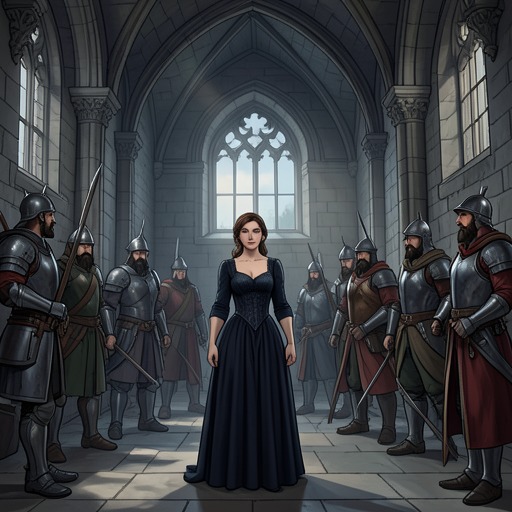
Therese first sees the château after being taken through the forest. It is a superb, vast building, capable of housing hundreds, yet seemingly almost empty. The few signs of life come from kitchens in vaults beneath the central structure. No one greets the newcomers at the entrance: one guide goes toward the kitchens, while another brings Therese to the Count.
The Count receives her in a spacious, richly furnished apartment, reclining in an oriental satin dressing gown. Two elaborately dressed youths are beside him; at first Therese mistakes them for girls, then recognizes them as boys of about fifteen and sixteen. The contrast between the estate’s grandeur and its sparse signs of ordinary life makes its scale feel less like a community’s and more like the Count’s domain.
The château’s isolation is reinforced by its hidden perimeter. When Therese and Madame de Gernande devise a plan to seek help from the Countess’s mother, they estimate that the terrace wall is scarcely thirty feet high and believe that descending it will bring them to the forest road. In fact, the apparent open ground is a park enclosed by another wall, more than forty feet high, thick and topped with broken glass. Trees and dense foliage have concealed this second barrier from view.
The Count’s Household and Its Secrecy
The château shelters the Count’s wife, whom he keeps in a room under constant watch and presents to outsiders as insane. He tells Therese that his wife has not been allowed to leave her room and that no one willingly accepts the work of serving her; girls are therefore seized and brought in by force. The house’s staffing and seclusion are thus part of a deliberate system for maintaining the Count’s control.
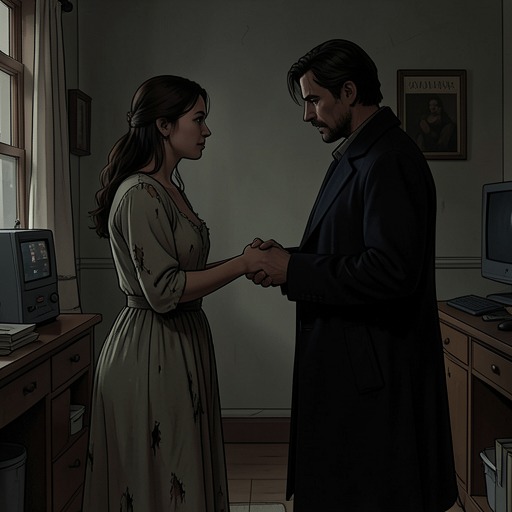
After Therese has been brought to the Count, he makes clear that she is not free to leave or seek help. Because no one will be looking for her, he claims that he can punish or kill her without attracting inquiry. He places her with his wife as a maid, while warning both women against conspiring with one another. Therese conceals her intention to help the Countess, assuring him that she will report anything the Countess says; this performance earns his approval and gives her access to the woman he has isolated.
The Count describes his treatment of his wife not as revenge or hatred but as the pursuit of his own passion. He says that the practice has continued throughout their three-year marriage, that he restricts her visitors and contact with her mother, and that he will keep her alive while she can endure it. He also describes her as one in a succession of wives. The château’s apparent domestic order therefore conceals a private regime of captivity, sustained by the Count’s control over both information and movement.
Captivity, Escape Attempt, and Flight
After a year in the house, Therese and the Countess have built enough trust to agree on a plan: they will inform the Countess’s mother of the abuses and ask her to intervene. The Countess writes a letter intended to persuade her mother to come to her aid. Since the women are closely watched and cannot leave openly, Therese undertakes to carry the letter over the wall, using bed linen to descend from the terrace after nightfall.
The attempted escape exposes the château’s deceptive layout. Therese reaches the ground outside the terrace but finds herself only inside the park. The outer wall, which she had not seen through the trees, blocks the way to the forest. She is trapped within the estate’s wider enclosure, and the approaching dawn makes the failed attempt dangerous: her unexplained presence in the park could reveal that she has tried to escape.
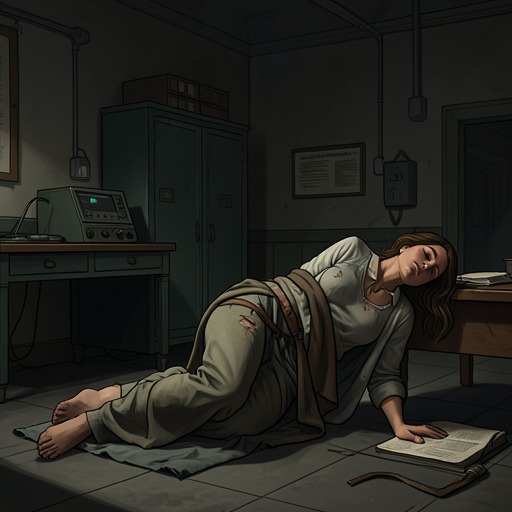
The Count discovers the attempt and confines Therese. After thirty-six hours without relief, he comes to her in anger and announces that he will make her endure repeated bloodletting. As he begins, a servant interrupts with news that the Countess is dying and wants to speak to him. The Count leaves in alarm, failing to secure the dungeon doors. Though weakened by fasting and blood loss, Therese escapes her cell, crosses the court and park, and reaches the forest unseen.
She finds shelter in a cottage four leagues from the château. After resting, she sets out at daybreak and reaches Lyon on the eighth day, still weak but no longer pursued. Rather than renew her complaints to the authorities, she turns her thoughts to recovery and plans to travel onward to Grenoble. The château’s grip on her ends not through a successful breach of its walls, but because the Count’s attention is diverted at the moment he leaves her confinement unsecured.
Narrative Significance
The château’s architecture gives physical form to the Count’s power. Its vastness does not imply openness: the secluded building is sparsely inhabited, its inner rooms are controlled, and its surrounding park is ringed by a second wall concealed by foliage. Each apparent route outward proves to lead only to another boundary. The estate’s beauty and size thus coexist with a structure designed to keep its inhabitants hidden and dependent.
The estate is also a setting in which testimony and access matter. The Count’s explanation to Therese reveals that his account of his wife’s supposed madness is a cover for her confinement, while his warning about the consequences of resistance is meant to make Therese an instrument of the same isolation. Therese’s guarded alliance with the Countess, the letter intended for her mother, and her thwarted attempt to deliver it all turn the château into a place where communication is as restricted as movement. Its hold finally breaks only when the Count leaves a door unsecured, and Therese can carry the truth of the household beyond its walls.