Saint-Marcel
JustineSaint-Marcel is a town about five leagues from Paris where Therese reaches shelter after escaping the Comte de Bressac’s château. Its surgeon, Rodin, treats her wounds and houses her during her recovery; the apparent refuge then opens onto the hidden abuses of his school. Saint-Marcel thus marks both a pause in Therese’s flight and the beginning of another episode in which care and danger share the same address.
Setting and Arrival
Therese enters Saint-Marcel at dawn, after spending a night in the forest with bleeding wounds. The previous evening, exhausted and in pain, she had sought the very thicket where she had slept four years earlier during another period of distress. At first light she leaves the forest quickly, frightened by the nearby château, and resolves to reach the first inhabited place she can find. The town is about five leagues from Paris, a detail that locates her just beyond the capital while leaving her exposed and without protection.
She asks for the address of a surgeon and presents herself to Rodin, explaining that she fled her mother’s house over a love affair and that bandits set dogs upon her after she resisted them. This account conceals the actual source of her injuries: the Comte de Bressac’s cruelty. The concealment is practical. Having just escaped a powerful persecutor, Therese does not disclose the events that might identify her or expose her to further danger.
Recovery in Rodin’s House
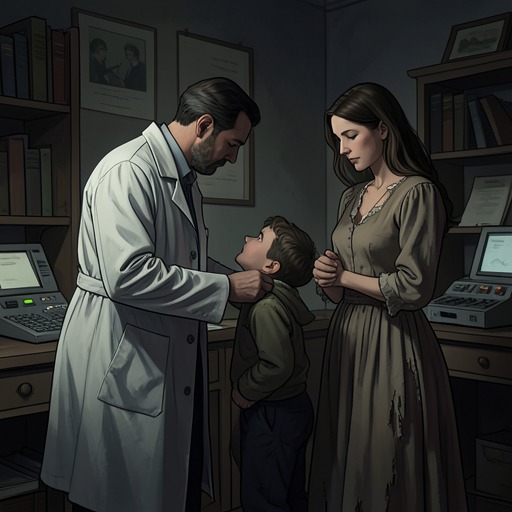
Rodin examines Therese and judges that her injuries are not dangerous. He tells her that, had she come to him immediately, he could have restored her within a fortnight; because she spent the night outdoors and her anxiety has aggravated her wounds, he expects recovery to take a month. He gives her space in his house and takes care of her. On the thirtieth day, she says, no trace of the Comte’s violence remains on her body.
The recovery gives Therese time to consider what happened at the château and to regain enough strength to make plans. She has only about six louis with her, while more than forty louis that she earned remain in her room at the estate. She writes to the Comte asking him to return her old clothes and the money, taking care not to reveal where she is. A peasant girl named Jeannette delivers the letter and returns the next day with a reply. The response denies Therese what she considers her rightful earnings and threatens that a further request will bring arrest and efforts to discover her hiding place. The town is therefore also the setting for a failed attempt to recover her property, one that renews the legal threat from which she has fled.
The School and Its Hidden Structure
While convalescing, Therese studies Rodin’s household before agreeing to stay. Rodin is a wealthy surgeon who lives in Saint-Marcel with two young women servants and his fourteen-year-old daughter, Rosalie. Therese is wary of the arrangement: she wonders why he wants another woman in the house when he already employs two attractive servants, and waits to understand his intentions. During this interval she grows close to Rosalie, whose affection and candor make her a source of information about the household.
Rodin also runs a school for boys and girls under a charter obtained during his wife’s lifetime. It has twenty-eight pupils in total: fourteen girls and fourteen boys, aged between twelve and sixteen. He rejects children he considers physically defective or unattractive, using ingenious-sounding excuses, so the pupils he does admit are selected for their appearance. The students come twice a day, from seven to eleven in the morning and from four to eight in the afternoon, and do not take meals at Rodin’s house. When Therese first arrives, classes are on holiday; the pupils return toward the end of her recovery.
Rodin teaches the boys himself, while his governess teaches the girls. He visits the girls after finishing his own lessons and teaches writing, arithmetic, a little history, drawing, and music; no other master is employed. Therese finds it strange that a man wealthy enough not to need either occupation should work both as surgeon and schoolmaster. Rosalie’s laughter at the question, and her promise to tell Therese everything because she trusts her not to betray the secret, signal that Rodin’s public roles do not explain what happens within his house.
Narrative Significance
Saint-Marcel is not simply a waypoint between the forest and Therese’s next ordeal. Rodin’s medical attention genuinely restores her after the Comte’s attack, yet the same household’s respectable occupations and carefully selected pupils conceal a more sinister reality. The contrast makes the town a temporary refuge whose safety cannot be judged by its surface: a surgeon’s house is also a school, and the school’s official routines leave unanswered the question Therese asks about Rodin’s motives.
The episode also extends the novel’s pattern of interrupted refuge. Therese arrives with almost no money, wounded and pursued by the prospect of arrest; in Saint-Marcel she receives care, but her attempt to reclaim her wages brings a fresh threat, while her investigation into Rodin’s household uncovers another source of peril. The town’s narrative importance lies in this uneasy interval: recovery gives Therese enough strength to observe, question, and judge, even as the shelter that makes those actions possible draws her deeper into danger.