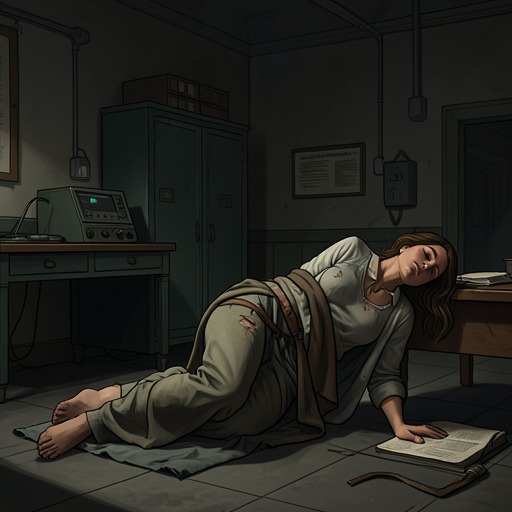
Corville's Château
JustineCorville's Château is the country estate where Monsieur de Corville shelters Therese after her sister Juliette’s recognition of her and his intervention on her behalf. The estate briefly makes concrete the prospect that Therese’s innocence might at last be protected: there she receives comfort, care, and help securing legal redress. Yet it is also the setting of her sudden death by lightning. The refuge that seems to restore her life becomes the place where the story’s promised relief is violently cut short.
Definition and Narrative Setting
The château is Monsieur de Corville’s country residence, where he is staying when the events of the final episodes unfold. After meeting Therese in custody and learning the significance of her story, he assumes responsibility for her and asks that she be held at his château rather than another prison while her case is clarified. The house therefore enters the narrative first as an alternative to confinement: a private residence offered in place of the penal system that has repeatedly failed her.
Its role changes as soon as Therese arrives. The estate is both the setting for her recovery and the domestic space in which her last crisis occurs. The narrative places scenes of hospitality and apparent restoration beside a storm that overwhelms the house’s open windows, making the château a temporary refuge rather than a lasting guarantee of safety.
Rescue and Protection
Monsieur de Corville’s intervention begins before the journey to the estate. He writes to the Lord Chancellor, gives an account of Therese’s fate, accepts responsibility for her innocence, and pledges to produce her in court when summoned. He entrusts the letter to her guards and makes himself answerable for their prisoner; they comply, and Therese is placed in his care. He then calls for a carriage and invites her to come with him, promising that circumstances will change and that her virtues will not remain unrewarded.
Juliette, newly reunited with the sister she had known as Justine, supports this act of protection. She urges Therese to trust their protector and presents his intervention as a refusal to abandon her, unlike the people who have previously left her exposed. At the château, Juliette and Monsieur de Corville both work to lift Therese from her despair. They provide rich food and a fine bed, encourage her to state her wishes, and attend to her with what the narrative describes as hospitality and understanding. The contrast is sharp: Therese, so long treated as a captive or an object of other people’s plans, is now invited to command and have her will obeyed.
Restoration and Legal Redress
Care at the château addresses the physical marks of Therese’s past as well as her immediate needs. She is given medicines for several days, bathed, dressed in elegant clothes, and attended by an excellent surgeon. The surgeon undertakes to remove the ignominious mark inflicted through Rodin’s villainy, and the mark soon disappears. The account describes her recovery through visible changes: the livid color in her cheeks gives way to a rosy hue, the effects of grief recede, and laughter returns to her lips. These details make the house a setting of bodily restoration, though the language of renewal cannot make the relief permanent.
Meanwhile, Monsieur de Corville works beyond the estate to secure public and legal redress. With the help of Monsieur S* * *, he brings Therese’s ill-treatment to wider attention and seeks to restore her to peace. Letters from the King eventually annul the legal proceedings begun against her, restore her standing as an honest citizen, and silence the tribunals that had tried to defame her. They also grant her an annual income of a thousand crowns, drawn from interest on gold seized in the counterfeiters’ workshop in Dauphine.
The royal measures do not produce an equivalent reckoning for Therese’s powerful persecutors. The authorities wish to hold Monsieur de Cardoville and Saint-Florent answerable, but Cardoville has already been appointed to provincial administration and Saint-Florent to the general supervision of Colonial Trade; both have reached their destinations. The edicts affect neither man, and their powerful families soon quiet the resulting storm. The château thus offers protection to Therese while remaining connected to a wider world in which justice for her does not undo the privilege enjoyed by her abusers.
Storm and Death
Even after the legal news and her physical recovery, Therese becomes somber and uneasy. She dreams, weeps before her friends, and cannot explain the cause of her sorrow. Although they tell her that her troubles are over, she insists to Juliette that she was not born for happiness and fears it cannot last. The narrative links this apprehension to the setting’s eventual reversal: the estate’s security cannot keep the forces of the final scene outside.
Near summer’s end, a planned outing is postponed because a dreadful storm approaches. The excessive heat has led the household to leave all the windows open. Lightning flashes, hail strikes, and violent winds buffet the château; the storm is described not merely as weather but as Nature convulsed, seemingly ready to confound the elements and wrench new forms from them. When Juliette begs her sister to hurry and close the shutters, Therese rushes to the windows, which are already breaking. She struggles briefly against the wind, is driven back, and is struck by a blazing thunderbolt in the middle of the room.
The lightning enters Therese’s right breast, reaches her heart, consumes her chest and face, and bursts out through her belly. Monsieur de Corville calls for help and orders that she be carried away. Juliette, after fainting and recovering, stops him: she wants the body left before her eyes while she considers the resolve she has just taken. The château’s room, first associated with shelter and attentive care, becomes the site of a death that no human protection can reverse.
Narrative Significance
The château’s decisive significance lies in the contrast it stages between human refuge and sudden natural violence. Monsieur de Corville can remove Therese from prison, make himself responsible for her, arrange skilled care, and help obtain a royal decree; he cannot secure her life. Nor does the legal restoration of her name erase the failure to punish the powerful men who harmed her. The estate gives Therese a brief experience of protection, but not a durable escape from the pattern of suffering that has shaped her story.
Juliette interprets the lightning as a warning rather than as proof that crime has triumphed or virtue has been abandoned. Looking at Therese’s body, she says that the girl’s undeserved sufferings have opened her eyes and that the apparent prosperity of the villains should not seduce her. She compares the prosperity of Crime to lightning: a deceptive brilliance that beautifies the atmosphere for an instant before hurling the dazzled victim into death. The château thus joins the book’s final reversal to Juliette’s decision to renounce her former life and enter religious devotion. Its refuge is real, its care consequential, and its promise of lasting safety tragically brief.