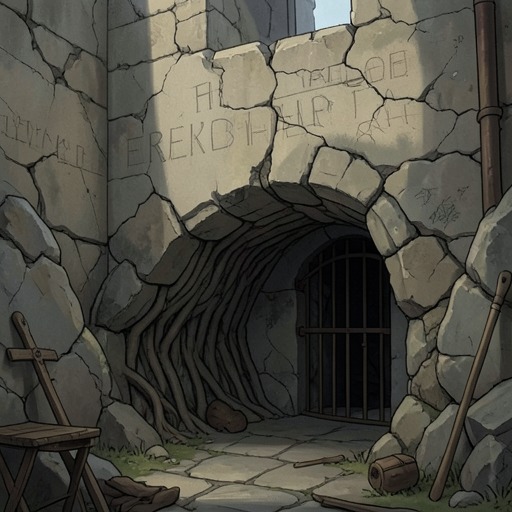
Saint Mary's Forest Monastery
JustineSaint Mary-in-the-Wood Monastery is presented as a remote Benedictine refuge devoted to religious observance, but its outward sanctity conceals a system that imprisons and exploits women. The contrast begins with Therese’s hopeful approach to the house and culminates in the discovery that its isolation is deliberately engineered: the monastery’s religious reputation draws trust, while its concealed quarters and barriers help ensure impunity.
Setting and Arrival
Therese encounters the monastery after leaving Auxerre on August 7. Resting beneath an oak, she sees a distant bell tower and imagines a sanctuary of virtuous recluses, far removed from the crimes that have repeatedly endangered innocence. A shepherdess reinforces that expectation: she describes a Benedictine house occupied by four exceptionally devout monks and tells Therese of a miraculous Virgin whose annual pilgrimage draws people seeking aid. Therese gives the girl a crown despite her own need, then sets out to pray and make amends for the religious duties she has been forced to neglect.
The journey gradually unsettles the picture of an accessible holy refuge. The tower disappears from view; Therese follows a track through the forest for at least five leagues, with no houses or signs of human life, before hearing a bell after dark. The monastery lies in a depression surrounded by dense woodland, its nearest neighboring habitation six leagues away. Visitors first apply at a gardener’s cabin beside the walls. The secluded setting is not merely picturesque: distance and isolation make the house difficult to approach and remove it from ordinary observation.
Religious Welcome and Concealed Danger
At the late hour, the steward, Dom Clement, initially questions Therese and says it would have been better for her to arrive in the morning. The superior, Dom Severino, then receives her more graciously. He agrees to hear her confession and says that they will find a proper place for her to spend the night; the visit to the sacred image can wait until the following day. The courteous welcome fits the reputation the shepherdess has described, and Therese trusts him enough to disclose her history, including the brand inflicted by Rodin.
The confession also becomes an assessment of her vulnerability. Severino asks whether she is an orphan born in Paris, whether she has relatives or anyone to whom she could write, whether anyone knows she has come to the monastery or expects to meet her afterward, and whether she might have been followed. His questions establish how little protection or outside connection she has. Once she has answered, he leads her away from the church and reveals that her hoped-for religious shelter is being used to bring her under the monks’ control. The reversal makes the monastery’s language of hospitality and spiritual care part of the means by which Therese is deceived.
Hidden Architecture and Captivity
The house’s public church and pavilion are linked to a separate, concealed building. As Omphale explains to Therese, a spring-operated door hidden in the sacristy’s wainscoting opens onto a long, dark passage. The tunnel first descends beneath a thirty-foot moat, then rises and runs about six feet below ground for a quarter of a league before reaching the pavilion’s basements. Therese’s fear during her passage through it had prevented her from noticing its course.
The pavilion is designed not to be recognized from outside. It stands less than twenty-five feet high, while six surrounding barriers—some stone walls and some closely planted living palisades—rise at least fifty feet. Its roof carries earth and evergreen shrubs that blend with the screens around it, so the building appears from a distance to be part of the forest. The physical concealment extends the monastery’s social isolation: even someone who could reach the church tower would not readily see the pavilion.
The interior is organized to confine its occupants and support the monks’ control. In the basements, a central hall is surrounded by eight smaller rooms: two are used as dungeons, while six store provisions. The upper areas include kitchens, dining spaces, and private cabinets, as well as the monks’ cells and two large dormitory chambers arranged as seraglios, each edged by eight cubicles. Four serving friars perform functions including guarding, attending the monks, providing medical care, and cooking; they are deaf and dumb, do not socialize with the women, and are not to be approached. This arrangement leaves the captives with no dependable channel of communication or aid from the staff.
Barriers, Routine, and Impunity
Escape is obstructed at every level. A person reaching a window would still face five palisades, a wall, a moat, and the closed monastery courtyard. The alternative route through the underground passage is no practical solution: the cellars are locked, the entrance is hidden and barricaded, and the tunnel contains traps whose positions are known only to the monks. Omphale, who instructs Therese about the building, says that she herself would have fled if escape were possible. Her account makes the architecture more than a prison’s defensive shell; it is a system whose complexity is meant to extinguish the expectation of freedom.
The monks return to the pavilion each day at five in the afternoon and go back to the monastery at nine the next morning. One is selected each day as Officer of the Day, while the four serving friars remain at the pavilion. Bells in the women’s chambers connect to the jailer’s cell, but the superintendent alone may ring for him. The monks bring provisions when they return, and an artesian well and wine stores supply the house. These routines sustain the hidden community while keeping the women dependent on its internal authorities.
Omphale connects that enclosed system to a longer history of concealment. She says the house has operated in the same manner for more than a century, with successive superiors perpetuating it, and that Severino intends to preserve its secret privileges. The monastery belongs to the diocese of Auxerre, but the women never see the bishop, who does not visit the house. According to Omphale, very few outsiders arrive during the year, apart from the period around the Notre-Dame d’Août festival. When visitors do come, the superior’s hospitality and the appearance of religious austerity leave them satisfied; their praise, based on good faith and religious credulity, helps protect the monks from scrutiny.
Public Reputation and Narrative Significance
The annual festival shows how the monastery’s reputation is maintained. The monks stage a supposed miracle by presenting Florette as the Virgin, using concealed strings to control her appearance and movements. The people interpret the display as a genuine apparition, leave rich offerings, and depart more convinced of the Virgin’s power. The fabricated spectacle turns public devotion into a resource for the institution: belief brings donations and renews the trust that keeps outsiders from looking closely at the concealed life of the house.
The monastery thus joins two forms of deception. Within its walls, a confession offered in faith helps identify a visitor’s isolation and lack of protection; beyond them, a staged miracle reassures the public that the institution deserves its reputation. The same place that Therese approaches as a sanctuary becomes a hidden prison, and its apparent distance from a corrupt society does not place it beyond wrongdoing. Instead, remoteness, religious authority, and engineered invisibility combine to shelter abuse from witnesses and law. In Therese’s story, the monastery is a decisive example of how institutions that promise spiritual refuge can exploit the very trust that promise inspires.