Eagle
KalevalaThe Eagle is a speaking, judging, and consequential creature in the Kalevala: it first recognizes Wainamoinen’s kindness toward birds, later rescues him from the sea in repayment, and finally appears in a hostile, transformed guise when Louhi attacks the heroes over the Sampo. Across these episodes, the bird links human conduct toward the natural world with reciprocal aid, while its immense later form makes it an image of the danger surrounding the contested treasure.
The Eagle and the Standing Birch
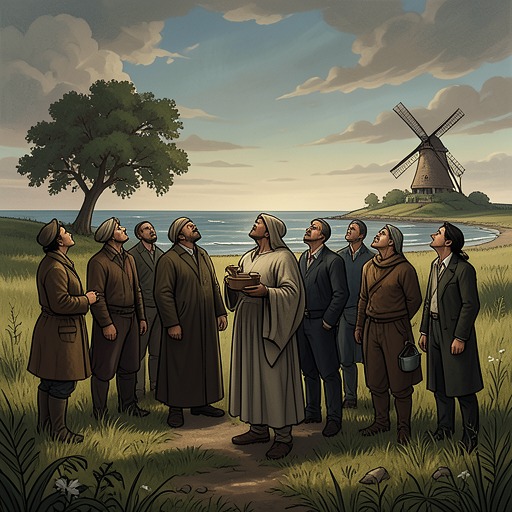
The Eagle first descends from heaven to consider a tree that Wainamoinen has left standing. The surrounding scene makes the choice significant: after the other trees have been cut, the slender birch remains as a place where birds may settle. Wainamoinen explains that it is there for birds to rest and for the Cuckoo to sing. The Eagle’s arrival brings an observer into this small act of care; the scene is not only about a cleared landscape, but about whether anything has been spared within it for other lives.
The Eagle explicitly approves Wainamoinen’s judgment. Its response gives the spared birch a value beyond its usefulness to people: the tree offers shelter to birds, including the Eagle itself. The bird is therefore more than scenery or a sign of wilderness. It can assess human action and answer it, establishing a relationship in which the choice to preserve a place for birds is remembered rather than lost in the passing scene.
Rescue at Sea and Reciprocal Aid
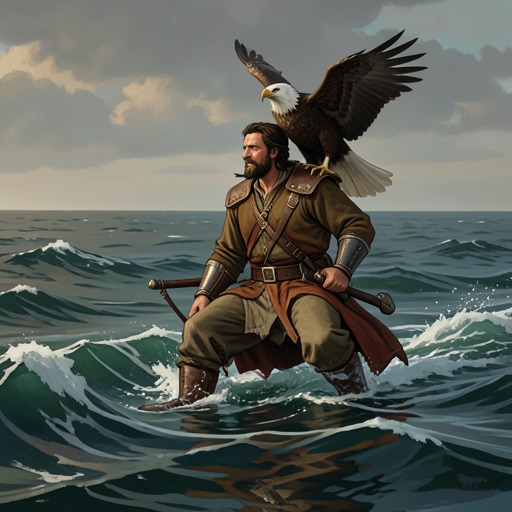
Later, Wainamoinen is adrift and fears that he may sink beneath the waves and perish from cold and hunger. An Eagle comes from Pohyola, flying from the west, and answers his distress with practical help: Wainamoinen is to place himself between its shoulders, and the bird will carry him wherever he wishes. The rescue turns the Eagle’s earlier approval into action. Its strength matters, but so does its decision to use that strength for the endangered traveler.
The bird explains its intervention by recalling Wainamoinen’s former service to the Eagle and to the birds. The remembered favor is the standing birch, left so that birds could rest and the Cuckoo could sing. This recollection makes the rescue reciprocal rather than arbitrary: a choice made on land returns as aid over the sea, where Wainamoinen has no comparable power to save himself. The episode also joins two contrasting settings through the same creature—the birch that provided a resting place and the open water that threatens to engulf him.
The Eagle’s role in this episode is sharply defined by the change in Wainamoinen’s situation. At first he faces isolation and possible death by exposure or drowning; the bird offers a way out by carrying him on its own body. The rescue depends on a remembered relationship between human and bird, not on a bargain newly struck in the moment. In this way, the Eagle’s memory becomes as important to the episode as its wings.
Louhi’s Monster-Eagle Form
During the conflict over the Sampo, the Eagle’s image becomes associated with an opposing force. Louhi is seen flying as a monster-eagle, and the narrative identifies the formidable bird with her. This is not the earlier, helpful bird arriving to repay a kindness: the eagle form now belongs to Louhi’s attack, as she swoops onto the Sampo’s lid and grasps it in her talons. The same capacity for flight that made rescue possible is recast as a means of assault and seizure.
The monster form is given a constructed body. The vessel’s body becomes the frame of an eagle, and five sickles are shaped into talons. Its mighty pinions spread as it rises, while deadly spears and crossbows contribute to its armed, fearsome appearance. These concrete materials make the transformation more than a change of shape: parts of a vessel are reorganized into a bird built for aerial combat. The result joins the mobility of a living creature to weapons and crafted structure, giving Louhi a striking means to enter the struggle over the Sampo.
Recurrence and Narrative Significance
The episodes distinguish between the Eagle as an independent bird and Louhi’s later use of the monster-eagle form. In the earlier encounters, the bird speaks, recognizes a good decision, remembers a favor, and chooses to rescue Wainamoinen. In the Sampo conflict, the eagle shape instead enlarges Louhi’s hostile power. The recurrence does not make these appearances identical; it allows the bird’s form to carry sharply different consequences, from shelter and deliverance to pursuit and seizure.
The Eagle’s first two appearances give the story a compact pattern of remembered care: Wainamoinen leaves a tree for birds, and an Eagle later carries him from danger. That pattern makes the final hostile image more than a display of size. The monster-eagle retains the force of a bird capable of crossing the distance between earth and sky, but now that force serves conflict over the Sampo rather than reciprocal help. Through this contrast, the Eagle connects the story’s attention to human dealings with other creatures to its larger contest over power and possession.