Wainamoinen's Magic Boat
KalevalaWainamoinen's Magic Boat is a vessel made through song and enchantment, and its construction turns mastery of magic into a practical craft. Wainamoinen shapes it from oak, loses the words needed to finish it, and resumes work only after recovering them. The boat is then launched, ornamented, and presented in a courtship exchange as a promised ship capable of crossing both the angry seas of Northland and the quieter waters of Pohyola.
Identity and Purpose
The boat is identified as the singer's magic vessel and the magician's boat: a crafted object whose making depends on Wainamoinen's skill as both builder and singer. He is described as old and skilful, an eternal wonder-worker, and the enchantment is not merely attached to the finished vessel. Song performs the work of construction itself. The boat therefore joins two kinds of mastery in one object: the shaping of physical materials and the command of words powerful enough to make those materials hold together.
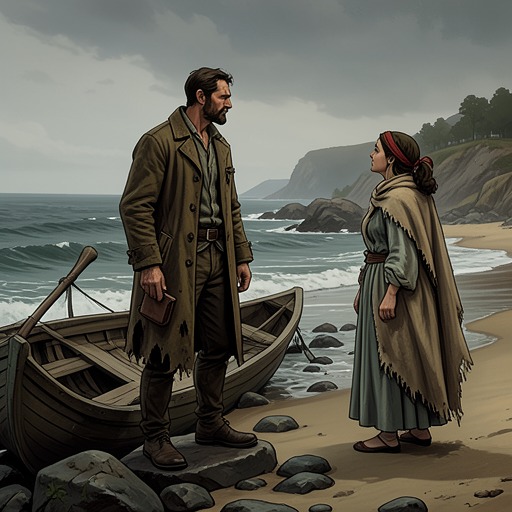
The vessel also enters a courtship negotiation. The Maiden of Pohyola asks whether Wainamoinen has built the ship promised for her, and names fragments of a distaff and splinters of a spindle as the materials she associates with it. Wainamoinen answers that he has built the promised vessel and firmly joined its parts by magic. The construction account, however, describes oak timber, posts, planks, and flooring. The passages give both material descriptions without explaining how they relate; what remains clear is that the boat is presented not as an ordinary craft but as an achievement whose making is bound to a promise.
Enchanted Construction and Interruption
Wainamoinen begins with oak, using its timber for the boat's posts, planks, and floor. He sings the frame together, sings again to set the siding, and sings a third time to fit the row-locks. The sequence makes each stage of assembly distinct: the frame comes first, the sides next, and the fittings after them. Song is represented as an operative technique, applied repeatedly to separate parts of the work rather than invoked only as a general blessing over the completed boat.
The work reaches a decisive limit once the ribs are fastened and the sides tightly joined. Three words are missing: Wainamoinen has lost the words of master-magic needed to fasten the ledges. His skill has brought the vessel close to completion, but cannot substitute for the precise knowledge required at this final stage. The unfinished boat thus gives the loss a concrete consequence. The missing words are not an abstract gap in learning; without them, the structure cannot be completed as intended.
After finding the keys of secret doctrine and the lost words of the Master, Wainamoinen goes straight back to the place where he has been working. He binds the stern together and completes the forecastle. The return to the boat turns recovered knowledge into visible action: the words that were absent from the building process now enable the remaining parts to be joined. The episode links the vessel's completion directly to the recovery of specialized magical knowledge.
Completion and Appearance
Once the stern and forecastle are finished, the account presents the boat as built through magic alone and launched by magic as well. Wainamoinen's work therefore extends beyond assembly: the same enchantment that brings its structure together also sets the completed vessel afloat. The boat's making and its transition to use belong to one continuous exercise of magical craft.
After its passage from dismal Sariola to the meadows of Wainola, Wainamoinen decks the vessel. He paints it blue and scarlet, trims its forecastle with gold, and equips it with sails of blue, white, and scarlet, woven into fine fabric. These particulars give the completed boat a deliberately finished appearance: its colors extend across hull and sails, while gold marks the forecastle. The narrative moves from the hidden knowledge needed to fasten the structure to ornament that can be seen once the vessel is ready to travel.
Voyage and Courtship Significance
Wainamoinen steps aboard and steers the boat across the waters. In addressing the Maiden of Pohyola, he describes it as firmly joined by magic, able to weather the roughest billows and outlive winds and waters. He also claims speed, comparing its glide to an airy bubble rising and a cork moving on lake and river. These comparisons stress buoyancy and ease, while the claim of endurance sets those light images against the force of the seas the vessel must cross.
The promised range is broad: the boat is said to travel through the angry seas of Northland and the peaceful waters of Pohyola. Its qualities are thus stated in relation to contrasting conditions, turbulent and calm, rather than confined to a single crossing. In the courtship exchange, the vessel stands as evidence of Wainamoinen's accomplishment and of his fulfillment of a promise. The account establishes what he has built and what he says it can do; it does not, in these passages, establish that the boat wins him the Maiden of Pohyola. Its decisive significance lies instead in the conjunction of craft, recovered knowledge, and a promise made tangible in a finished, seaworthy ship.