Nature as a Spiritual and Religious Space
LeilaNature as a spiritual and religious space gives the novel a language for experiences that its characters cannot resolve through argument or institutional authority alone. Green paths, mountain ridges, lake weather, and a waterfall do not merely frame human feeling: they alter what can be felt and understood. In contrast, the natural world is closed to Don Emanuele Costi de Villata, whose religious ambition rests on manipulation. These contrasting responses make nature a measure of spiritual receptivity as well as a setting for Lelia Camin and Massimo Alberti’s changing relationship to faith and love.
A Landscape of Spiritual Attention
For Don Aurelio, the countryside is a place of quiet religious perception. On his accustomed walk near the Church of Sant’Ubaldo, he experiences the grasses, vines, and trees as innocent lives opening themselves to his soul. Their presence draws him into a Franciscan sense of kinship and a wordless adoration of God, understood as present in wisdom and love. His response is not a theory about nature but a practice of attention: the living landscape offers a form of communion in which he sees himself as a servant rather than a master.
The same path reveals the limits of that openness by setting Don Aurelio against Don Emanuele. Don Emanuele believes he serves God through a private architecture of lies and calculated influence, but the green world gives him no mystical consolation. The grasses, vines, and trees remain closed to him; he passes among them without noticing flowers or leaves. The narrator makes the contrast moral without making nature a simple emblem: the environment’s spiritual significance depends on a person’s capacity to attend to life beyond self-interest. Don Aurelio finds fellowship in it, while Don Emanuele moves through it as an outsider.
Nature and Massimo’s Crisis
Nature also touches Massimo’s religious doubts before it becomes central to Lelia’s journey. Exhausted by attacks from both religious traditionalists and free-thinking critics, he longs to leave the arena of religious action and turn instead toward the beauty of the world, love, and joy. The impulse is presented as an outlet for bitterness, not a settled decision. Nevertheless, it exposes a tension that will recur: the world’s beauty can seem like an alternative to religious struggle, yet the novel also allows natural experience to deepen rather than simply replace spiritual questioning.
In a letter to Donna Fedele Vayla, Massimo traces his faltering Catholic faith to a long process of disintegration. He describes the influence of his dead teacher, the injuries and disappointments he suffered as a disciple, and his growing fear that Catholicism might be a historical form from which a new religion could emerge. His doubt is therefore not a casual rejection of dogma. It threatens to leave him without any positive religious certainty. The contrast between this unsettled intellectual account and the direct force of landscape later in the novel is important: nature does not furnish him with a ready-made answer, but it provides a shared language through which the characters can approach experiences that abstract debate has left unresolved.
Lelia’s Passage Through Valsolda
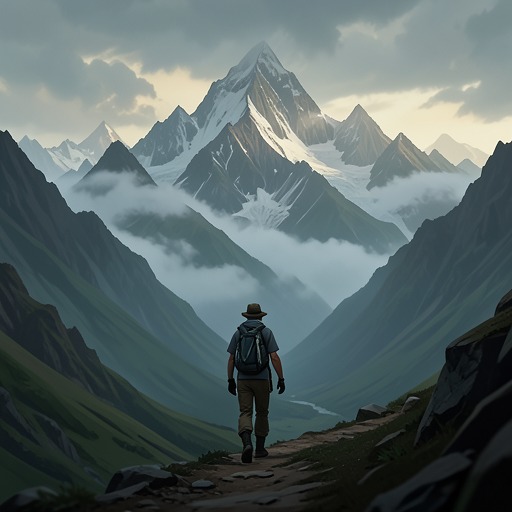
During her journey toward Dasio, Lelia’s encounter with the landscape is gradual and physical. After travelling by boat through rain and fog, she steps forward alone as a strong wind rises over the lake. The weather shifts; mountain faces and distant peaks emerge from the mist. Wind, dark water, and mountains affect her with an intensity that makes her feel newly certain. The passage gives the environment narrative force: changing visibility and weather accompany a change in her inward resolve, without reducing the mountains to a mere reflection of her mood.
As she climbs with a boy serving as her guide, the human scale of the journey remains present. He silently offers her cyclamens he has picked from a dangerous slope, and she accepts them as though chance had brought her flowers for Massimo. At a rise above the path, she pauses to learn the names of the villages spread across high Valsolda: Loggio, Drano, Puria, Castello, and Dasio. From there her gaze travels from Dasio’s small bell tower to the ridges above it, where she recognizes a dolomite point that recalls a view associated with Massimo and the piano piece Aveu. The landscape gathers remembered music and present longing into a single act of recognition.
Nature speaks to Lelia in the figurative language of the narration. The cliffs and ridges seem to acknowledge her arrival, and the waterfall gorge offers an imagined place of privacy, beauty, and music. Yet the account does not make her journey effortless or detach it from ordinary circumstances. She grows tired, hesitates, and must ask others whether Massimo is at home. A small chapel along the route sharpens the spiritual tension: seeing its painted Passion scene and crucifix, she thinks she might have knelt to pray if the crucifix had stood alone, then continues on. The moment leaves faith unresolved even as the landscape draws her toward a more intense sense of presence.
The Shared Landscape of Love and Faith
When Lelia and Massimo meet, the natural setting becomes a medium of recognition. They rest in a hollow in the rock above a stream descending from the Passo Stretto, then speak of the dolomite point that had figured in Lelia’s solitary ascent. She cannot explain her recognition in ordinary terms; she says she would answer through Schumann’s music, putting her whole soul into it. Massimo understands that Donna Fedele has told her about his letter. Their shared memory of music and landscape lets feeling pass between them before either can fully articulate it.
The waterfall gorge becomes the setting for an hour of quiet intimacy. Seated on grass opposite the narrow fall, they communicate their love through joined hands and silence. Massimo associates the scene with Schubert’s Der Müller und der Bach and imagines a summer of love there, alone together. The stream’s music and the surrounding gorge give their feeling a form, but the scene does not settle the questions of faith or the practical obstacles facing them. Instead, the landscape holds a brief possibility of harmony while those questions remain open.
Lelia’s letter to Massimo makes explicit the religious meaning she seeks in such places. She says that neither the religion of her school nor the forms embodied by people she distrusts have sustained her; the alternative of having no faith satisfies her even less. She asks for a God she could adore in the woods of Dasio, the waterfall ravine, the lake, and a future marital room: a God requiring love and forbidding hatred, without official intermediaries or dogmas that torment the intellect. This is Lelia’s own expressed desire, not a general doctrinal resolution offered by the novel. Nature matters because she imagines it as a place where devotion might be lived directly, though the language of love and the prospect of marriage remain intertwined with that spiritual hope.
Refuge, Constraint, and Meaning
The novel’s natural spaces offer intervals of inward freedom, but they do not erase the social and practical conditions that govern the characters. In Valsolda, Donna Fedele decides that Lelia cannot remain there and arranges for her to travel to Turin, with the possibility of staying with a relative at Santhià. Her decision acknowledges both Lelia’s aversion to returning to Velo and the risks of leaving her without support. The mountains and waterfall can shelter a moment of recognition; they cannot by themselves provide a secure home or settle the obligations surrounding Lelia’s future.
Across these episodes, nature’s spiritual force is neither uniform nor simply escapist. Don Aurelio finds humility and divine presence in ordinary living things; Don Emanuele’s ambition leaves him unable to receive that fellowship. Massimo’s fatigue makes worldly beauty tempting as an escape from religious conflict, while Lelia imagines landscape as a possible home for an unmediated devotion. The lake, mountains, flowers, chapel, and waterfall therefore carry distinct meanings rather than one fixed symbol. Their recurring significance lies in their power to disclose different relations to faith: attention or self-absorption, longing or uncertainty, and a hope for spiritual life that remains inseparable from the choices and limitations of the human world.