The Tower of Pride
LeilaThe Tower of Pride is Massimo Alberti’s imagined fortress of self-sufficiency: a structure he builds in thought after Lelia’s rejection and the hostility he encounters in Milano. It turns hurt into an exalted posture of independence. Yet the image is unstable from the start: Massimo calls solitude a delight while still measuring himself against Lelia, his uncle, and a hostile public, and then begins looking for somewhere beyond the city to carry his tower.
The injury behind the image
The tower takes shape amid a dispute about dignity. When Donna Fedele asks why Lelia would inflict pain on an old man, Lelia answers that she can give up everything except her dignity. Donna Fedele challenges the implication that her advice could require Lelia to betray it. The exchange makes dignity a contested claim rather than a settled virtue: Lelia invokes it to defend a refusal, while Donna Fedele insists that listening need not mean surrendering self-respect.
After Donna Fedele reports the conversation to Massimo in full, he first judges Lelia foolishly, his face flushing with anger he had been suppressing. Donna Fedele suspects instead that Lelia may not have been sincere, and wonders whether someone really told her about a supposed relationship Massimo had in Milano. Massimo does not ask what else she thinks. He feels, for the moment, as if he no longer loves Lelia, and wants only to leave for good. He even feels grateful for what he regards as her small, foolish pride: it releases him from the prospect of love and lets him recast his own brief wish to abandon work for the Good and the True as a weakness. His uprightness is thus born partly from injury. Rather than examine the uncertain accusation or wait for Donna Fedele’s further thought, he seizes on rejection as permission to withdraw.
Solitude as a chosen defense
The tower’s moral language is clearest when Massimo meets Lelia again. He has already tried to calm people angered by Don Aurelio’s treatment, defending the parish priest and the bishop and warning that a refusal to attend church would hurt Don Aurelio with his superiors. He also argues that the Sacrament deserves more love and respect than any individual priest. Although he has not persuaded his listeners, he feels satisfied that he has risen above resentment as Don Aurelio would have done.
From this sense of moral elevation, Massimo regards Lelia’s insulting judgments as beneath him. He resolves to treat their period of love as a period of weakness, suppress a feeling incompatible with his dignity, and reserve himself for a woman more akin to him in thought and heart. His courteous greeting and offer to scrub away the writing on the wall present a composed surface; beneath it, the resolve to be untouched has hardened. The tower is not merely pride in the abstract: it organizes how he interprets the end of the relationship, turning a painful attachment into something he can classify and disown.
The imagined fortress
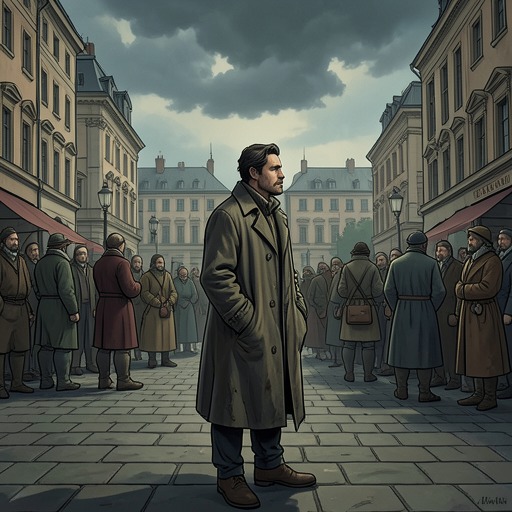
The image becomes explicit after Massimo is challenged in a social gathering. Asked why he does not defend himself, he says he has no wish to persuade anyone and takes pleasure in being alone. He fears that speaking would produce words insufficiently humble or kind; when told that arguments, not humility, are wanted, he replies that no one has actually asked him for arguments. His silence can therefore look like restraint, but it also refuses the exchange that might test or revise his account of himself.
Once alone, Massimo feels bitterly and proudly content. He imagines himself set apart from Lelia, his uncle, and a world that is by turns hostile, mocking, or indifferent. He raises the tower in thought to the clouds, sheaths it in steel and gold, and delights in occupying it alone, impregnable. The grand materials make the private retreat seem at once invulnerable and splendid. But the tower’s imagined height does not remove the people against whom it is defined: its isolation depends on keeping their judgments in view as the opposition from which Massimo claims release.
From symbol to direction
Even as he imagines the tower as impregnable, Massimo starts looking for a place outside Milano to take it. Walking distractedly past the arches of Porta Nuova and on toward the underpass, he returns to the idea of competing for a medical post in the mountains, an idea that had come to him among the chestnut trees at La Montanina. The practical possibility gives the fantasy a direction, though the episode does not establish that he takes the post. His inward withdrawal is beginning to shape a possible outward departure.
At home, he writes Donna Fedele to explain that he will not attend the funeral, then tears up that letter and writes another. In the replacement, he says he will come down to Seghe on July 4 at noon to visit the cemetery at Velo and hopes she will accompany him. This concrete plan complicates the image of the solitary tower: even while Massimo claims not to need defense or company, he invites Donna Fedele to join him. The metaphor captures a real impulse to protect himself through pride, but its final movement in these passages is not pure isolation. The imagined fortress travels with him as he considers a life elsewhere, while his actions still leave room for another person beside him.