Roman Catholicism and Church Authority
LeilaRoman Catholicism and Church Authority form a central conflict in the novel, where religious allegiance is tested not only by doubts about doctrine but by the demands of obedience, the failures of churchmen, and the pressure of public identity. Massimo Alberti’s movement away from Catholic belief is neither a casual rejection of ritual nor a clean liberation from the Church: it threatens the framework by which he has understood himself. In contrast, Don Aurelio and Benedetto represent forms of fidelity rooted in submission to ecclesiastical authority, while Lelia’s response exposes how compromised religious representatives can drive a person toward unbelief. The novel leaves these positions in tension, making the question of authority at once theological, ethical, and intimate.
Authority and the Believer’s Public Identity
Massimo’s conflict begins within a double opposition. In Milan, freethinkers condemn him as weak for maintaining military loyalty to the Church’s laws, while Catholic traditionalists reproach him as a heretic for thinking and writing as a modern man. He experiences hostility from both sides, and the religious cause he serves appears to bring wounds, disappointments, and humiliation rather than resolution. The temptation to withdraw from religious work therefore arises alongside a wish to escape the noisy contest over belief and live for beauty, love, and joy. Yet the novel makes clear that this impulse is not a settled renunciation: his public role as a religious writer and speaker has become both a support and a kind of prison, shaping how he can understand his own choices.
That conflict is connected to the authority of the Church as an institution. Massimo recalls that, while his Roman teacher lived, he could imagine wishing the Church’s authority had chosen a different course in some matter, but could not imagine rebelling against it. After the teacher’s death, accusations against the teacher and hostility toward Massimo as his disciple, combined with the corrosive influence of radical critics, begin to loosen his inherited beliefs. His crisis is thus not presented as a simple dispute over disliked customs or obscure dogmas. He fears instead that Catholicism may be a historical religious form whose divine element could pass into a successor, as Christianity emerged from Judaism. The possibility that he might be called to proclaim such a successor faith makes the problem personal as well as intellectual: he does not know whether breaking with Catholicism would leave him with any positive religious certainty at all.
Massimo’s Crisis and the Limits of Obedience
In his letter to Donna Fedele Vayla, Massimo traces his uncertainty back to doubts that began in youth. Meeting Benedetto, whom he loved and followed, had brought those doubts to rest for a time. He was willing to give his life for his faith and the Church, and the Church’s authority did not seem open to revolt. Later, however, he came to see the attacks on Benedetto as unjust and ill-founded, while also encountering forms of criticism that he regarded as corrosive rather than constructive. The competing pressures do not cancel each other out; instead, they unsettle the beliefs that had held his religious identity together.
The crisis deepens as Massimo distinguishes rejection of the Church from the consequences that follow it. He first separates himself mentally from Rome, but then finds himself moving rapidly away from belief in Christ’s divinity and resurrection; he fears that belief in a personal God may be next. He recognizes that the collapse only seems sudden because the Church’s obligation had been holding together convictions already weakened by sustained reading and conversation. In a moment of reaction, he kneels before an image of the Savior and Peter on the waters and begs for faith. The prayer does not restore certainty. His letter instead records a mind caught between inherited religious feeling and a loss of confidence in the authority that had once ordered it.
Even so, Massimo does not regard Catholic practice as necessarily fraudulent once belief has become uncertain. He tells Donna Fedele that, were he dying, he would ask for a priest, confess, and receive Communion—not to feign convictions, but out of a need for sincerity and humility before death. His distinction matters: he can no longer affirm the Church’s claims as he once did, yet he remains drawn to Christ and to religious acts whose meaning is not exhausted by institutional allegiance. At Benedetto’s funeral, this uncertainty becomes a public test. Massimo reveres his teacher, but worries that speaking would imply assent to beliefs he no longer holds; refusing to speak, however, risks seeming to insult the dead. He chooses not to deliver the address his Roman friends had expected, because he cannot make public homage without feeling that it would be hypocritical.
Lelia, Religious Disillusionment, and a Desired Faith
Lelia’s account gives the crisis a different origin. She says she had clung to the religion of her school partly because she feared the emptiness of having none. She distrusted religious novelties that seemed destructive rather than constructive and preferred the established religion represented by the local archpriest and chaplain. But she also found the religious stance of Marcello Trento and Donna Fedele impure in its own way, because they spoke of the Gospel as though laypeople had the right to interpret it for themselves. Her initial standard was all or nothing: while she could accept the whole inherited structure, she did; when people she associated with that structure appeared compromised, she concluded that nothing was preferable.
Her rejection is therefore tied to people as well as doctrines. She names the archpriest, the chaplain, the archpriest’s sister, her father, and her father’s friend Molesin among those whose association with the religious whole she could not reconcile with her expectations. Her resulting unbelief does not satisfy her, however. In a letter to Massimo, she asks for a God she could worship in the woods of Dasio, by a waterfall, on the lake, or in a bridal room: a God who requires love and forbids hatred, without official intermediaries or demands that torment the understanding. This wish describes a personal religious ideal, not a settled doctrine. Massimo answers that the ideas he once defended would have allowed worship in those same places and a less painful acceptance of dogma and religious observance. He and Lelia consequently imagine seeking faith together, even as his earlier beliefs remain painfully unsettled.
Donna Fedele treats Lelia’s loss of faith as more than a quarrel between them. When Lelia worries that her words about Catholicism have hurt her, Donna Fedele replies that the important matter is the loss of faith itself, and asks to be allowed to pray for her. She also insists that belief cannot simply be chosen at will. The exchange places religious conviction alongside their affection: disagreement does not erase care, but the possibility of dying while Lelia remains without faith is a source of serious sorrow for Donna Fedele.
Don Aurelio, Benedetto, and Competing Claims of Fidelity
Don Aurelio embodies a quieter relation to authority. The Diocese of Vicenza sends him formal notice that he must leave his pastoral charge at Lago di Velo within fifteen days, and the archpriest asks that the house be cleared of both furniture and people so that his successor can bring his mother and sister. The notice leaves Don Aurelio facing the loss of his home and his small congregation, with no clear prospect of shelter or livelihood. The text does not establish that the order is punishment for a particular act. It does show the force of institutional procedure in the life of a priest, while presenting Don Aurelio’s response as inwardly composed: after his first shock and grief, he turns his attention to finding a Bible seller and to a grave conversation Marcello Trento had held with him after Mass.
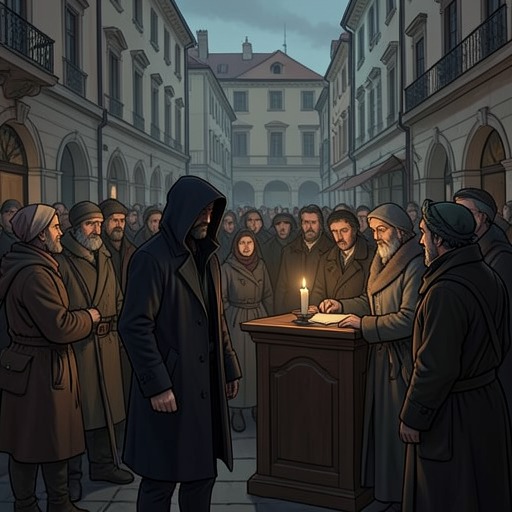
At Benedetto’s funeral, Don Aurelio speaks directly to the dispute over how the dead man’s religious life should be understood. He distinguishes Benedetto’s central work—the call to believers of every rank to embody the Gospel in their lives, feelings, and actions—from theological propositions that might have been mistaken and subject to the Church’s judgment. He presents Benedetto as having professed obedience to Church authority and the Roman Pontiff, and as having conformed to Catholic belief and practice until death. This is Don Aurelio’s account of Benedetto, spoken in his name; it should not be confused with Massimo’s present uncertainty or treated as a neutral resolution of the novel’s debate.
The funeral address also turns authority into an ethical question about judgment. Don Aurelio says that Benedetto wished to forgive those who condemned him without authority to judge, while also correcting accusations that had falsely associated him with errors he rejected. He urges the assembled mourners to forgive both the people who made false accusations and those who mocked Benedetto’s faith, because human beings know too little to judge another’s ignorance. His appeal to travelers in the night seeking their way together offers a communal image different from either unquestioning certainty or solitary repudiation: people may announce the path they believe they have found, help one another, and pray for all without presuming to condemn those who have not followed. The Church remains, in his speech, the object of Benedetto’s filial devotion; forgiveness becomes the means of answering the wounds inflicted around it.