Religious Mysticism
LeilaReligious Mysticism in the novel is an inward, experiential form of devotion: faith felt through prayer, beauty, repentance, and a longing for communion with God. It is not presented as a settled alternative to Catholic doctrine or Church authority. Instead, the narrative tests its value against institutional suspicion, contrasting ideas of religious duty, and the anguish of a believer whose convictions begin to fail.
An inward experience of God
For Marcello Trento, religious feeling gathers around the prospect of death. Alone after an emotionally significant conversation, he stands at the window, hands joined in prayer, looking toward Mount Torraro and the dark landscape. The moment does not seem tragic to him so much as solemn: he imagines death as a hoped-for reunion with the beloved dead, yet feels both sweetness and trembling before a God who is loving and also judge. The silent flame of The Florentine brass lamp becomes an image of that inward state, alive with memory but unable to speak for it.
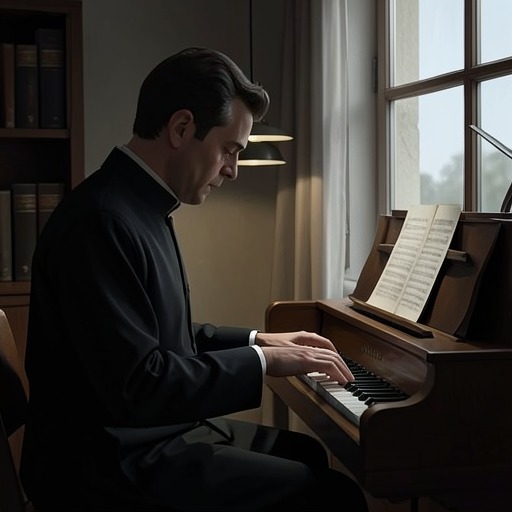
The same union of devotion and feeling shapes Marcello’s music. He is not a powerful pianist, but music gives expression to his religious faith, his affections, and his sense of beauty. One night he kisses a portrait of Andrea Trento, then plays with his eyes closed, seeking music adequate to the words of the Stabat Mater. Unable to find the passage he wants, he searches for sounds that descend into grief and rise toward joy. The imagined glory of Paradise and reunion with his son remain indistinct, but music lets him approach them emotionally. When memories of his sins interrupt that ascent, his hands fall still on the keyboard. He resumes with a Miserere: a prayer of sorrow and love that imagines divine mercy as a cleansing flow. Mystical experience here does not erase sin; it makes repentance and the hope of mercy more immediate.
Devotion and religious authority
Don Aurelio embodies a different form of inward religion. Massimo Alberti describes him to Marcello as a priest wholly given to his ministry, charity, and divine love, and as someone apart from religious disputes. Marcello responds with deep emotion, longing for the Church to have many priests like him. In this portrait, spiritual authority arises not primarily from argument or rank, but from a life that makes religious charity visible.
That quality also makes Don Aurelio’s preaching vulnerable to criticism. Donna Fedele reports that the chapel priest had suggested his sermons contained too much pure morality and mystical feeling, and too little theology and asceticism. The distinction is consequential: what admirers experience as a living, humane faith can appear to institutional critics insufficiently disciplined or doctrinally precise. When a letter from the Vicenza diocesan curia orders Don Aurelio to leave his parish within fifteen days, the dismissal is not explicitly attributed to his mysticism. But the reported criticism establishes a context in which his style of religious life is under suspicion, while the demand to vacate the house—including for its people—makes the institutional decision painfully concrete.
The contrast with Don Tita clarifies the dispute without making it a simple opposition between faith and unbelief. Don Tita is sincerely religious, generous in almsgiving, and committed to religious duty. Yet he regards charity as an external obligation rather than an impulse of the heart, dislikes and distrusts the poor, and dismisses mystical religiosity as human sentimentality. His faith is organized around law, tradition, and hierarchy. Don Emanuele, too, is described as sincerely devout and personally pure, but his conception of God is more that of a sovereign than a beloved Father, and he identifies the Church chiefly with its hierarchy. These different forms of piety show why the novel’s conflict is not simply between religious and irreligious characters: it concerns what religious life means and how inward conviction relates to authority.
Mysticism under the pressure of doubt
Massimo’s crisis reveals the fragility of an inward faith when it is caught between institutional conflict and intellectual uncertainty. In a letter to Donna Fedele, he traces his doubts to his youth and describes how his devotion to a spiritual teacher once kept them at bay. After that teacher’s death, accusations against him, hostility toward his disciples, and Massimo’s exposure to radically critical religious thought gradually unsettle his beliefs. Massimo does not present this change as a casual rejection of Catholicism. He fears that Catholicism may undergo a transformation like the earlier religion it fulfilled, with a new religious form emerging from it; he wonders whether he should take part in that change, even at the cost of opposing the faith he once preached.
His account also distinguishes personal witness from proof. Don Aurelio’s goodness seems to Massimo an argument for the Catholic Church, stronger than arguments the priest might make, but not decisive: noble and sincere people can be found inside other churches and outside them. The admission makes mystical goodness powerful but not conclusive. A holy life can embody faith, yet it cannot by itself resolve Massimo’s theological and historical doubts. He is also reluctant to speak at Benedetto’s burial because he fears that his present uncertainty would make any defense of Benedetto’s conviction in the Church’s permanence and the duty of obedience hypocritical.
A lived faith, not a license to judge
At Benedetto’s funeral, Don Aurelio gives public form to a religious vision that joins inward conviction to Church obedience. He presents Benedetto not as an authoritative theologian, but as someone whose central work was to recall people of every condition to the Gospel embodied in life, feeling, and action. Don Aurelio insists that Benedetto professed obedience to the Church and the Roman Pontiff, and that he conformed to Catholic belief and practice until death. The speech therefore resists the idea that spiritual intensity must entail rebellion against the Church.
The sermon also makes forgiveness part of this religious practice. Don Aurelio says that Benedetto would forgive those who condemned him without authority, and would also want the false accusations answered. He asks the mourners to forgive both accusers and mockers, since human ignorance limits everyone’s right to judge. His image of people traveling through darkness, calling to one another and seeking a path without condemning those who cannot follow, gathers the novel’s mystical and ethical concerns into a final communal appeal. Religious Mysticism is thus neither merely private emotion nor a replacement for doctrine: it is a way of apprehending divine mercy and translating that apprehension into charity, humility, and restraint in judgment.