Vocazione religiosa e vita monastica
LeilaVocazione religiosa e vita monastica is the novel’s idea of religious withdrawal as both a possible response to suffering and an object of other people’s plans. It becomes most pointedly entangled with Lelia Camin, whom Don Emanuele Costi de Villata imagines cultivating for the cloister after she has been bereaved, estranged from her father, and driven to thoughts of self-destruction. Yet the narrative does not establish a vocation freely chosen by Lelia: the possibility is interpreted and promoted by others, while their religious language overlaps with efforts to control where she lives and who may influence her.
A vocation proposed for Lelia
After learning that Lelia had contemplated a desperate act, Don Emanuele reasons that she might be drawn away from worldly life and toward God. He regards her as a good and religious soul, and imagines that a forceful reaction to injury could carry her wholly into religious devotion. In his account, the right spiritual care might cultivate a latent capacity for sanctification. The language makes vocation sound like a seed waiting to be tended, but the plan belongs to the priest before it belongs to Lelia: the evidence records his reading of her condition, not her own declaration of a call to religious life.
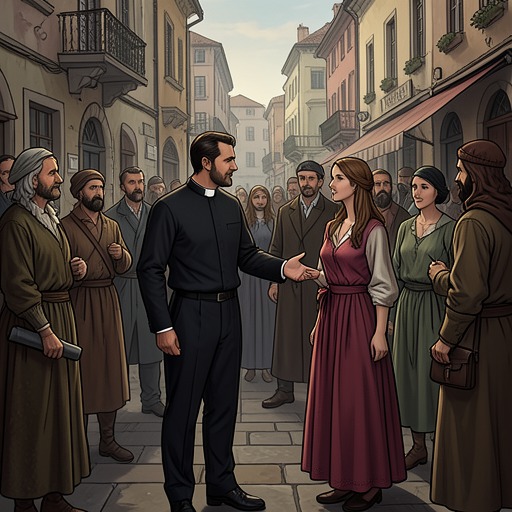
The priest’s reading also depends on a highly selective picture of her. He supposes that she is indifferent to wealth and would surrender everything to her father without regret. He wants her removed from Donna Fedele Vayla’s influence and sees her separation from her father as an obstacle that the father’s authority might overcome. Don Emanuele therefore urges Molesin to invoke paternal rights and, if necessary, the force of law to bring her home. His proposal to foster a religious vocation is inseparable from a plan to change her household and advisers.
Suffering, escape, and the cloister
The idea of religious withdrawal gathers force amid Lelia’s bereavement and family conflict. The account of her attempted flight is retold by Don Tita as a calculated scheme: he claims that Donna Fedele is sheltering her until she reaches adulthood, and casts her journey toward Piedmont as part of a plan involving Massimo Alberti. This is Don Tita’s accusation, not a neutral account of Lelia’s motives. In a different interpretation, Don Emanuele supposes that Lelia’s suicidal thinking arose from her wish to escape life with a father he considers disreputable. He concludes that the cloister could remove her from that influence and from the world of romantic attachment.
Siora Bettina Fantuzzo echoes the religious solution in a more wistful form. She imagines that, had the Trento family not taken Lelia in, grief for her dead fiancé might have led her to leave the world and give herself to God. The thought is hypothetical, but it reveals how readily other characters turn Lelia’s suffering into evidence for a religious future. Her grief can be read as a possible opening to devotion, but that reading risks making her pain serve someone else’s spiritual or social purpose.
Competing claims over Lelia
The narrative complicates Don Emanuele’s apparent solicitude by exposing the mixture of motives behind his intervention. He has been disturbed by Lelia’s rose perfume and has privately imagined her confined to a monastery, removed from love and from the pleasure she might offer others. He does not acknowledge this element to Don Aurelio. Instead, he presents the plan as religious care: Lelia should be separated from Donna Fedele, the scandal associated with Carolina Gorlago should be addressed, and a religious inclination should be encouraged. His own account of his motives is therefore incomplete even to the people he enlists.
His proposed intermediary, Siora Bettina, is reluctant to approach Lelia but tries to serve the priest’s purpose. She asks Teresina whether Lelia reads her devotional books, including a Gospel volume given by Marcello Trento and two books from her schooldays. Teresina confirms that the books are among Lelia’s possessions but does not say that she reads them. The exchange exposes a gap between the material signs of religious instruction and evidence of an inward vocation. A hope that Lelia will go to confession after the night’s events is likewise a hope held by the parish circle, not proof that she has accepted its reading of her distress.
Religious obedience and the wider crisis of faith
The question of vocation sits within a broader argument about religious authority. In a letter to Donna Fedele, Massimo Alberti describes a faith unsettled by theological conflict and by the possibility that Catholicism, like an earlier religious dispensation, might be succeeded by a higher form. He wonders whether he should sacrifice himself to proclaim such a change, but fears that speaking at Benedetto’s grave would betray the dead man’s steadfast belief in the Catholic Church and obedience. His crisis shows that religious commitment in the novel is not simply a matter of choosing retreat or worldly life: it also involves the painful question of what obedience requires when belief itself is uncertain.
At Benedetto’s funeral, Don Aurelio presents a contrasting account of religious fidelity. He says that Benedetto may have erred in theological propositions, yet recalls his call for believers to embody the Gospel in their lives and his enduring submission to Church authority. Don Aurelio also insists that Benedetto rejected the errors attributed to him and conformed to Catholic belief and practice until death. This public remembrance places disciplined religious life within a community of faith, rather than treating withdrawal from the world as an isolated private escape.
An unresolved possibility
Lelia’s immediate course does not fulfill Don Emanuele’s monastic design. At Valsolda, Donna Fedele and Massimo agree that Lelia cannot remain there and arrange for her to travel with Donna Fedele toward Turin, with a possible stay at Santhià if her father permits it. The arrangement responds to her precarious position and her aversion to returning to Velo d’Astico; it does not direct her toward a convent. The distinction matters: others repeatedly propose religious withdrawal as an answer to her grief or family circumstances, while the decisions recorded here concern protection, travel, and the effort to secure her a place to stay.
The concept consequently remains unsettled rather than resolved as Lelia’s destiny. The cloister can signify genuine devotion, but it also becomes a language through which clergy and advisers interpret a young woman’s grief and contest her relationships and residence. By setting that proposed vocation beside Massimo’s intellectual crisis and Benedetto’s obedience to the Church, the narrative distinguishes a calling imagined on someone else’s behalf from faith tested through personal conviction and lived commitment.