Article 208 of the Russian Criminal Code
LimonovArticle 208 of the Russian Criminal Code is presented as the provision concerning the organization of an illegal armed group or participation in one. In Eduard Limonov’s case, it was one element of a four-article indictment that transformed a remote encampment near Kazakhstan into an alleged threat to national security. The charge mattered not only as a basis for prosecution but as a test of the distance between the state’s account of the group and the circumstances the book describes.
Meaning and place in the indictment
The book glosses Article 208 as covering the organization of, or participation in, an illegal armed group. It does not offer the statute’s full text or a general account of its application; its focus is the role the article played in Limonov’s prosecution. The number became part of a formula he had to recite alongside the other provisions cited against him: Article 205 for terrorism, Article 222 paragraph 3 for firearms offenses, and Article 280 for incitement to extremist activities.
The indictment followed Limonov’s transfer from Lefortovo Prison to Saratov, the jurisdiction nearest Kazakhstan, where the alleged crimes were said to have occurred. At his first hearing, the investigating judge recited the charges and the severe sentences they carried. The book emphasizes the peculiarity of a political prisoner having to learn not just the description of the alleged acts but the criminal-code numbers by which the state classified them.
The alleged armed group
The prosecution’s account, as described in the book, treated Limonov and six companions as a serious security threat. The author sets that claim against a more modest scene: half a dozen men in a log cabin in the Altai, about sixty miles from the Kazakh border, with no weapons beyond a couple of hunting rifles. Limonov faced a double pressure. He felt a measure of pride at being accused of such grave offenses, yet needed to undermine the claim that the group could destabilize Kazakhstan if he was to avoid a possible twenty-year sentence as a terrorist. To defend himself, he had to present the expedition as inept and inconsequential rather than as the formidable operation implied by the charge.
The Federal Security Service’s version was reinforced by a television film, The Ghost Hunt, broadcast as Limonov arrived in Saratov. The film depicted the National Bolshevik Party as an Al-Qaeda branch and the Altai hut as a secret camp training hundreds of fanatical fighters. The book distinguishes that imagined scale from the small group and limited weapons it has just described. Article 208 therefore sits within an accusation whose force depended on portraying the gathering as an organized armed formation, not merely on the presence of a few men and rifles.
From legal label to prison identity
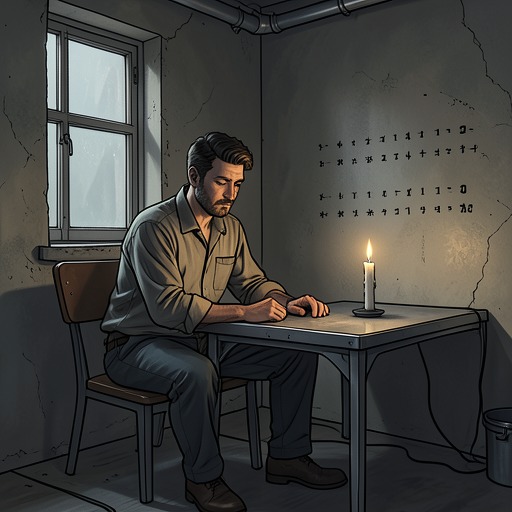
The charge’s consequences unfolded across sharply different detention settings. At Lefortovo Prison, where Limonov spent fifteen months before his transfer, secrecy and isolation defined his confinement: he had not seen a lawyer or received visitors, and initially did not know precisely what he and his companions were accused of. The prison was clean and not overcrowded, but its controlled routine restricted contact and left inmates isolated in white cells equipped with televisions. Limonov nevertheless insisted on exercising on the roof, even in winter darkness and temperatures of minus twenty-five degrees, running and training on his assigned patch of concrete.
Saratov reversed the conditions of Lefortovo. Cells built for four often held seven or eight, and Limonov’s first response was to lay his mattress on the floor rather than protest that every bed was occupied. He shared packages, took on chores, and avoided games in favor of reading and writing; within a week, his fellow inmates regarded him as a good man. The contrast shows how the same prosecution moved him from solitary, opaque custody into crowded communal prison life, while the Article 208 charge remained part of the formal explanation for his confinement.
Significance in the book
Article 208 is not treated as an abstract legal rule detached from events. Its meaning in the narrative comes from the collision between the scale asserted by the authorities and the small, poorly equipped group described in the account. The provision helped turn the Altai gathering into one component of a grave criminal case, alongside terrorism, weapons, and extremist-incitement charges; at the same time, the prosecution’s dramatic portrayal of the camp made the charge a vehicle for the state’s broader depiction of the National Bolshevik Party as a security menace. The book leaves the reader with that tension: a compact statutory label carrying the weight of a much larger political story.