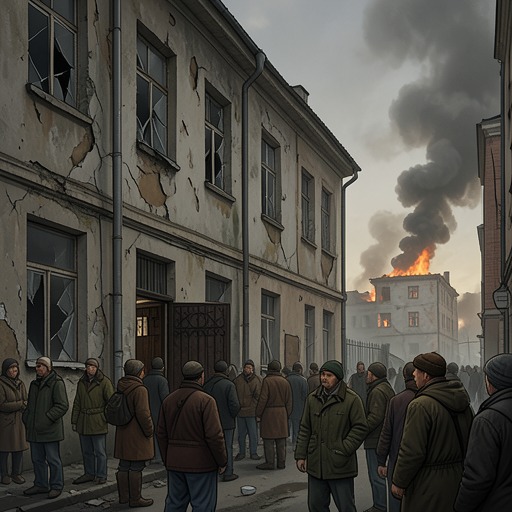
Russia’s voucher privatization program
LimonovRussia’s voucher privatization program was an attempt to turn citizens into investors by distributing shares in the country’s national wealth. But introduced alongside shock therapy, it was overtaken by 2,600 percent inflation: by the time the vouchers arrived, they could buy little more than a bottle of vodka. The gap between the program’s promise of collective ownership and its practical outcome captures the upheaval of Russia’s transition to a market economy.
Purpose and Design
The voucher initiative was part of the rapid economic reforms pursued by Boris Yeltsin and Yegor Gaidar. After decades in which, in theory, people worked for the collective rather than for themselves, the government sought to make citizens investors and encourage the growth of businesses and private property. Each voucher was presented as an individual share in the national wealth.
On September 1, 1992, vouchers valued at ten thousand rubles were sent by mail to every Russian citizen over the age of one. The distribution was sweeping in its intended reach: even infants were assigned a claim on the country’s wealth. Yet the nominal value printed on a voucher could not protect it from the economic shock occurring around it.
Inflation and Resale
Price liberalization caused inflation of 2,600 percent, rendering the parallel voucher initiative useless in practice. By the time the vouchers reached their beneficiaries, they had lost so much value that, at most, they could purchase a bottle of vodka. Citizens resold them en masse to buyers offering roughly the value of a bottle and a half. The intended transformation of ordinary people into investors thus began with vouchers that many could only treat as urgently exchangeable scraps of value.
The book identifies Boris Berezovsky, Vladimir Gusinsky, and Mikhail Khodorkovsky among the shrewd buyers who would become multibillionaires within months. Their rapid ascent gives the program’s failure a human and political scale: the vouchers were distributed broadly, but the value released by the transition accumulated unevenly. The narrative does not present the three men as inherently dishonest; it emphasizes that business had been forbidden in their earlier world and was suddenly permitted in a setting without rules, laws, a banking system, or taxation.
From Privatization to Oligarchic Power
The voucher program must be distinguished from the later loans-for-shares scheme. In that separate arrangement, oligarchs lent money to an empty state treasury and took shares in major, as-yet-unprivatized assets—including natural gas and petroleum—as collateral. If the state failed to repay them within a year, they could claim those assets. The account presents this later deal as a further route to wealth and as the immediate reason the oligarchs feared a possible Communist victory: they needed Yeltsin to remain in power until the repayment deadline had passed.
The same concentration of private wealth also became political leverage. Berezovsky persuaded six other powerful oligarchs to unite behind Yeltsin’s reelection, setting aside even violent conflicts between their own organizations. They deployed their financial and media influence across newspapers, radio, and television to argue that the choice was Yeltsin or chaos. The voucher program was not itself this later campaign, but its place in the account helps explain how economic change produced a class of wealthy actors able to intervene in national politics.
Significance
The vouchers embody the distance between reform’s stated purpose and its lived consequences. They were meant to give every citizen a share in national wealth, yet inflation had already reduced their practical worth before they arrived, and mass resale transferred them toward buyers able to accumulate resources. The contrast is not simply between a failed policy and a successful one: it is between universal entitlement on paper and the rapid concentration of economic and political power in post-Soviet Russia.