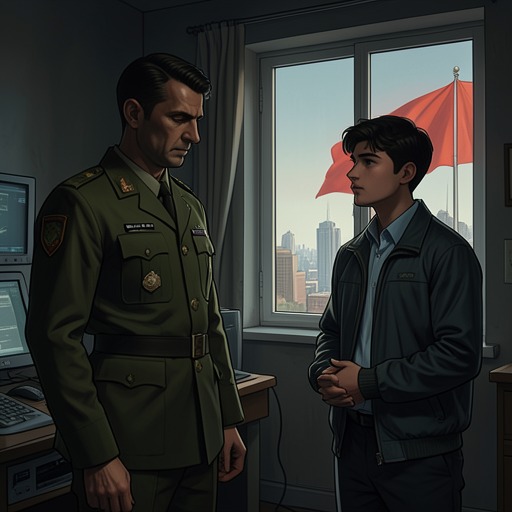
Soviet restrictions on contact with foreigners
LimonovSoviet restrictions on contact with foreigners turned even commonplace cultural exchange into a matter for state suspicion. In the episode of the French visitor, a denim jacket and two old copies of Paris Match are enough to provoke fear of surveillance and a search of Anna Moiseyevna Rubinstein and Eduard Limonov’s home. The rule is presented not as an abstraction but as an intrusion into an artists’ domestic space, where its enforcement takes on the awkward, almost burlesque quality the narrative ascribes to Limonov’s encounters with the security organs in Kharkov.
Scope and Rationale
The restrictions are described as having particular force shortly after Nikita Khrushchev was toppled and the Leonid Brezhnev–Kosygin–Gromyko troika took power. Contact with foreigners was banned because the state suspected it of carrying two kinds of danger: Western cultural influence, imagined as a virus arriving in books, records, or clothes, and the clandestine movement of dissident texts out of the country. A garment could therefore be treated as more than a gift, and a magazine as more than something to read. The rule made material objects evidence of a politically suspect connection.
The Search at Anna and Eduard’s Home
A painter known as Bakht had met a Frenchman passing through, who gave him a denim jacket and two back issues of Paris Match. As soon as Bakht left the Frenchman’s hotel with the jacket on and the magazines in a plastic bag, he worried that he was being followed. He went to Anna and Eduard’s home and confessed what had happened. They had only just managed to hide the jacket and magazines in a chest before a state-security officer knocked at the door.
Eduard let the officer in. The visitor appeared uncomfortable among the books and paintings, as though aware that the artists led a more interesting life than he did. He searched because it was his job, but without conspicuous zeal; the occupants expected him to leave empty-handed. Then his attention settled on the chest. Anna had remained seated on it throughout the search, and when the officer asked her to open it, she tried to refuse. The episode ends at this standoff: the rule has transformed a concealed jacket and a pair of magazines into the focus of a confrontation inside the home.
Enforcement and Narrative Significance
The scene shows the reach of the restriction through its ordinary objects and domestic consequences. Bakht’s fear begins not with a public political act but with a foreign visitor’s gifts; the search follows those objects into the artists’ private space. Yet the officer is not depicted as an eager inquisitor. His apparent embarrassment and lack of zeal complicate the encounter without softening the rule itself: he searches because his job requires it, and his attention to the chest brings the household to a decisive moment of refusal.
The narrative’s contrast between the Western reader’s expectation of the Gulag and the more burlesque character of these particular encounters does not make the restriction harmless. Instead, it makes its operation concrete: state power appears in the knock at the door, the search among paintings and books, and the demand that Anna open the chest on which she is sitting. The episode gives the policy its lived scale, showing how suspicion of foreign contact could make a jacket and magazines sufficient to place private life under official scrutiny.