Shock therapy market reforms
LimonovShock therapy market reforms were Boris Yeltsin and Yegor Gaidar’s attempt to impose a market economy quickly on a country that had never had anything remotely like one. The book presents the program as an abrupt experiment in price liberalization and privatization: it was meant to unsettle opponents of reform and make citizens participants in private enterprise, but inflation rapidly eroded the value of the vouchers meant to share national wealth. Its consequences were sharply unequal, enriching a small group while plunging many Russians into hardship.
Background and rationale
Boris Yeltsin, conscious of his lack of economic expertise, brought forward Yegor Gaidar, a young economist descended from the high Communist nomenklatura and an ardent believer in liberalism. In the book’s account, the scale of the challenge was unprecedented: Russia had never had a functioning market of this kind. Yeltsin and Gaidar believed that speed was essential. They wanted to push their ideas through before reactionary forces could defeat reform, as they had defeated earlier Russian reformers. They named the remedy shock therapy; the word captures not only the intended speed, but the force of the disruption that followed.
The reforms arose amid a political moment of extraordinary expectation. Boris Yeltsin had broken with communism, become Russia’s first elected president, defended the White House and outlawed the Communist Party. For a time, the question was whether political freedom could be turned into a functioning democracy, market economy and new social order. Shock therapy was the economic answer to that question, and its urgency reflected the reformers’ fear that delay would allow the old order to recover.
Price liberalization and the voucher scheme
The first measure was to liberalize prices. Inflation reached 2,600 percent, a shock so severe that it undermined the other major initiative before that initiative could work as intended. On September 1, 1992, the government mailed vouchers worth 10,000 rubles to every Russian citizen over the age of one. Each voucher was supposed to represent its holder’s share in the national wealth. The scheme aimed to turn people into investors and encourage businesses and private property after seven decades in which, in theory, people worked for the collective rather than for themselves.
By the time the vouchers arrived, however, inflation had made them practically worthless. Their recipients discovered that a voucher might buy a bottle of vodka. Many sold them in large numbers to opportunistic buyers, who offered roughly the value of a bottle and a half. The gap between the program’s promise and its immediate everyday meaning is central to the book’s account: a paper claim on national wealth became, for many households, a small amount of cash or drink, while those able to gather the vouchers could turn that collapse in value into an opportunity.
New fortunes and widespread hardship
The buyers who benefited included Boris Berezovsky, Vladimir Gusinsky and Mikhail Khodorkovsky. The book says that they became multibillionaires within months and uses them as representative figures for the oligarchs. It does not describe them as inherently dishonest; instead, it stresses the abruptness of their new position. They had grown up in a system that prohibited the business activity at which they were talented, then found themselves told to pursue it in a landscape with no rules, laws, banking system or taxation. The resulting economy is compared to the Wild West: the opportunity was real, but so was the absence of institutions capable of governing it.
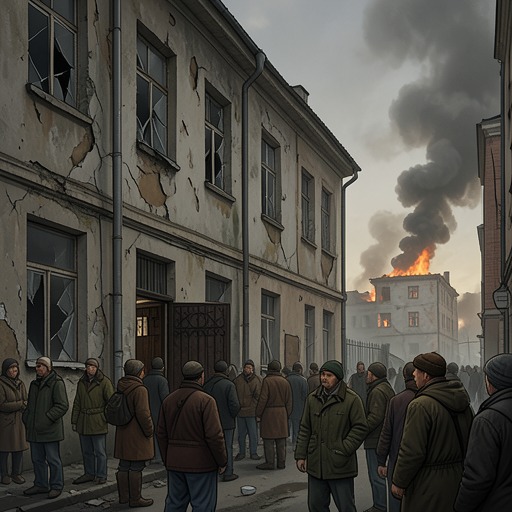
The distribution of gains and losses was not remotely even. While a million people enriched themselves through shock therapy, 150 million who were less quick to seize its opportunities were plunged into misery. Prices continued to climb as salaries stood still. An ex-KGB officer such as Limonov’s father could barely afford two pounds of sausage with his monthly pension. The change was not simply an abstract dispute over economic doctrine; it reached into the ability of ordinary people to buy food and maintain a livelihood.
The book also gives the upheaval a political and demographic measure. A higher-ranking former intelligence officer, repatriated after East Germany ceased to exist and left without work or a home, made a living as a black-market taxi driver and cursed the new Russians. He was Vladimir Putin, then forty, who shared with Limonov the view that the end of the Soviet empire was the twentieth century’s greatest catastrophe. Russian male life expectancy, meanwhile, fell from sixty-five in 1987 to fifty-eight in 1993. The old queues outside empty shops gave way to elderly people selling whatever they could in underground passages: pickles, tea cozies and old magazines. In a society where survival goods were being sold by the poor, others sold verdicts, official tolerance or military equipment; murder contracts were negotiated for between $10,000 and $15,000.
Social change and political afterlives
The reforms accompanied a rapid, visible transformation in Moscow. Streets restored their pre-Revolution names; neon signs, traffic jams and black Mercedes with tinted windows appeared alongside old Ladas. Goods once carried in from abroad for deprived friends—jeans, CDs, cosmetics and toilet paper—became readily available. A McDonald’s opened on Pushkinskaya Square, followed by a trendy disco; restaurants that had once offered little beyond a single disappointing dish began serving Kobe beef and oysters flown in from the coast of Brittany. The new Russian entered popular mythology as wealthy, ostentatious and brutal. These scenes do not erase the misery elsewhere in the account; they set conspicuous abundance beside stalled wages and collapsing pensions.
The book places the reforms within a wider post-Soviet political landscape without presenting every later conflict as a direct result of the economic program. Anna Politkovskaya’s defense of forty National Bolshevik Party militants, sentenced after occupying and vandalizing the presidential administration’s offices while shouting for Vladimir Putin to go, reveals how differently the opposition could be viewed: she described the prisoners as courageous people of integrity and a source of hope for the country’s moral future. Later, the party’s convention drew several hundred delegates from a membership of seven thousand, and Eduard Limonov urged support for Russians in former Soviet republics. When the state denied the party authorization, Limonov warned that it would have to operate secretly; the party was subsequently outlawed. These episodes show a political contest unfolding in the same unsettled society, not a simple economic chain of cause and effect.
The longer arc reaches opposition politics after the coalition The Other Russia ceased to exist following its failure in the presidential elections. Limonov’s Strategy 31 then invoked the constitutional right to demonstrate: participants gathered on Triumfalnaya Square on the thirty-first of months with that many days, where police outnumbered them roughly five to one and regularly arrested demonstrators. The narrative’s juxtaposition of economic upheaval, new wealth, public hardship and political confrontation gives shock therapy significance beyond a list of policy measures. The reforms promised to make citizens owners and open a market; in the account, the vouchers’ collapse and the uneven distribution of opportunity instead expose how quickly a promised share in national wealth could become a token of dispossession.