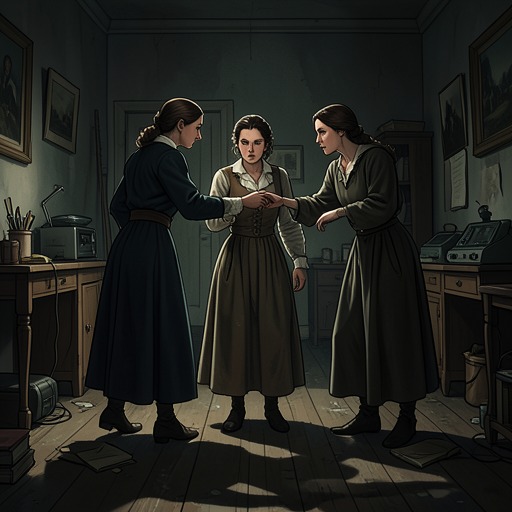
Eduard Limonov and Tanya's marriage and separation
LimonovEduard Limonov and Tanya’s marriage begins to fracture as the comfort they find in facing adversity together gives way to growing distance. Their separation is not caused by a single disagreement: it develops through the unequal pressures of their life abroad, Tanya’s uncertain attempt to enter the modeling world, and Limonov’s increasingly anxious conviction that she will leave him as he once left Anna.
Togetherness under strain
At first, being together offers shelter from hardship, but Tanya is away more often. Encouraged by Lilya Brik’s predictions, she had imagined becoming a famous model. Alex Liberman, who might have opened doors at Vogue, offers compliments instead; calls from Richard Avedon’s and Salvador Dalí’s assistants never come. To approach agencies, Tanya needs a portfolio, and her need for one exposes her to photographers who exploit aspiring models. The luxury world she hoped to enter therefore makes her feel the humiliation of being poor and precariously placed within it.
Her absences acquire a regular shape. She calls Limonov to say that a shoot is still under way and that he should eat without her; the music behind her voice makes him wonder when she will return. “Soon” can mean two or three in the morning. She comes home exhausted, irritated by how much champagne she has drunk and cocaine she has taken, and insists on the value of her work. In their cold apartment she goes to bed fully dressed and wants him to hold her, but has no strength for sex. Limonov stays awake, imagining that he cannot afford a wife as beautiful as Tanya and that she will leave him for someone the market has to offer. He treats this anticipated abandonment as inevitable, even telling himself he would make the same choice in her place.
Jealousy, confession, and the failing pact
The distance between them becomes an interrogation. Tanya accuses Limonov of making scenes and questioning her like the KGB; he presses her about where she has been until she names Jean-Pierre, a forty-five-year-old French photographer with a loft on Spring Street. Her account makes the contrast painfully specific: Jean-Pierre is neither rich nor a star, but he is an adult, unlike the Ukrainian she now sees as troubled, self-pitying, and prone to blaming others. The revelation does not end the marriage at once. Instead, Limonov cries and imagines himself reduced to a shadow if that is what would keep Tanya from leaving. When she says she does not want to leave him, he seizes on the reassurance and proposes that they remain together even if she has a lover, recasting the arrangement as another adventure for two inseparable companions. His eagerness to celebrate the pact meets Tanya’s evasive assent, and relief briefly disguises how little the promise resolves.
The reconciliation collapses into another quarrel. Tanya wants to go out; Limonov does not. They drink, argue, and come to blows. Because he has insisted that she hide nothing, she tells him that Jean-Pierre introduced her to sadomasochistic practices, including tying each other up and using a spiked collar. The detail that makes Limonov lose control is her description of a sexual act involving a dildo. He pins her to the bed and squeezes her neck. The narration follows the change in her expression from laughter and defiance to disbelief and terror as she struggles for air. Limonov releases her only after his own sexual climax. The scene turns the couple’s earlier language of adventure and inseparability into a physical danger that Tanya cannot treat as another eccentric bargain.
Much later, Tanya tells Limonov that the episode aroused her too, but that she left because she believed he might do it again and go all the way. He acknowledges that she was right. Their eventual discussion does not undo the assault or restore the relationship; it clarifies the reason she left and records his recognition of the threat he posed. The separation becomes final in the ordinary evidence of absence: returning from shopping, Limonov finds the cupboards empty. He searches the drawers, the space under the bed, and the garbage, then gathers a torn stocking, a tampon, and unflattering photographs Tanya had ripped up. He places these remnants beneath the icon in their room and lights a candle, turning discarded traces of married life into a private memorial before leaving.
After the separation
Their later encounter shows that separation has not extinguished Limonov’s hope of making a domestic life with Tanya. Gennady Smakov tells him she has split from Jean-Pierre, that other lovers have treated her badly, and that the most recent one has dumped her. She is living in a grim studio, sniffing, red-eyed, with an empty refrigerator. Limonov takes her to Bloomingdale’s and offers to buy whatever she wants, reassuring her that his welfare check will cover it. She chooses two pairs of underwear, for which he pays a hundred dollars. Her choice brings home the distance between them: she is no longer his wife, and he has no right to touch or claim her. At the same time, seeing her precariousness stirs tenderness beneath his contempt. He imagines abandoning the city that demeans them, taking ordinary work as a mover like Lenya Kosogor, building a moving business, and sharing a family life marked by soup, conversation, and mutual care. The plan is a private vision of loyalty and rescue, not a proposal Tanya accepts.
The encounter quickly exposes how far that vision is from their actual relationship. While Limonov waits to tell her what he has decided, Tanya asks whether a friend may join them. The man, in his fifties, orders a drink and behaves like her negligent master; he and Tanya talk and laugh about people Limonov does not know. She leaves with the man after kissing her former husband lightly at the corner of his mouth and thanking him for the outing. Limonov is left to pay for all three drinks. The small, courteous farewell makes the imbalance plain: he has imagined a shared future, while she can accept his money and company without returning to the marriage.
Years later, back in Moscow, Limonov revisits places that had served as settings for their love affair, including Novodevichy Cemetery and the building where he once slashed his wrists. He remembers Tanya’s poodle, whose white curls turned black with dirt during the thaw, and considers calling her in Madrid, where she is living with a Spanish marquis. Her number remains in his address book, and they still speak from time to time, but he cannot imagine saying anything other than that he has come to take her away. He decides that anything else would be sentimental empty talk. The memory therefore ends not in reunion but in recognition: the places and objects of their shared past remain available to him, while the life he wants to recover does not.
The icon as witness
In a moment when their shared life seems close to collapse, Limonov turns toward the icon they have hung in the corner of their dreary room. He imagines the Virgin looking sadly at them and asks her to save them, though he cannot believe in the prayer he is making. The scene places their intimacy between inherited ritual and disbelief: the icon offers a familiar point of orientation in an alien world, but no assurance that the marriage can be saved. Later, when Tanya is gone, he places the few things she has left beneath that same image and lights a candle. The household object that once watched over a plea for rescue becomes the center of a memorial, marking the passage from a life they might still have shared to one Limonov can only remember.