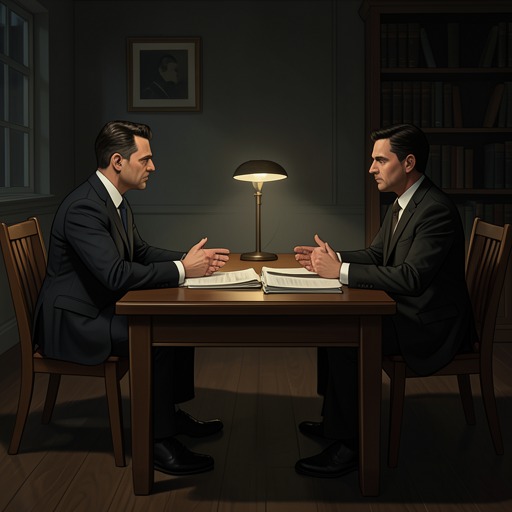
Eduard Limonov—Joseph Brodsky
LimonovEduard Limonov—Joseph Brodsky is a sustained rivalry over literary stature, political dissent, and the right to be recognized as an original figure. For Limonov, Brodsky is more than a celebrated poet: he is the adult version of Captain Levitin, the humiliatingly successful rival whose very existence turns admiration into resentment and makes another person’s acclaim feel like a loss of one’s own.
The Captain Levitin Pattern
The rivalry takes its shape from a childhood wound. Limonov’s father, Venyamin Savenko, once flourishes in a life of nightclubbing in the style of the NKVD, until Captain Levitin takes his job. Levitin becomes the Savenko family’s unwitting sworn enemy: a man who, in Limonov’s later formulation, is less capable than his father but more successful, and whose luck humiliates Venyamin before both his superiors and his family. The boy repeats his parents’ disdain, yet privately suspects that his father is pathetic and that Levitin’s son is fortunate. Limonov carries the contradiction forward, developing the idea that everyone has a Captain Levitin in life. Brodsky will occupy that place for him.
The pattern is not simply that one poet envies another’s success. It is that Brodsky’s success appears to confirm an old fear: that talent and merit do not guarantee recognition, and that the person who gets there first, or receives the right kind of attention, can become impossible to catch. Limonov’s account repeatedly returns to luck as an explanation for the difference between them. The explanation preserves his pride, but it also reveals how closely he measures himself against Brodsky.
Different Routes to Literary Prestige
Brodsky’s standing rests on a history that makes his acclaim difficult to dismiss. As a young man he left school, worked on a milling machine, dissected bodies in a morgue, and served as a geological assistant in Yakutia. He and a companion later tried to hijack a plane to reach Afghanistan. After being confined in a psychiatric hospital and subjected to painful sulfur injections and the icy-sheet treatment known as ukrutka, Brodsky was arrested at twenty-three for social parasitism. At his trial, his exchange with the judge circulated in shorthand transcript through samizdat and electrified a generation. Anna Akhmatova, who had dubbed him the young prodigy from Leningrad, saw a remarkable biography taking shape around him.
Banished to the Far North near Arkhangel’sk, Brodsky shoveled manure in a small village. The frozen landscape and the villagers’ rugged friendship fed poems that travelled by circuitous routes to Leningrad and became cult objects in dissident circles. At bookstore 41 in Moscow, everyone was talking about him. Limonov, already competitive, had little patience for the enthusiasm that had greeted Aleksandr Solzhenitsyn’s One Day in the Life of Ivan Denisovich; Solzhenitsyn, he reasoned, was old enough to be his father, whereas Brodsky was only three years older. They ought to have been competing in the same league. The fact that they were not intensified his irritation.
Limonov could recast Brodsky’s banishment as a lucky break: five years in the countryside, reduced to three, with a Nobel Prize waiting at the end. The jab makes Brodsky’s ordeal sound like a career strategy, but the narrative has already shown the physical hardship and the poems it produced. Limonov’s dismissive account therefore exposes the very rivalry it tries to master: Brodsky’s recognition is made to seem undeserved precisely because it matters so much to him.
Envy in the Underground
When Brodsky returned from exile and appeared occasionally in the Moscow kitchens of the underground, his reputation preceded him. People knew his poems, his courtroom rejoinders, and the international figures who had supported him. He arrived late, left early, and sat in a dark corner in baggy trousers and a worn sweater, while the room gathered around him. Limonov had previously been the young poet who drew attention with his insolence and crushed-velvet jackets. Brodsky’s quiet centrality displaced him.
Limonov tried to protect his pride by deciding that Brodsky’s aura was a constructed persona rather than something natural. A friend of the narrator who knew Brodsky allows that there may be some truth in the observation, while also noting that self-presentation is hardly unique to him. Brodsky’s public manner, however, was bound to a refusal of ordinary literary accommodation. He rejected publication offers from more compliant colleagues such as Yevgeny Yevtushenko and maintained a position described as less anti-Soviet than a-Soviet. In 1972, the KGB ordered him to leave the country. Limonov’s reaction, as the narrative imagines it, is relief at the rival’s departure.
That relief sits beside a broader act of distancing. Limonov mocked the dissident movement and treated figures as different as Brodsky, Solzhenitsyn, Leonid Brezhnev, and Kosygin as authorities speaking from opposite sides of the same barrier. He preferred the image of the clever outsider who could exploit Soviet chaos to the role of a dissident competing for an already crowded place. He also remained attached to Soviet power and national pride, and regarded accounts of the Gulag as exaggerated. Brodsky’s prominence thus threatened not only Limonov’s literary standing but also the position he had chosen: neither a loyal official nor a conventional dissident, but an outsider unwilling to become anyone’s second fiddle.
The Meeting in New York
Years later, after Brodsky had been expelled, Limonov and Tanya were given his address as a contact for émigrés arriving in New York. Brodsky had become a favorite of the Western intellectual establishment, from Octavio Paz to Susan Sontag. He had helped some of his new friends understand the Soviet regime and was admired both for his poetic conversation and for his ease in befriending literary figures. Russian émigrés respectfully called him nachal’nik, or boss—a title that also echoed the language used by Chekists for Stalin.
When Limonov called, Brodsky no longer remembered exactly who he was among the many Russians being sent his way, but arranged to meet him and Tanya in an East Village tearoom. The setting suited Brodsky’s long conversations about literature, yet it was precisely the sort of place Limonov disliked; it did not even serve alcohol. Tanya’s presence helped the encounter relax. Limonov watched Brodsky smoke and cough, his reddish hair already turning gray and his health apparently poor. Though the two were not far apart in age, Limonov felt reduced to a petulant child beside a wise older man—one whose friendliness did not conceal his awareness of the distance between his own established position and the newcomers still struggling to make their way.
Brodsky warned Limonov that survival in America required a thick skin, then offered concrete assistance rather than leaving the advice at the level of a put-down. Since Limonov could write and needed to earn a living, Brodsky directed him to Moishe Borodatikh, editor in chief of Novoye russkoye slovo, an émigré Russian daily where he might work while learning English. He also offered to take Limonov and Tanya to meet his friends, the Libermans. Limonov took pleasure in replying that they already knew the Libermans and would attend a party at their home the following week. Brodsky accepted the correction cheerfully. The encounter does not erase the rivalry, but it complicates its caricature: the rival who once seemed merely lucky and self-satisfied proves capable of practical generosity, while Limonov remains alert to any opening through which he can reclaim parity.