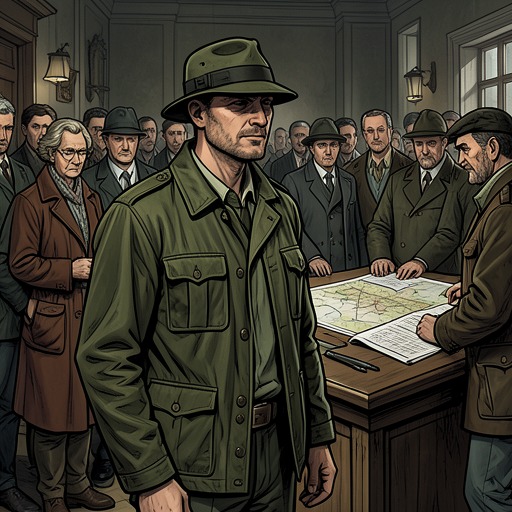
Eduard Limonov—Vladimir Putin relationship
LimonovEduard Limonov’s relationship with Vladimir Putin is, in Emmanuel Carrère’s account, a confrontation with a political double: a man whose background and instincts resemble Limonov’s, but who succeeded in acquiring the power Limonov never possessed. The comparison recasts Limonov’s place in opposition politics as an irony rather than a simple moral conversion. He stands against a ruler whose conduct and worldview, Carrère suggests, might have been his own had history put him in charge.
A belated encounter with power
Carrère makes Putin a central subject as he approaches the end of the book. Limonov, he argues, had believed himself free of the Captain Levitins who poisoned his youth; only later did a super-Captain Levitin rise before him in the form of Lieutenant Colonel Vladimir Vladimirovich. The metaphor links the authority Limonov once experienced as personal oppression to the formidable state power embodied by Putin. The recognition arrives late: the old pattern has not vanished but returned on a far larger scale.
The comparison is sharpened by the 2000 publication of Putin’s interview book, In the First Person. Carrère observes that the title could describe Limonov’s entire body of work, as well as parts of his own. He rejects the impression that Putin waffles when speaking: in Carrère’s reading, Putin does what he says and says what he does, while his lies are delivered with such audacity that they are difficult to mistake for truth. The book’s title thus becomes more than a publicity label. It points toward a public figure whose self-presentation, like Limonov’s writing, is bound closely to a forceful first-person persona.
Parallel origins and instincts
Putin was born ten years after Limonov into a family Carrère describes as much like his: a father who was a junior officer, a mother who worked in a factory, and a family sharing one room in a communal apartment. As a boy Putin was small and timid, raised amid reverence for the fatherland, the Great Patriotic War, and the KGB, along with fear of the West. As an adolescent, by his own account, he was a small-time hoodlum. Judo became the discipline that kept him from becoming a thug; friends remembered the ferocious cries that came from the gym when he trained alone on Sundays.
Putin joined the organs out of a kind of romanticism, drawn to an elite of men who defended the homeland and with whom he was proud to be associated. He distrusted perestroika and resented those who emphasized the Gulag and Stalin’s crimes, whom he regarded as masochists or CIA agents. He described the fall of the empire as the twentieth century’s greatest catastrophe, a judgment Carrère says Putin would still repeat without ambiguity. During the chaotic early 1990s, Putin was himself among the losers, reduced to driving a cab. The trajectory from that defeat to power gives the resemblance to Limonov an edge: both knew humiliation and marginality, but their routes out of it diverged.
Carrère also finds likeness in the image Putin adopted once in power. Like Limonov, Putin enjoyed being photographed bare-chested and muscular, in combat trousers with a commando knife at his belt. Carrère characterizes both men as cold and cunning, distrustful of human weakness, and inclined to see men as wolves. In this portrait, both privilege the right of the strongest, treat values as relative, and would rather make others afraid than experience fear themselves. The likeness extends to their contempt for those who insist on the sanctity of human life. It is not presented as proof that the men were identical in every respect; it is the unsettling basis for Carrère’s question of what Limonov might have done with Putin’s authority.
Power and its human cost
The decisive difference is straightforward: Putin succeeded. Carrère reduces the contrast to a statement of command—Putin is the boss—and then sets that power against its consequences. The crew of the Kursk submarine dies over eight days on the bottom of the Barents Sea; Russian special forces gas 150 hostages at Dubrovka Theater; 350 children are massacred at the school in Beslan. Against those deaths, Putin gives the public news of his dog and her newborn puppies, reporting that the litter is doing well and drinking its mother’s milk. The juxtaposition makes political power visible not only in the capacity to act, but in the choice of what to present as worth noticing.
Putin’s authority also reaches into public memory and institutions. He can order school textbooks to stop teaching what Carrère calls bad things about Stalin, and bring NGOs and the liberal opposition into line. He bows perfunctorily at Sakharov’s tomb while displaying a bust of Dzerzhinsky on his desk. The contrast between public gesture and conspicuous symbol condenses Carrère’s account of a ruler who can accommodate the appearance of homage while maintaining a different political inheritance. When Europe recognizes Kosovo’s independence, Putin threatens that South Ossetia and Abkhazia will also become independent, that Russia will send tanks to Georgia, and that it can cut off the gas if treated without respect. His power is expressed in blunt threats, not merely in resemblance to Limonov’s appetite for strength.
Opposition and the double
Carrère allows that Limonov would likely be impressed by Putin’s virile public image. Yet Limonov writes pamphlets presenting Putin not only as a tyrant but as a bland, mediocre figure in an ill-fitting hand-me-down suit. Carrère judges this picture glaringly wrong. In his view, Putin is, in his own way, a great statesman, and his popularity cannot be explained simply by the dumbing-down effect of media he controls.
Carrère locates that popularity in Putin’s appeal to a wounded collective memory. Putin insists that no one has the right to tell 150 million people that seventy years of their lives—and of their parents’ and grandparents’ lives—amounted to nothing, or that what they believed, fought for, and died for was worthless. Communism, in this account, involved atrocious acts, but was not the same as Nazism; it could also be remembered as grand, heroic, beautiful, and sustaining. For people living in the harsh world that followed, those political memories become entangled with childhood and with the grief that returns in sudden recollection. Carrère says he believes Putin sincere, and that these words speak directly to Russians, beginning with Limonov.
That appeal exposes the relationship’s final contradiction. Carrère suggests that Limonov would say and do everything Putin says and does, or worse, if he occupied Putin’s position. But he does not occupy it. Instead, he is left in the incongruous role of virtuous opposition figure, defending democracy and human rights alongside honest people who embody values he has always despised. The comparison does not resolve into a simple likeness or a clean moral opposition. It leaves Limonov confronting a possible version of himself who has won, while his own political position requires him to defend principles he does not believe in. Carrère’s closing image is not checkmate, but disorientation: the double’s ascent has made it difficult for Limonov to know where he stands.