Serb-Bosniak wartime conflict
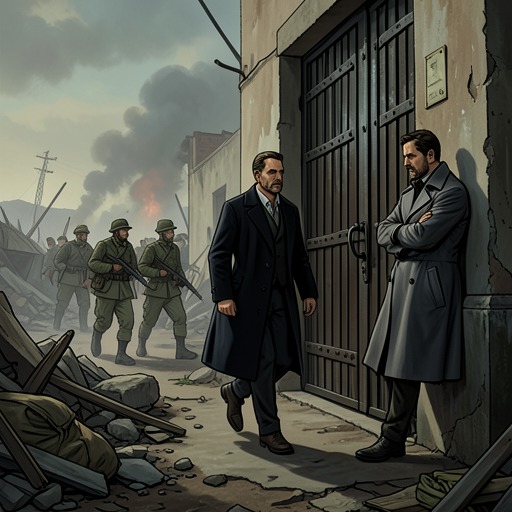
LimonovThe Serb-Bosniak wartime conflict becomes, in Emmanuel Carrère’s account, both a military confrontation and a test of how outsiders decide what they are seeing. As the fighting between Serbs and Croats paused and the war shifted to Bosnia in spring 1992, the public story in France seemed settled: Slobodan Milošević and Radovan Karadžić’s Serbs were the villains, while the Bosnian Muslims represented by Alija Izetbegović were victims of aggression. Yet the account does not resolve the conflict by replacing one simple story with another. It follows the pressure to choose a side while asking how scrutiny, uncertainty, and the actual distribution of force should shape that choice.
Competing accounts of the war
The initial image of Sarajevo carried a powerful ideal. Its book-filled apartments, classical music, and image of a harmonious, multiethnic society made the city seem like an emblem of the Europe its supporters hoped to defend. People in Carrère’s circle travelled there on what they understood as a sacred mission: they slept in bombarded buildings, crossed shattered streets under sniper fire, and lived with the knowledge that each day might be their last. The city’s symbolic meaning helped mobilize attention, but it also made the conflict vulnerable to a moral framing in which one side stood for tolerance and the other for barbarism.
Carrère describes his own susceptibility to counterarguments. He listened to commentators who depicted Izetbegović as a fundamentalist seeking an Islamic republic, suggested that he wanted the siege to continue, and asserted that many photographs of Serbian victims were being misread as images of other victims. Such arguments could make every conclusion appear provisional. The refrain that things were more complicated than they seemed felt like a caution against false certainty, but it could also become a reason to delay judgment. Bernard-Henri Lévy objected to that use of complexity: invoking it against reports of ethnic cleansing, he argued, risked turning analysis into diplomatic cowardice. Carrère found himself nodding to both positions, exposing not a settled interpretation but the pull between skepticism and the demand to respond to violence.
Evidence, injury, and the choice of a side
The account’s insistence on complication does not make the competing positions equivalent. Jean Hatzfeld initially believed that Serbian snipers had ambushed him because they were targeting a journalist. After a year in hospital, he returned to Sarajevo to investigate and concluded that the shots that cost him his leg had in fact been fired by Bosnian militiamen. The correction mattered: it showed that a victim’s first explanation could be wrong, and that an honest witness had to make room for evidence against his own expectation. It did not lead Hatzfeld to conclude that each side was equally responsible for the siege.
For Hatzfeld and Jean Rolin, the decisive practical distinction was where the shells were falling and where they were being fired from. Once the choice was between following events from inside the besieged city or from the besieging positions, they went to the weaker side, without needing to claim that its people were blameless. Rolin could even acknowledge an undeniable satisfaction when Serbs, for once, were being hit; the feeling was temporary, not a final moral verdict. As the balance of suffering shifted, he could condemn crimes by the stronger side in one moment and report on the harsh conditions of defeated Serbs in Kosovo in another. The account treats such reversals as a recurring danger of war: victims can become perpetrators, and perpetrators can become victims. The ethical demand is not to make the roles permanent, but to keep adapting one’s attention to the people actually exposed to harm.
Limonov on the besieging side
Pawel Pawlikowski’s film supplies a sharply concrete counterpoint to the conflict’s abstract arguments. In 1992, disturbed by London and Paris rhetoric casting Serbs as heirs to the Nazis, Pawlikowski went to see what was being said on the other side. He filmed Serbian musicians playing the hurdy-gurdy near soldiers’ tents, songs that travelled from country weddings into children’s ditties, and children singing while carrying Kalashnikovs. In a council of war, Karadžić and Ratko Mladić bent over maps, moving borders and populations as they weighed what could be conceded. The film also showed Pale, the ski resort that served as the Bosnian Serb Republic’s capital.
At Pale, Pawlikowski encountered Limonov among Chetniks, though Limonov was not himself one of them. He introduced himself to a French television crew as a writer interested in the world’s hot spots, then rejected the journalists’ neutrality as cowardice and declared that he stood with the Serbs. His identification was not merely rhetorical. Pawlikowski’s film, Serbian Epics, shows Limonov beside Karadžić on the heights above Sarajevo, where Serb batteries bombarded the city below. After Karadžić described his people as seeking to reclaim territory, Limonov praised Serbian heroism against the countries arrayed against them. When a soldier offered him a machine gun, Limonov took his place behind it and fired a magazine in the direction of the besieged city. The sequence makes the conflict’s asymmetry visible in physical terms: the city lies below, the artillery positions above, and Limonov chooses to participate from the firing side.
What complexity can—and cannot—do
The film does not erase the claims Limonov made about Muslim intellectuals or the Serbian experience of historical subordination. Nor does the account present those claims as sufficient to justify what the film shows. The meeting of political argument and gunfire is crucial: Limonov’s declared solidarity with the Serbs becomes an action directed toward Sarajevo, not simply a provocative position in an argument. His presence also complicates the familiar image of the detached foreign observer. He calls himself a soldier rather than a journalist, and the weapon turns that distinction into conduct.
Across the account, complexity is therefore an obligation to investigate rather than a license to withdraw. Hatzfeld’s correction of his first assumption demonstrates why claims must remain open to evidence; the siege and Limonov’s filmed firing demonstrate why uncertainty cannot be used to blur the difference between those under bombardment and those shooting into the city. The conflict tests the observer’s capacity to resist both moral simplification and moral evasion. Choosing the weaker side does not certify its innocence, but refusing to choose while one side is besieged can leave the stronger side’s violence undisturbed.