Serb-Croat wartime conflict
LimonovThe Serb-Croat wartime conflict emerges from the breakup of Yugoslavia as a collision between competing claims to national self-determination, historical memory, and security. Before the destruction of Vukovar made the violence harder to view at a distance, the narrator emphasizes why the conflict resisted an easy division into good and bad: arguments for Croatian independence seemed compelling, yet the position of Serbs living within Croatia and the histories invoked on both sides complicated that case.
Competing Claims and Historical Memory
In the first months after Yugoslavia began to break apart, many of the narrator’s friends supported Croatian independence on the principle that a people should be free to leave a state and that a nation cannot be held by force. Their opponents warned that applying this principle consistently could invite an unending series of separatist claims, from Corsicans and Basques to Flemish nationalists and supporters of Italy’s Northern League. The question was therefore not only whether Croatia could secede, but what rule of self-determination would govern other communities as well.
Historical memory gave the debate a sharper and more painful edge. Those arguing against the Croatian cause recalled that France had traditionally been friendly toward the Serbs, who had resisted Nazi Germany, while the Croats had supported the Nazis with particular zeal. They cited a scene from Curzio Malaparte’s Kaputt: when Malaparte visits Croatian leader Ante Pavelić and asks whether a basket contains Dalmatian oysters, Pavelić tells him it contains forty pounds of Serbs’ eyes, sent as a gift by his Ustaše. The narrator identifies the Chetniks as the Serbian counterpart in the conflict. This account makes wartime atrocity part of the argument over present political legitimacy, even as the book shows how such memories could be used to frame a newly unfolding war.
The narrator finds the fears of Croatia’s Serbs especially difficult to dismiss. A population long accustomed to being dominant within Yugoslavia faced the prospect of becoming a minority in an independent Croatia. Under Franjo Tuđman, the new government banned Cyrillic signs, dismissed Serbs from the civil service, and replaced Yugoslavia’s red-starred flag with Croatia’s red-and-white checkerboard flag. Because the latter had been created in 1941 by the Germans, people who had lived through the Second World War associated it with the swastika. These measures did not settle the legitimacy of Croatian independence, but they made the Serbs’ fear of subordination intelligible to the narrator, who says that in those early months it was possible to see them as a people at risk of persecution.
Vukovar and the Collapse of Distance
In November 1991, while in Belgrade for the launch of one of his books, Eduard Limonov was approached by uniformed men who asked what he knew about the Serbian Republic of Slavonia, an enclave of Serbs in eastern Croatia. The Serbs there had rejected Croatian secession and declared their own; Croatia had objected, and war followed. Vukovar, a key city in the fighting, had just fallen. Limonov was invited to see it. He had been more interested in events in his own country than in what he regarded as disputes between Balkan peasants, but, nearing fifty and never having been to war, he accepted. The prospect kept him awake through the night.
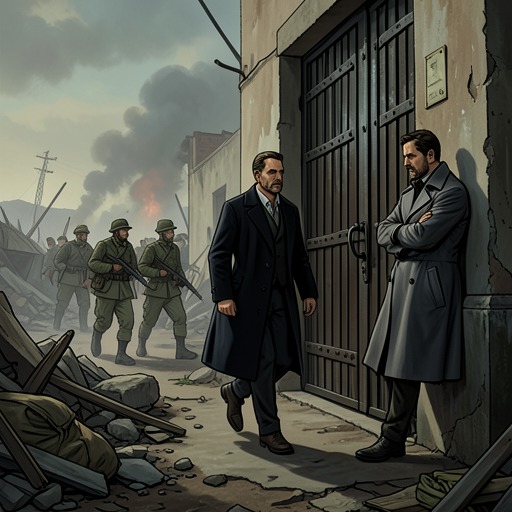
At dawn, two officers drove him from Belgrade toward Zagreb along a highway marked by roadblocks and checkpoints. Soldiers checked identification while others trained rifles on travelers. Limonov’s Russian identity suggested that he was Orthodox and pro-Serbian; his French passport, by contrast, made the escorts suspect that he might be Catholic and pro-Croatian. The tension eased after he joined them in denouncing Franjo Tuđman and Hans-Dietrich Genscher, the German foreign minister who had encouraged European recognition of Croatian independence and was regarded in Belgrade as an architect of a Fourth Reich. Their exchange ended with a drink and extravagant threats against their political enemies. The scene shows how national and religious categories, as well as a passport, could determine how a traveler was read before he reached the front.
The officers’ account left out a fact that should have unsettled Limonov: the soldiers supporting the Serbian cause wore the uniform of the Yugoslav People’s Army. Although the army was formally not a party to the conflict, its predominantly Serbian ranks had shelled Vukovar and surrounding Croatian positions. The omission weakened the comparison the accompanying officer drew between Croatia’s Serbs and Jews during the Second World War: Jews had not had the Wehrmacht’s steadfast support in defending them from the Nazis. But Limonov was drawn less to the argument than to the material signs of war—the armed men, tanks, sandbags, gray-green uniforms against snow, and mortar fire heard in the distance. Passing villages that were still smoking, he could imagine himself in 1941 rather than 1991. What the political explanation obscured, the military landscape made immediate: the conflict could not be reduced to the defense of one innocent people against another’s aggression.
Vukovar as Ruin and Witnessing
Vukovar had been taken by Serbian troops two days before Limonov arrived. The people around him called the city’s fall a liberation without irony, although what he encountered was devastation on a scale that made the word ring hollow. The once-pretty Habsburg city looked to him like a smaller Berlin after the Red Army’s advance: a wasteland of rubble, twisted metal, and glass, with bulldozers beginning to clear the wreckage. There were no hotels left, few standing houses, and none that could be lived in. Even stepping off the path to urinate was forbidden because of mines. The bodies visible in the streets had mostly already been removed, but Limonov was taken to a body-identification center, where he saw the human cost the ruined city could not conceal.
There he saw tortured, purple and charred bodies, slit throats, and bags of remains unloaded from trucks. When he asked who the dead men were, his guide answered that they were Serbs, apparently unable to imagine another answer: in the officer’s account, Serbs were by definition the war’s casualties and Croats their torturers. That certainty collided with the city around them, annihilated by Serbian—or, more precisely, federal—artillery, with a quarter of its population missing. Limonov did not conclude that only one side had innocent victims, brave fighters, or displaced civilians; he recognized that such suffering existed on both sides. But he rejected neutrality as cowardice and felt that fate had placed him with the Serbs. The episode holds together the book’s two competing perspectives: the Serbian fear of becoming a persecuted minority and the destruction inflicted on Croats in the very city where that fear was being invoked.
Militias, Atrocity, and Limonov’s Allegiance
The conflict was fought largely not by regular armies but by militias, whose power blurred the line between combat and predation. Drawing on Jean Rolin’s account in Campagnes, the narrator describes roadblocks manned by fighters whose affiliations were difficult to identify and a paramilitary culture that attracted young peasants, football hooligans, criminals, psychopaths, foreign mercenaries, Russian Slavophiles supporting the Serbs, neo-Nazis drawn to the Croats, and, later, jihadists among the Bosnian Muslims. The militias’ shared look—camouflage, green berets, sunglasses, and weapons, sometimes decorated with Smurf stickers—coexisted with drunkenness, intimidation, and violence against civilians. War offered these men power and impunity: the freedom to terrorize, abuse, and take what ordinary life kept beyond their reach.
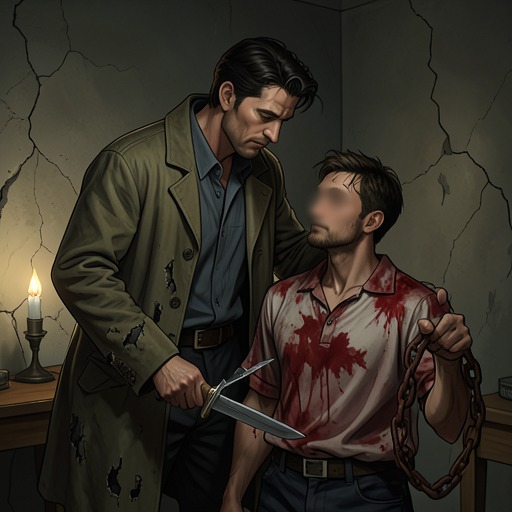
Jean Hatzfeld’s account of the Serbian militia known as the Tigers makes that violence intimate. Led by Arkan, the group operated in the aftermath of Vukovar’s surrender, as Croatian prisoners were gathered in a warehouse. The prisoners were nominally under the protection of the Yugoslav People’s Army, but its soldiers stepped aside while Arkan’s men determined their fate. Victors and captives had often lived and worked in the same villages and neighborhoods; people who had recently shared a drink could now be forced onto military trucks by rifle blows. Hatzfeld also recounts a young Tiger’s description of initiation: recruits were expected to slit the throat of a kneeling prisoner, and those too nervous to do it had to begin again. Violence was not merely an abstract consequence of ethnic hatred; it became a practice through which a militia made its members.
Against this account, the narrator sets Limonov’s encounter with Arkan at the militia leader’s headquarters in Erdut, near Vukovar. Limonov found him astute and circumspect, felt flattered to be treated as more than an ordinary journalist, and drank slivovitz with him. They agreed on their condemnation of Mikhail Gorbachev, Boris Yeltsin, Franjo Tuđman, and Hans-Dietrich Genscher, and on the need for a Russian revolution. When Limonov asked whether he could join as a Russian volunteer, Arkan welcomed him. Their meeting became the beginning of a fast friendship, not just a momentary wartime alliance: months later, reading that Arkan’s men had defeated Bosnian Muslim forces, Limonov wept, took out a photograph of himself with Arkan and the Tigers’ mascot, and longed to return to the war. The photograph preserves the pull of that brotherhood even as the surrounding testimony shows the prisoners, atrocities, and civilian terror that its heroic image leaves out.
The War’s Political Afterlife
At a later National Bolshevik Party convention, Limonov turned the experience of Serbs in Croatia into a political analogy for Russians living beyond Russia’s borders. He told several hundred delegates, drawn from a party he said had seven thousand members, that the dissolution of the Soviet Union had abandoned twenty-five million Russians. In his account, people who had once administered Soviet territories were now marginalized in countries they had helped build, much as Serbs who had once been dominant in Yugoslavia faced becoming a vulnerable minority in Croatia. The comparison carried the conflict’s earlier language of dispossession into a new post-Soviet setting, making the Balkan war part of the party’s argument about Russian identity and grievance.
Limonov attached specific populations and a program of action to that analogy. He said Boris Yeltsin would not come to the aid of the 900,000 Russians in Latvia, the eleven million in Ukraine, or the five million in Kazakhstan, and proposed fostering insurgency and separatist republics in the former Soviet periphery. The delegates responded with applause, and a hundred hands rose when he called for volunteers to join a tour of Central Asia. The passage shows the Serb-Croat conflict’s continuing political use in the book: its history of competing claims and minority fears becomes, in Limonov’s rhetoric, a template for mobilizing a new constituency and opening a new front.
The War’s Political Afterlife
At a later National Bolshevik Party convention, Limonov turned the experience of Serbs in Croatia into a political analogy for Russians living beyond Russia’s borders. Several hundred delegates attended from a party he said had seven thousand members. Limonov argued that the dissolution of the Soviet Union had abandoned twenty-five million Russians: people who had once administered Soviet territories were now marginalized in countries they had helped build, much as Serbs who had been dominant in Yugoslavia faced becoming a vulnerable minority in Croatia. The comparison carried the language of dispossession from the Balkan conflict into a post-Soviet setting, making the fate of Croatia’s Serbs part of a new argument about Russian identity and grievance.
Limonov named the populations he said were at risk: 900,000 Russians in Latvia, eleven million in Ukraine, and five million in Kazakhstan. He accused Boris Yeltsin of refusing to help them and proposed fostering insurgency and separatist republics on the former Soviet periphery. The delegates applauded; when Limonov invited volunteers to join him on a canvassing tour of Central Asia, a hundred hands rose. The conflict’s political afterlife thus lay not only in memories of competing national claims and minority fears, but also in Limonov’s use of those memories to mobilize a constituency and propose a new front.
Names, Evidence, and the Limits of Allegiance
The conflict is also a struggle over who may be named as victim, aggressor, or liberator. The narration repeatedly sets official labels against the material evidence that unsettles them: a Serbian account of a threatened minority sits beside the Yugoslav People’s Army’s role in shelling Croatian positions; the language of liberation sits beside a city reduced to rubble. Even at the body-identification center, the guide’s certainty that the dead must be Serbs exposes how allegiance can shape what a witness is able to recognize. These contradictions do not erase the earlier grounds for Serbian fear, but they prevent that fear from serving as a complete account of what happened in Vukovar.
That tension distinguishes the narrator’s attempt to understand the conflict from Limonov’s decision to take sides. The narrator presents competing arguments and follows them into the consequences of war; Limonov acknowledges suffering on both sides, yet treats neutrality as cowardice and accepts fate’s assignment to the Serbs. The relation between Serbs and Croats therefore remains more than a contest of national claims: it tests whether a political analogy can survive the violence it is used to explain. Limonov’s later invocation of Serbs as a model for Russians abroad carries the force of remembered dispossession, but the book’s account of Vukovar keeps that analogy shadowed by the destruction and expulsions it cannot contain.
From Distant Caricature to Witness
Before he had a firm view of the conflict, the narrator likened Serbs and Croats to rival villagers in The Adventures of Tintin: mustachioed men in embroidered clothes, supposedly ready after a drink to take up rifles over ancient feuds. The comparison records his own distance from the war, not an explanation of it. He admits that he initially listened to arguments without joining them, and that the apparent simplicity of the national caricature gave way as he encountered the competing claims, remembered atrocities, and concrete destruction surrounding Vukovar. The shift matters to the relation between Serbs and Croats as the book presents it: neither the language of timeless feud nor a clean division into righteous and guilty can account for the political choices and human consequences that come into view.