Novoye russkoye slovo
LimonovNovoye russkoye slovo is a Russian-language daily founded in 1910, shortly before Pravda. In the book, its modest New York newsroom becomes a sharply defined world of émigré routine: a place that offers Eduard Limonov work and welcome, but also makes visible the stalled hopes and social limits of exile. His time there culminates in a polemic that unsettles the paper’s community and in a departure that is at once personal and political.
History, format, and work
The paper’s format and general appearance so resemble Pravda that the two can be difficult to distinguish. Its offices occupy one floor of a run-down building not far from Broadway. For Limonov, the name initially carries a charge of possibility: he imagines journalism as a path taken by writers such as Hemingway, Henry Miller, and Jack London. The actual work is much less glamorous. He compiles and translates articles from New York newspapers for Russian subscribers, who receive the news three days late and are not especially concerned about its freshness.
The daily’s contents have a distinctive mixture of routine and polemic. Alongside the translated news runs the interminable serialized novel Princess Tamara’s Castle; recipes, most of them variations on kasha; and a stream of contributions from obsessive anti-Communists. In practice, the boundary between a letter and an article is not always clear. The paper’s pages therefore bring together delayed reports, domestic advice, serialized fiction, and the arguments of a political exile community without making them feel like parts of a modern, fast-moving newsroom.
Editors and the émigré community
Most of the editors are elderly Jewish émigrés who speak little English despite having lived in the United States for almost fifty years. Many left after the Revolution. The oldest among them remembers Leon Trotsky visiting the paper before the Revolution and retells the story of his Bronx years: Trotsky lectured on world revolution to nearly empty halls, alienated restaurant waiters by refusing to leave tips, and bought furniture on installment before disappearing. When the loan company finally found him, he had become commander of the Red Army. The newsroom preserves such recollections as living fragments of a political past, turning the paper into more than a workplace: it is also a repository for its editors’ memories of departure and upheaval.
The atmosphere is affectionate and old-fashioned. Coffee in the morning and sweetened tea throughout the day accompany frequent birthday gatherings, when vodka, pickled cucumbers, and the linotypists’ prized Napoleon cognac appear. Colleagues address Limonov warmly as Eduard Venyaminovich. For a newcomer who has just arrived and does not speak English, this familiarity provides comfort. Yet the same closeness has a stagnant side. The editors’ dreams of a new life in America have, in the narrator’s account, ebbed into nostalgia, minor quarrels, and hopes of returning that remain unfulfilled. Limonov senses that he cannot stay enclosed in this atmosphere indefinitely.
The editors’ shared resentment of Vladimir Nabokov makes their cultural outlook particularly clear. They object not simply to Lolita, which unsettles them somewhat, but to Nabokov’s abandonment of émigré novels written for émigrés and his refusal to remain within their small literary world. Limonov dislikes Nabokov too, from class resentment and disdain for literary writing, but he does not want to share the editors’ reasons or their confinement. The contrast marks his uneasy position: he can recognize a grievance while rejecting the narrow community and inherited outlook through which it is expressed.
Limonov’s polemic and the break
After about six months at the paper, Limonov is still languishing in an unremarkable job and making only marginal appearances around the jet set. The articles he tries to pitch about Kharkov toughs and the Moscow underground attract no interest, nor do his poems. With no success in fiction and little response to his reporting, he turns to polemic as the remaining route to recognition. Andrei Sakharov’s Nobel Peace Prize provides the occasion. Limonov spends two days writing an attack on the dissidents, arguing that they are cut off from ordinary people, represent their own scientific elite, and would not necessarily govern better than the bureaucracy they oppose. He also disputes their picture of Soviet life as a concentration camp and challenges the idea that emigration offers a welcome alternative.
The essay, titled Disillusion, draws on a fear that is also Limonov’s own: that he has arrived in America only to discover that nobody needs him there. The New York Times and several other prestigious newspapers do not acknowledge receiving it. An obscure magazine eventually publishes it more than two months later, and the people it targets in New York’s intelligentsia largely do not notice. Its effect is instead concentrated in the small émigré community around Novoye russkoye slovo. Even editors who concede that parts of the argument may be true worry that publicizing it would serve Communist interests. The dispute exposes the limits of the paper’s refuge: the same community that welcomed Limonov is troubled when his writing challenges its habits of political speech.
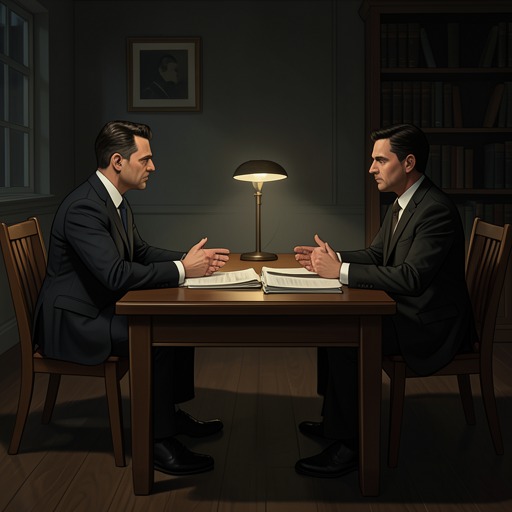
The conflict becomes decisive when editor in chief Moishe Borodatikh summons Limonov and points to a Soviet newspaper spread across his desk. Komsomolskaya Pravda has printed a photomontage, using an old Moscow photograph to place Limonov at the foot of a New York skyscraper, and presents him as a poet revealing the truth about dissidents and emigration. Borodatikh tells him that the paper’s readers say he works for the KGB. Limonov responds with a shrug and a question, then leaves the office without waiting to be dismissed. The scene does not establish a formal firing; it shows him taking the initiative in a departure whose cause is the widening gulf between his public polemic and the newspaper’s political anxieties.
Narrative significance
Novoye russkoye slovo is portrayed neither as a simple refuge nor merely as a failed institution. Its food, familiar forms of address, and birthday gatherings give Limonov a temporary home when language and work elsewhere are difficult. At the same time, the delayed news, aging staff, and inward-looking debates embody the cultural and professional stagnation he fears. The newspaper’s authority within its own small community is real, but its reach is limited: Limonov’s essay passes unnoticed by its intended intellectual targets and becomes consequential chiefly through the unease it creates among émigrés.
That limited circulation links the paper’s ordinary labor to Limonov’s emerging identity as a polemicist. He enters imagining journalism as a literary apprenticeship, spends his days translating other people’s news, and finds attention only when he attacks the politics of his surroundings. The Soviet newspaper’s reuse of his image then turns that attack into a new problem at work. Novoye russkoye slovo thus serves as both the setting of his early American disappointment and the institution from which he steps away when its community can no longer contain the meaning attached to his words.