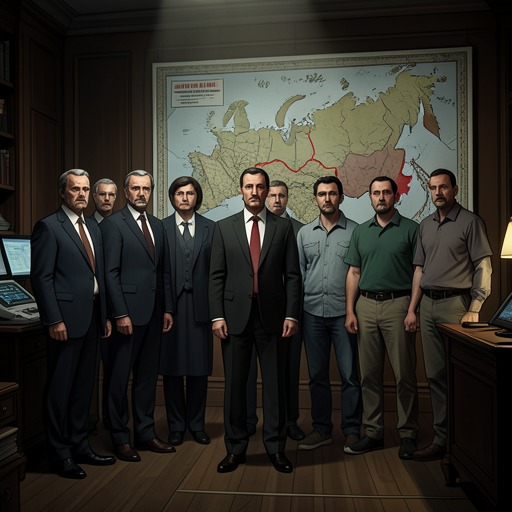
The Other Russia
LimonovThe Other Russia was an opposition coalition led by Garri Kasparov, Mikhail Kasyanov, and Eduard Limonov, an unlikely alliance that made Limonov newly legible as a political actor to observers who had regarded him as an extremist. Its emergence appeared to offer a democratic alternative to Vladimir Putin’s government before the 2008 presidential election. Yet the movement’s rise was accompanied by doubts about whether opposition could operate within Russia’s political rules, and its post-election disappearance left Limonov to pursue a different form of protest.
Formation and political setting
The coalition took shape several months after a more unexpected reassessment of Limonov. While researching the trial of forty National Bolshevik Party militants accused of occupying and vandalizing the presidential administration’s offices, the narrator found that Anna Politkovskaya had defended them as courageous people of integrity and a source of hope for Russia’s moral future. Yelena Bonner, widow of Andrei Sakharov, had also spoken favorably of the militants, despite reservations about their party’s name. These endorsements unsettled the narrator’s settled image of Limonov as a fascist leading a skinhead militia: people widely regarded as moral authorities were describing his followers as participants in a struggle for democracy.
The coalition’s announced leadership brought together figures from sharply different public worlds: Garri Kasparov, one of the greatest chess players of his time; Mikhail Kasyanov, a former prime minister under Vladimir Putin; and Limonov, a writer whose political company many observers considered disreputable. For the narrator, that combination was precisely what made the subject worth investigating. The coalition’s formation did not resolve the contradiction surrounding Limonov; it made the contradiction central to how the movement was seen.
A democratic opening under scrutiny
At a press conference, Kasparov set out the case for the coalition. Vladimir Putin was nearing the end of his second term, and the constitution barred him from serving a third consecutive term. With no officially endorsed successor yet apparent, Kasparov argued that the coming election offered a historic opportunity for a democratic opposition. He said that controlled media concealed public discontent with oligarchs, corruption, and the power of the security services, and presented the coalition as a way to give that discontent political expression.
The press conference attracted foreign journalists as well as militants. A Swedish film crew was preparing a documentary, planning three months of filming in the expectation that The Other Russia might rise to power. For a moment, the narrator found Kasparov’s confidence persuasive and imagined witnessing an extraordinary democratic breakthrough. A British journalist beside him countered that Russians liked Putin and might welcome his return after a compliant successor rather than regard it as a constitutional evasion. The exchange punctured the narrator’s optimism: the coalition’s promise could not be separated from the possibility that its reading of public opinion and the constitutional opening was mistaken.
The room’s arrangement sharpened that uncertainty. Kasparov occupied the podium as the commanding public speaker, while Limonov sat beside and slightly behind him, listening calmly as Kasparov described official persecution. Limonov did not appear to be waiting impatiently for his turn. His attentive stillness made his role difficult to read: he might have believed in the coalition’s democratic project, or he might have been exploiting it while remaining the outlaw and provocateur his earlier politics had made him. The movement thus presented not only a united opposition to the authorities but an unresolved question about what kind of opposition Limonov was willing to represent.
Competing accounts of legitimacy
The coalition’s democratic language emerged amid fierce disagreement over what counted as defending democracy. In the confrontation around Boris Yeltsin’s presidency, thousands gathered at the White House, a building that had symbolized Yeltsin’s victory over the earlier putsch. Some of the self-described patriots were fascists, yet they presented themselves as defenders of constitutional order and accused the democrats of preparing a dictatorship in democracy’s name. Eduard Limonov joined the gathering. When he met Alexander Rutskoy, he encouraged the general to see the confrontation as a democratically elected parliament resisting dictatorship and argued that the decisive struggle would take place at the White House. The scene illuminates the political vocabulary from which Limonov entered the later coalition: claims of democratic legitimacy could be made by opposing camps, and the label alone did not settle their motives or practices.
Nor did discontent with the post-Soviet order automatically translate into support for a liberal opposition. Five years after Yeltsin had outlawed the Communist Party, polls pointed to a possible large vote for the Communists. Their leader, Gennady Zyuganov, appealed to people angry with democracy’s economic injustices through promises to fight corruption, restore national pride, and narrow the gap between rich and poor. The account stresses the material and political grievances against which an opposition coalition had to compete. In a country where many voters had become disillusioned with the market and its distribution of wealth, a democratic alternative faced more than the challenge of gaining access to public attention: it had to contend with competing promises of order, fairness, and national purpose.
Electoral failure and the movement’s end
In retrospect, the coalition’s hoped-for opening proved temporary. By the time the narrator later asked Limonov what had happened, Kasparov had not tried to run, and The Other Russia had ceased to exist after what the narrator calls its failure in the presidential elections. The evidence does not give a detailed account of the coalition’s electoral performance; it does establish that the movement did not survive as a political force after that episode. The earlier press conference’s confident portrayal of a historic opportunity therefore stands against the later plain fact of dissolution.
Limonov did not abandon opposition politics. He created Strategy 31, named for Article 31 of the constitution, which guarantees the right to demonstrate. Its supporters gathered on Triumfalnaya Square on the thirty-first day of months containing one. Usually about a hundred demonstrators faced five times as many police officers, and police arrested several dozen participants; Limonov consequently spent a couple of days in prison on a regular basis. The small scale and repeated arrests marked a shift from the coalition’s national electoral ambition to recurring street protest around a specific constitutional right.
Limonov also sought to establish a national assembly of opposition forces with support from some older democrats and human-rights activists. Kasparov tried to preempt that project by launching his own platform, and the former allies had become rivals. Their competition was presented as comparatively tame: Limonov took satisfaction in his website attracting more visits than Kasparov’s. The contrast completes the coalition’s brief arc. The Other Russia had brought together an improbable leadership under the prospect of a democratic opening; after it disappeared, its leading figures pursued separate platforms, while Limonov’s opposition continued in smaller, more vulnerable forms.