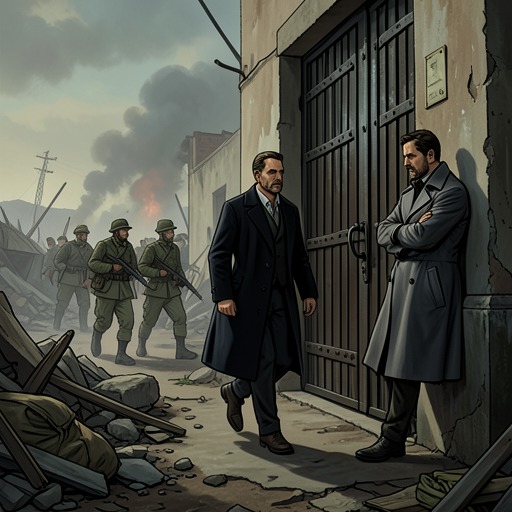
Serbian Volunteer Guard
LimonovThe Serbian Volunteer Guard, known as the Tigers, appears as one of the most notorious Serbian militias of the wars in the former Yugoslavia. Led by Arkan, it is shown at Vukovar exercising power over Croatian prisoners after the city’s surrender, while the military force nominally responsible for their protection steps aside. Its place in the narrative is sharpened by Eduard Limonov’s friendship with Arkan: the same militia that presides over the prisoners’ uncertain fate becomes, in Limonov’s recollection, the setting for comradeship and a lost opportunity to return to war.
Identity and wartime setting
The book introduces the Tigers within a wider paramilitary world of camouflage, weapons, armed vehicles, heavy drinking, and men returning from the front or from what the account calls cleansing operations. That description establishes the surrounding culture of irregular violence, rather than attributing every detail of it specifically to the Serbian Volunteer Guard. Jean Hatzfeld identifies the Tigers as the most famous of the Serbian militias in this setting and names Arkan as their leader, a man whose reputation among Belgrade’s pimps accompanied his record as a war criminal.
The episode centered on the unit takes place in a warehouse the day after the surrender at Vukovar. Croatian prisoners, driven from their cellars in the final attacks, are assembled there. In principle, the People’s Army is meant to protect them; in practice, it steps aside and leaves Arkan’s men to decide what happens next. The militia’s authority thus operates in the gap between nominal military protection and the captives’ immediate exposure to armed men.
Prisoners and the militia’s violence
The victors and captives are not strangers brought together only by battle. Hatzfeld’s account stresses that many had recently lived in the same villages and neighborhoods, worked together, or shared a bar. The prisoners, described as pale and terrified, are forced onto military trucks at rifle-point and taken to unknown destinations. Familiarity does not restrain the violence; the narrative makes it part of its disturbing force, as yesterday’s neighbors become today’s captors.
A separate encounter reported by Hatzfeld gives the militia’s violence an everyday, almost conversational register. He picks up a young, athletic member of the Tigers who is on leave and travelling to see his mother. The young man cheerfully describes the initiation imposed on prisoners: “Initiation consists of slowly slitting the throat of a kneeling prisoner.” He adds that recruits who are too nervous must begin again, that few refuse, and that the patrol’s members celebrate afterward. The casual manner of the account places organized killing alongside ordinary leave and family visits, without suggesting that the violence is exceptional within the group’s practice.
Arkan and Limonov
The narrator deliberately presents Hatzfeld’s account before turning to Limonov’s version of his meeting with Arkan. At Arkan’s headquarters in Erdut, near Vukovar, Limonov finds him astute and circumspect and feels flattered to have been singled out from the ordinary run of journalists. The two drink slivovitz and discover broad political agreement: they condemn Mikhail Gorbachev and Boris Yeltsin, Franjo Tuđman and Hans-Dietrich Genscher, call for revolution in Russia, and criticize French intellectuals who support the Croats. Limonov asks whether Arkan would accept him as a Russian volunteer; Arkan replies, “Everyone’s welcome.” The narrator presents the meeting as the beginning of a fast friendship.
That friendship persists in Limonov’s imagination after the encounter. Several months later, when he reads in Le Monde that Arkan’s militiamen have won a clash with Bosnian Muslims, he is moved to tears. He takes out a photograph of himself with Arkan, posing beside the group’s small tiger mascot, and remembers the scene with radiant nostalgia. His words make the longing explicit: “My brother Arkan, how I’d love to be back at your side! How I long to return to the war in the Balkan mountains!” The image of the mascot and the language of brotherhood turn a militia leader associated with prisoner killings into the object of Limonov’s yearning for renewed combat.
Political meaning in the narrative
The account does not let Limonov’s affectionate recollection replace the evidence of what the Tigers do. It places his enthusiasm beside Hatzfeld’s scenes of captives being forced onto trucks and prisoners being killed as an initiation, making the contrast central to the portrayal of the Guard. Limonov’s later political language also echoes this attachment: at a National Bolshevik Party convention, he invokes Serbs in the former Yugoslavia as a people once dominant and now victimized, and uses that analogy to argue for defending Russians in former Soviet territories. The passage shows how his memory of the Balkan wars feeds a political picture of abandoned and dispossessed peoples; it does not establish that the party’s proposed campaigns were operations of the Serbian Volunteer Guard.