Big Bang
MayaThe Big Bang is the universe’s beginning and, in the novel, the pivotal test of whether an event can acquire meaning retrospectively. Its fireworks appear blind and purposeless when imagined from within the instant of creation; only billions of years later, with life able to look back, can anyone call them a spectacle or ask what they were for. The novel sets that backward-looking interpretation against evolutionary biology’s account of mutation and natural selection, without simply erasing the difference between scientific mechanism and a claim about cosmic purpose.
The Beginning Seen from Afterward
The narrator places the Big Bang within a broader argument about how beginnings and endings become intelligible. In a reflection prompted by the writing of a book’s prologue, he imagines that a prologue may properly be written only when the story itself is over. The first amphibians took hundreds of millions of years to give rise to a living being able to describe their emergence onto land. Humanity can therefore write the prologue to its own history only after that history has, in a meaningful sense, already happened. The beginning is not altered; what changes is the perspective from which it can be understood.
The same principle shapes the narrator’s compressed account of cosmic history: the Big Bang’s applause did not arrive until fifteen billion years after the explosion. The image converts an impersonal origin into a performance whose audience is not present at the opening. Its delay is the point. The applause belongs to observers who emerge only after the universe has developed far enough to contain life and consciousness; the event’s significance is thus presented as something recognized after the fact, not as an intention visible at the moment of creation.
The narrator’s own scientific outlook gives this speculation a personal background. As a child, he became interested in nature and immense spans of time after finding a dead young roe deer in a forest in Vestfold. He was about seven or eight, and the discovery made mortality bodily and immediate: the animal was not asleep, and he understood that he, too, was a living creature who would one day no longer be here. He kept the experience secret, and later described its concealment as part of what made it traumatic. His subsequent fascination with the Big Bang and cosmic distances became one way of placing a brief individual life inside a scale larger than itself.
That enlargement of perspective is not presented as a cure. The narrator says he has tried to understand himself as a fleeting part of life’s larger adventure, and as a temporary bearer of the universe’s awareness of itself. Yet awareness of cosmic time has intensified rather than quieted his fear of disappearing. The Big Bang matters to him not just as scientific knowledge, but as the furthest reach of a history in which consciousness can look backward while remaining acutely conscious of its own limited duration.
The Debate over Purpose
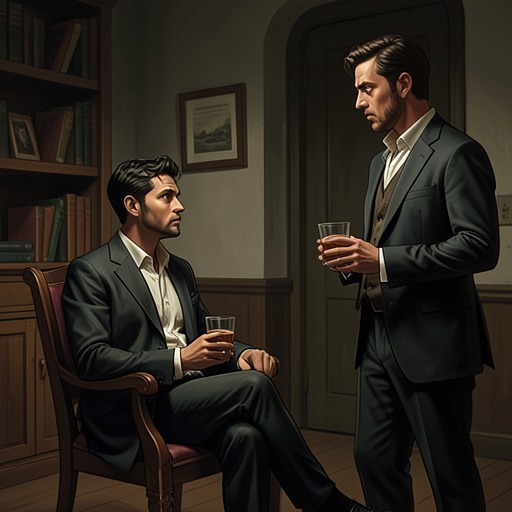
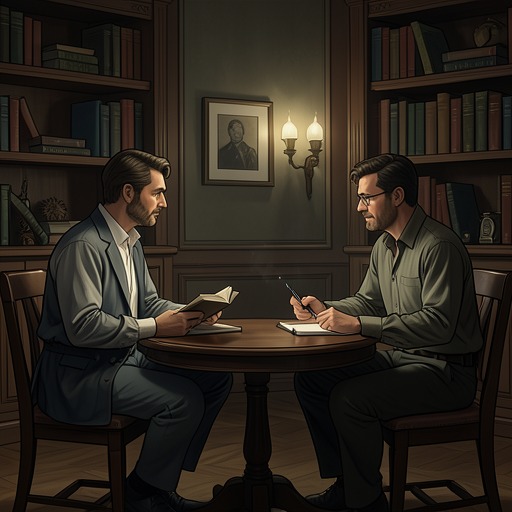
During conversation at Maravu, José turns a discussion of card-playing and probability toward evolution. He asks whether life on Earth has been driven solely by unpredictable mutations, or whether natural science may be overlooking a mechanism connected with intention and purpose. The narrator, an evolutionary biologist, gives the standard scientific account and initially hopes the subject will end there. Instead, José presses the question of whether evolution is merely a real process or also a meaningful one.
José argues that human consciousness should not be treated as an arbitrary feature produced in the struggle for existence, but as the process’s end. He points to repeated developments across the history of life: eyes and vision have arisen independently, as have flight and upright walking. To him, these recurrences suggest a natural movement toward increasingly comprehensive intellectual vision. The narrator recognizes an idea he had entertained in childhood under the influence of Pierre Teilhard de Chardin, but says that studying biology led him to reject evolution directed toward a final purpose. He feels obliged to resist José partly because he represents the authority of a scientific institution.
The narrator’s account of evolutionary mechanisms complicates, but does not settle, the dispute. He notes that eyes have been independently developed some forty or fifty times, and that insects evolved wings more than a hundred million years before reptiles did. Pterosaurs, the first vertebrates capable of flight, appeared roughly two hundred million years ago and became extinct with the dinosaurs; they were not ancestors of modern birds. They flew somewhat like large bats and had no feathers. Archaeopteryx, about 150 million years old, was a small dinosaur, and the development of wings and feathers took place independently of the pterosaurs. These examples establish repeated solutions and separate evolutionary histories; they do not, by themselves, demonstrate a destination toward which evolution was aiming.
The narrator describes natural selection in terms of mutations across many thousands of generations: an individual with a small advantage in the struggle for existence is more likely to pass on its genes. José challenges the ease with which that mechanism can explain the earliest stages of a structure such as a wing, when rudimentary growth might hinder an animal before it becomes useful. The question exposes a difficulty in the conversation, not a scientific conclusion that the novel independently proves. The exchange keeps the distinction in view between explaining how traits may be selected and claiming that the whole process has an intended end.
A Future That Reinterprets the Past
John Spooke gives the debate its clearest account of retrospective purpose. Three hundred million years ago, he says, it would have been premature to conclude that life on Earth was absurd or purposeless: its purpose had not yet had time to flower. The present, in his formulation, belongs to the vanguard rather than the destination. It may take a hundred years, a thousand years, or a billion years for observers to know where the process was going. What happens in the future can consequently become, in a particular sense, the cause of what happens here and now—not a cause that operates backward as an ordinary physical mechanism, but a later outcome that changes the meaning assigned to earlier events.
John extends the thought from evolution to the formation of the solar system. A witness to that spectacle of natural forces might have called it absurd, he suggests, but such a judgment would have been premature. He then imagines seeing the Big Bang itself: the creation of time and space, experienced as extravagant fireworks. From within that imagined scene, he says, he might have felt disgust and asked what the display was for. Looking back from the present, however, he can understand its reason as the possibility that observers exist now to look back at it.
Laura challenges the human-centeredness of this claim, asking why the privileged witnesses should be humans rather than a toad or a panda. John’s answer remains tentative in wording but firm in direction: perhaps those who deny any meaning behind the universe are mistaken, and perhaps the Big Bang had a purpose, although that purpose can be contemplated only retrospectively, at least by human beings. The question of who counts as the audience therefore unsettles the claim even as the image of the audience makes it vivid. Consciousness is both a possible culmination of cosmic history and a partial, situated point of view within it.
The narrator objects that causes ordinarily point backward in time, so a future event cannot be a cause in the usual sense. John replies that the perspective itself may be wrong. Had life not developed from the first amphibians, he proposes, no one could have declared earthly life meaningless or purposeless: there would have been no observer to make the declaration. The argument’s force lies in this dependence. The claim that the universe is meaningless is also made from within the history whose existence it judges; the eventual arrival of a witness changes what can be said about the earlier stages, even if it does not establish that those stages were consciously planned.
The Cosmic Performance and Its Audience
The Big Bang’s theatrical image returns in Ana’s enigmatic speech beneath the night sky. José has asked how probable it is for something to arise from nothing, or for something to have existed forever, and whether cosmic matter might one morning awaken to consciousness. The narrator answers that such questions have no answer. José rebukes the assumption that an answer does not exist merely because it is beyond the narrator’s reach. Ana then describes the beginning as an explosion long ago, followed by a second performance at night. The extra payment, she says, is the creation of the public: without a chorus of spectators, there would have been no point in calling what happened a spectacle, and seats remain available.
The narrator applauds before realizing that his response may have been a mistake. Ana’s image condenses the novel’s central paradox into an audience arriving after the show has begun: consciousness is not merely looking at a finished universe but supplies the witnessing through which the cosmic event can be named a spectacle at all. The image does not resolve José’s metaphysical questions or prove a designed universe. Instead, it makes the dependence between event and observer palpable, while leaving open whether that dependence is purpose, interpretation, or both.
The narrator’s larger reflection on time returns to the same structure through his dead daughter, Sonia. In Salamanca, he and Vera remember her during a visit to the old university city; the past becomes present between them through stories and shared recollection. He writes that only the two parents can create a living space in which their daughter’s memories continue to have an effect. He then wonders whether something happening now can point backward and give a new meaning to something that happened before, including Sonia’s death. That intimate question echoes the cosmic argument: later awareness cannot undo an earlier event, but it can alter the place the event occupies in a life’s story.
The Big Bang is thus less a solved origin than the novel’s largest model of retrospective significance. Its physical beginning is distinct from the claims made about its purpose; the dialogue preserves that tension between natural selection and teleology, mechanism and interpretation. Yet the delayed applause, Ana’s audience, and the narrator’s reflections on mortality all return to one structure: an event may have to be survived, witnessed, or remembered before its meaning can be seen. The universe’s first explosion becomes legible only from far downstream, where a brief-lived consciousness can look back and ask what the long journey was for.