Tropical Summit
MayaThe Tropical Summit is a dinner gathering at Maravu Plantation Resort that turns a mixed group of travelers into an audience for a debate about the Universe, scientific knowledge, and the purpose of life. Organized by John Spooke, it moves from a sociable introduction to sharp disagreements over evolution and meaning, then breaks into an unsettling exchange when Ana speaks of life beyond death and John names her spirit Maya. The evening’s abstract questions acquire immediate emotional stakes: José tries to stop the exchange, and Laura’s physical retaliation against Bill carries the meeting from discussion into conflict.
Setting and Assembly
The summit takes shape over dinner at Maravu Plantation Resort, where the tables have been joined into one. The resort’s owner, Jochen Kiess, had wanted the place to serve as a refuge for individualists; John, however, uses the communal arrangement to bring the guests together before they settle into separate conversations. The narrator, Frank Andersen, arrives early and speaks with John about reptiles in Oceania, especially house geckos, which both men keep in their rooms. Their confidences establish the personal losses beneath the evening’s broad intellectual subject: Frank tells John that he and Vera lost their daughter in a traffic accident, and John tells him that his wife Sheila died after a long illness. He also says that, after years away from writing, he has begun taking notes for a new novel.
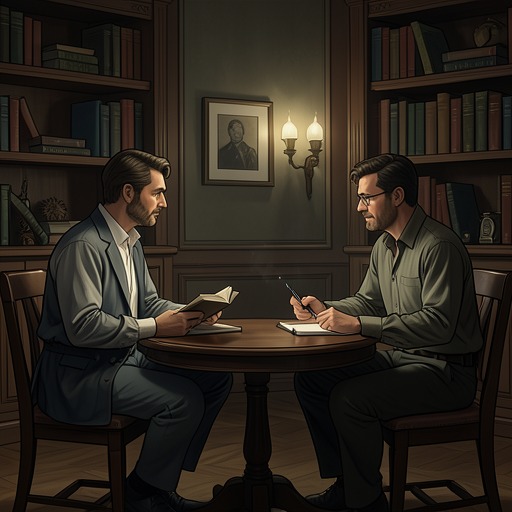
John has learned that this is the first time in months the same guests have sat down in the restaurant two nights running. Before dessert, he taps his glass with a fork and describes the gathering as a rare opportunity to discover what the travelers share despite their different origins and temperaments. He calls this common ground a “least common multiple” and presents the company, by name, as something like a cross-section of humanity beneath a vast starry sky. The title he gives the evening, “Tropical Summit,” makes a dinner among strangers sound like a deliberative gathering, while the tropical setting and the guests’ long journeys from Europe, America, and Australia give the occasion its international frame.
From Introductions to a Cosmic Debate
John’s opening proposal is that the group leave politics and current scandals aside and focus instead on the Universe. He regards even an informal evening as needing a moderator, and invites the guests to consider how their ordinary identities—as professionals, travelers, or people marked by private losses—fit beneath an enigmatic sky of stars and galaxies. The room does not respond uniformly. Ana and José follow his lead with interest; Laura, who had earlier dismissed John as a clown, appears to join in; Mark and Mario are less willing participants, Evelyn says astronomy is not for her, and Bill seems more interested in ordering a drink. John nonetheless turns the dinner into an organized exchange.
He begins with a question about whether life exists on other planets. Evelyn abstains, and the remaining guests divide into two equal groups. John declares that four answers are correct and four wrong, an intentionally provocative claim that puts the guests’ judgments, rather than a settled scientific result, on display. When Bill’s champagne arrives, the gathering shifts into a round of short presentations on each person’s view of life. José argues for a human-centered reading of the cosmos: the Universe’s scale and physical character, he suggests, were necessary for stars, planets, and eventually human beings to arise. His account includes the role of Jupiter’s gravity in shielding Earth from impacts, making the planet’s apparent hostility part of the conditions that allowed life to develop.
John’s own contribution draws a boundary around what science can explain. Evolution, relativity, quantum physics, and the Big Bang are powerful accounts, he says, but resolving the human genome would not by itself explain what consciousness is or why it exists. Nor, in his view, can scientific observation step outside the Universe it studies. He compares the world to a dream: science can investigate what the dream consists of and measure distances within it, but cannot see it from outside. The image frames the summit’s central disagreement—not simply whether scientific knowledge is valuable, but whether it can reach the question of meaning that has prompted the discussion.
Evolution, Purpose, and Retrospective Meaning
The debate becomes more pointed when José asks Frank, a biologist, whether life’s development can be explained only by the unpredictability of random mutations, or whether natural science may have overlooked a mechanism involving intention or purpose. Frank feels the question presses on an issue he has been handling delicately all day and initially gives the conventional textbook response. As the discussion continues, however, José’s humorous questions make Frank more conscious of uncertainties he had not previously questioned.
José’s claim is that human consciousness is not merely one arbitrary trait among many in the struggle for existence, but may be the direction toward which the process of life has been tending. He compares the recurring emergence of eyes and vision, flight, and upright walking to a larger tendency in nature toward intellectual comprehension. Frank accepts that similar capacities have appeared independently: he cites the repeated evolution of eyes, the much earlier development of flight in insects than in reptiles, and the separate histories of pterosaurs and birds. Pterosaurs, he explains, flew without feathers and disappeared with the dinosaurs; the ancient Archaeopteryx, by contrast, was a small feathered dinosaur. José’s question about wings and feathers exposes the gap between describing a succession of mutations and explaining how an incomplete structure could be advantageous before it became useful. Frank answers with natural selection: small advantages can help an individual’s genes persist through many generations.
John extends the discussion beyond biological mechanisms into the interpretation of evolutionary history. Three hundred million years ago, he argues, it would have been premature to call life absurd or purposeless simply because its purpose had not yet had time to flower. He describes the present as a position at the vanguard, not the destination: only a future reached in hundreds, thousands, or millions of years might disclose where the process was going. From this perspective, what happens later can function as a cause of what happens now—not as a conventional cause acting backward, but as a future that gives earlier events a meaning they could not yet display. Frank explicitly objects that causes point backward in time and cannot belong to the future. John answers by suggesting that the difficulty may lie in the perspective itself: without the later evolution of life, no observer would have been present to pronounce its earlier history meaningless.
The disagreement therefore remains more than a contest between a religious account and a scientific one. Frank’s explanations describe mechanisms and resist treating an outcome as a prior intention; John asks whether the completed or continuing history of life can retrospectively make its earlier stages intelligible. The summit gives neither position a simple victory. Instead, its repeated movement between natural history and cosmic purpose makes the limits of their disagreement visible: evidence about how capacities evolve does not by itself settle whether the history as a whole has meaning.
Ana’s Declaration and the Breaking of the Meeting
After John argues that human intuition may be needed to approach the Universe’s riddles, he asks Ana to respond. She looks into the tropical night, straightens, and speaks with authority: there is a reality beyond this one; when she dies, she will not truly be dead; those present will believe she has died, but she will soon meet them again somewhere else. Her words change the character of the gathering. The game ends, the conversation turns ominous, and Frank notices that José has shed a tear.
Ana insists that this world is not all there is and describes those present as temporary spirits passing through it. José quietly tells her in Spanish that she need say no more. John repeats her phrase about passing spirits, touches Ana’s forehead with one finger, and declares, “And the name of that spirit is Maya!” The gesture gives his intervention an intimacy that José plainly dislikes. José puts a protective arm around Ana, objects to John’s comment, and raises Ana from her chair, thanking John and telling him that it is enough. John bites his lip, as if aware that he has acted imprudently, but adds that Ana is a masterpiece. The encounter leaves its meaning unresolved: John treats Ana’s statement as part of a pattern he recognizes, while José’s response signals that the naming and the touch have crossed a personal boundary.
The resulting silence is interrupted by Bill, who jokes about the billions of people who want to speak despite having only eighty or ninety years in which to do so. Laura rises, takes a jug of iced water from the serving table, and pours half a liter over the back of Bill’s neck. Bill remains motionless for at least two seconds, then springs up, grabs Laura’s left arm, and slaps her. Frank’s sympathy for Bill ends at the blow. Although he describes it as a light, open-handed slap rather than a hard one, he observes that the whole group is now against Bill; even the two empty bottles of Veuve Clicquot do not rescue him. Laura returns calmly to her seat beside Frank without speaking. The episode is distinct from the debate over Ana, but it reinforces the summit’s larger movement: an evening convened as talk about common human questions repeatedly exposes the force of personal boundaries, loss, and anger beneath the performance of sociability.
Significance
The summit binds philosophical argument to lives already shaped by bereavement. Frank and John disclose the deaths of their respective daughters and wives before the group begins discussing consciousness, purpose, and the possibility of realities beyond the observable world. Ana’s announcement then makes the abstract question of death immediate, while José’s tear and protective gesture show that her claim is not merely a proposition for him to debate. The meeting’s shift from discussion to unease, and then to Laura and Bill’s physical confrontation, prevents the gathering from settling into a clean intellectual exercise.
Its most consequential tension lies between explanation and interpretation. Frank can describe natural selection and the independent development of biological capacities; John and José ask whether such developments can be read as signs of direction or purpose. John’s idea of retrospective meaning refuses the assumption that present uncertainty proves the whole process meaningless, while Frank’s objection preserves the distinction between a later outcome and an earlier cause. Ana’s declaration pushes the same uncertainty past evolutionary history and toward death itself. By ending not with agreement but with a named spirit, a protective embrace, a broken silence, and a slap, the Tropical Summit makes its competing claims felt as events rather than resolving them as theory.