Frank’s Childhood Discovery of a Dead Roe Deer
MayaFrank’s childhood discovery of a dead roe deer is the private origin of his lifelong confrontation with mortality: a small animal beneath autumn leaves makes him recognize that he, too, is a living body with only a limited time on Earth. Because he keeps the discovery to himself, the fear becomes an enduring wound; decades later, it reopens during a turbulent flight to Taveuni, forcing the paleontologist who studies dead animals to face his own eventual place among them.
The encounter in the forest
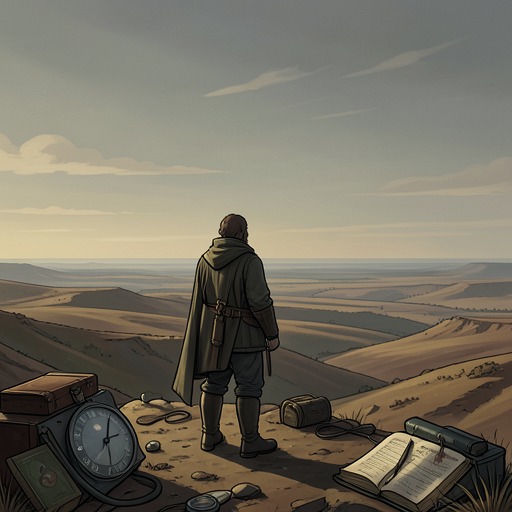
Before the age of eight, while living with his family in Vestfold, Frank ran along a forest path with hazelnuts in his pockets, eager to show them to his mother. On the damp ground, partly covered by autumn leaves, he saw a small roe deer lying still. The leaves, some yellow and some red, remained sharply fixed in his memory. He thought the animal was asleep and approached, perhaps intending to stroke it or brush the leaves away. It was dead.
The discovery mattered not simply because Frank encountered death, but because he understood himself in relation to it. He imagined that if the little deer could lie dead on the forest floor, he too might fall dead one day. The thought was obvious in retrospect, yet it arrived with the force of a revelation: he was not outside the world of animals but one of its mortal members, made of flesh and destined eventually to disappear.
Secrecy and a lasting wound
Frank did not tell his parents or grandparents what he had found. He experienced the discovery as humiliating and ignominious, something too shameful to share. In his later account, that imposed silence is what made the encounter traumatic. Had he gone home crying and told his mother, he believes he would have received the help he needed to recover from the experience. Instead, the knowledge stayed within him, almost like a physical sensation.
The memory therefore joins two kinds of vulnerability: the animal’s exposed body and the child’s inability to speak about what he has seen. Frank does not present the roe deer as a symbol detached from its own death; it is a particular dead creature lying among the leaves. Yet the sight also becomes the image through which he measures his own possible end. The deer never rises or moves in his subconscious, a persistent presence beneath the adult effort to place personal life in a larger context.
From childhood revelation to scientific identity
Frank says the encounter decisively shaped his interest in nature and influenced the direction of his studies. His attraction to immense spans of time became part of his identity: as a knowledge-hungry twelve-year-old, he already knew about the Big Bang and vast distances in space. He learned to situate himself on a planet nearly five billion years old in a universe three or four times older, widening the scale against which he could consider the brevity of an individual life.
That intellectual strategy does not erase the fear. Frank describes training himself to accept that he is a tiny part of life’s great adventure, a fleeting fragment of something larger and more powerful than himself. Enlarging his sense of identity comes at the expense of the small, vulnerable self that may meet the roe deer’s fate. The practice offers a way to reckon with mortality, but not a final escape from it: he admits that he has made no great progress and still wakes with the acute sense that only he is himself, here and now.
The wound reopens on the way to Taveuni
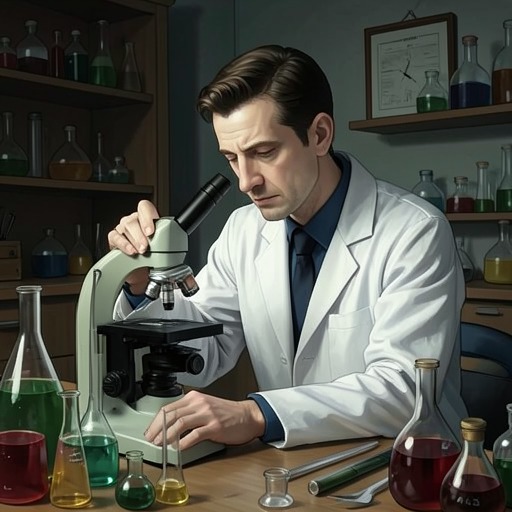
Years later, after a risky flight from Nadi to Matei, Frank’s childhood discovery returns with renewed force. He is in a state of panic and recognizes himself as a paleontologist afraid of bones, a zoologist struggling to accept that he is an animal, and an evolutionary biologist who finds it difficult to grasp that his time on Earth is limited. He has spent his life examining the remains of vertebrates with insatiable curiosity; now the thought that he too will contribute to the same matter fills him with fear.
The flight does not create this crisis so much as reopen an old injury. Frank explicitly connects the journey from Nadi to Matei with the forest encounter: the child who discovered the dead roe deer and the adult who studies animal remains confront the same fact of bodily finitude. His scientific knowledge can trace life through an unbroken chain of ancestors and cellular divisions, but that vast history does not make his own death less real. The contrast between accumulated evolutionary time and the short span of an individual life gives the childhood event its continuing force.
Bereavement and the continuing presence of the dead
Frank’s later reflections on loss echo the structure of the roe-deer memory: what has died remains present through recollection, even as the living must adjust to its absence. After rereading his letter to Vera, he is finally able to sort Sheila’s clothes for collection by the Salvation Army. He compares the task to removing a swallow’s nest that has been empty for years. Looking at Sheila’s large colour photograph no longer makes him shudder as much, and he anticipates becoming accustomed to life as a widower.
That accommodation is not the same as letting go. Frank says he would still take Vera’s Magic Drink without hesitation, even though he is not sure he could find someone with whom to share its other half; it is too late for Sheila, whose last year of life brought little beyond chemotherapy. In another reflection, he continues to converse inwardly with Sheila, misses her body and their shared routines, and especially misses her asking him to shuffle the cards for her solitaire. Qualities that once irritated him, including her long solitaire games and occasional cheating, become things he misses after her death.
The distinction between the child’s shameful silence and the adult’s remembered conversations is significant. Frank once believed the dead deer’s discovery could not be told to anyone; later, he gives words to mortality and grief, even while acknowledging that his effort to accept finitude remains incomplete. The roe deer stands at the beginning of this lifelong reckoning, not as a lesson that resolves death, but as the first body through which Frank understood that his own life, too, would end.