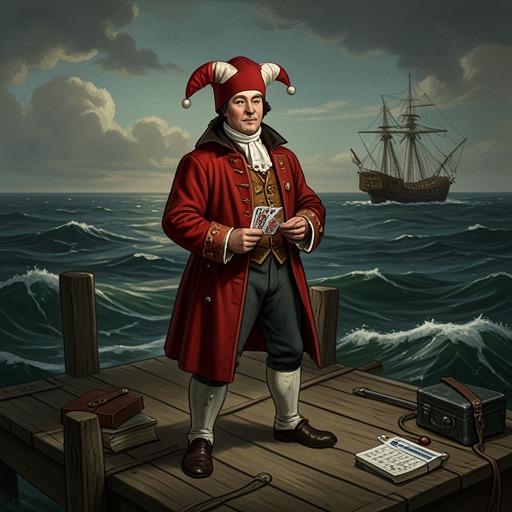
Manuel el Solitario Meets Comodín and Is Fatally Injured
MayaManuel el Solitario Meets Comodín and Is Fatally Injured is an embedded family legend set in Triana in 1894 and recounted by José to Frank. It links Manuel, a respected flamenco singer and card player, to the mysterious Comodín through a meeting beside the Guadalquivir, then gives the legend a brutal, partially corroborated ending: Manuel is beaten after telling the story and dies from his injuries days later.
Setting and Retrospective Account
José places the episode in June 1894, 52 years after the encounter between El Planeta and the enigmatic dwarf in Marseille. That interval makes the story part of a recurring chronology, though its supernatural implications remain within family tradition rather than established fact. Frank recognizes the interval as 104 years from the time of their conversation, underscoring how José’s historical tale reaches back through generations.
Manuel was Ana’s great-grandfather and lived in Triana, then known as the Gypsy quarter of Seville. José describes him as a respected cantaor during flamenco’s so-called golden age, when the cafés cantantes were appearing in Seville. Manuel performed at Silverio Franconetti’s café and walked beside the Guadalquivir each night after singing. The setting is precise: José locates the reported encounter between the Triana and San Telmo bridges, only a few metres from the Church of Santa Ana, and offers to show Frank the place. The remembered riverbank thus gives a local, walkable geography to a story whose central figure may belong to legend.
The account is not presented as a settled historical record. José says that he has heard several versions from Ana’s cousins, and that he has never heard the same version told twice. He promises to combine them and retain only points on which they agree. The episode consequently arrives as a layered oral narrative: José selects among family tellings, while Frank’s questions prompt him to fill in or clarify its sequence.
Manuel and the River Encounter
Manuel’s family reputation combines artistic accomplishment with solitude and card-playing. He was nicknamed El Solitario, a name José associates with several possible qualities: eccentricity, social marginality, thoughtfulness, or simply a solitary nature. Songs attributed to Manuel dealt with human loneliness. He was also said to be a skilled card player who liked to play solitaire, and José presents him as a versatile artist and an expert card reader. These details make the cards more than a device in the later violence: they already belong to Manuel’s public image and private habits.
One summer night in 1894, after singing at Silverio Franconetti’s café, Manuel walked along the Guadalquivir as he did every night. Tradition says he saw a strange figure moving in the darkness between the two bridges. The figure was a dwarf. Manuel recognized the significance of the encounter because he knew the old story of El Planeta’s meeting with a dwarf in Marseille; the repeated appearance seemed to connect his own night walk with the earlier legend.
The dwarf, José says, was not an aged version of the figure from the Marseille story. He wore ordinary clothing of the period and greeted Manuel with his index finger, the same gesture attributed to the dwarf in the copper engraving of El Planeta by Francisco Lameyer. He spoke Spanish with an Andalusian accent, but his manner of speaking suggested that he had been born neither in Seville nor elsewhere in Andalusia, nor even on the Iberian Peninsula. He and Manuel then began an animated conversation. The repeated gesture and the stranger’s conspicuously nonlocal voice serve as the story’s identifying clues, even as the account remains hearsay passed down through the family.
The Legend’s Uncertain Versions
José distinguishes the encounter from a straightforward conversation: the dwarf spoke about his origins. But he cautions Frank against expecting a single authoritative version. The story had circulated among Ana’s first and second cousins, and the family accounts differed. José’s combined retelling is explicitly a selection of common elements, not a claim to recover every detail or resolve every contradiction.
That qualification matters to the episode’s construction. Its chronology is unusually exact—the encounter comes 52 years after the Marseille episode—while its contents are unstable, carried by versions that change with each teller. Manuel’s own reported recognition of the earlier legend gives the two meetings a connection inside the story, but it does not independently establish the dwarf’s identity or nature. José’s narration preserves the family’s conviction that the events belong together while exposing the oral process through which that conviction has been transmitted.
The Card Game and Manuel’s Death
A couple of years after the river encounter, Manuel was playing cards with friends and winning repeatedly. He liked to present himself as a kind of magician, able to win without effort through special powers. That night he told the assembled players the stories of the dwarf on the island that sank into the sea, the dwarf’s meeting with El Planeta, and his own encounter beside the Guadalquivir. He also spoke about the dwarf’s origins. José identifies that last part of the tale as the point that set off the fatal quarrel in Triana.
The immediate violence followed a loss at the card table. One player had been losing all night and was very drunk on manzanilla. After Manuel said he had learned some tricks from the dwarf encountered by El Planeta in Marseille, the losing player attacked him with his fists. Manuel died several days later from his injuries. He left a wife and two young children, a boy and a girl. Some accounts hold that he acquired the nickname El Solitario only after telling the sailor-and-magical-deck story, adding another point at which family memory offers more than one explanation.
José separates what can be corroborated from what remains legend: police confirmed that a man named Manuel was beaten to death in Triana around that time. For him, this makes at least the quarrel historical; it does not verify the supernatural story that preceded it. The contrast is central to the episode’s effect. A remembered meeting with a mysterious figure and a tale of magical cards lead into a death for which José can point to a historical trace, but the record confirms the violence rather than the legend’s explanation of it.
Narrative Significance
Manuel’s episode binds successive tellings to a repeating 52-year pattern: the Marseille encounter associated with El Planeta precedes Manuel’s meeting in Triana by exactly that interval. The cycle gives the family story a structure of recurrence, but its transmission is anything but fixed. The dwarf’s gesture and the places and dates recur, while the versions of what he said remain unsettled. The legend’s form therefore holds repetition and variation together rather than supplying a definitive solution.
The cards also connect Manuel’s character to the circumstances of his death. A man known for solitaire, card-reading, and his ability to win becomes the target of a drunken opponent after recounting a story about card-playing and tricks. His boast that he learned those tricks from the dwarf carries an inherited legend into an ordinary gathering of players, where the response is not wonder but a beating. The tale moves from the mysterious to the bodily and irreversible: Manuel’s family may preserve the legend, but its historical hinge is his death and the wife and children left behind.
José’s telling makes this episode one strand in the larger Comodín tradition rather than a self-contained supernatural proof. It contributes a local encounter, a family connection to Ana, a recurring interval, and a killing that the police record partly confirms. Its conclusion leaves two kinds of knowledge side by side: the uncertain inheritance of stories and the documented fact of a man’s fatal injuries.