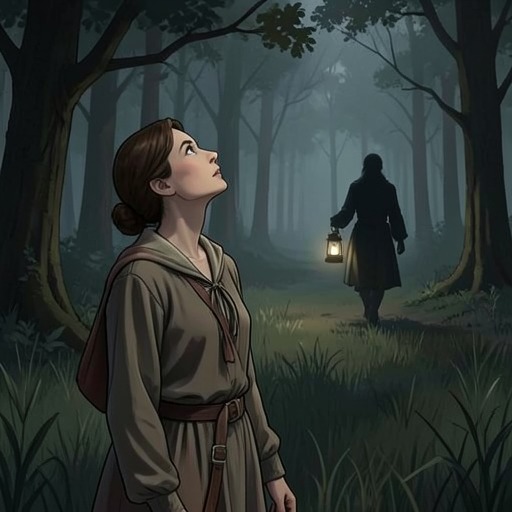
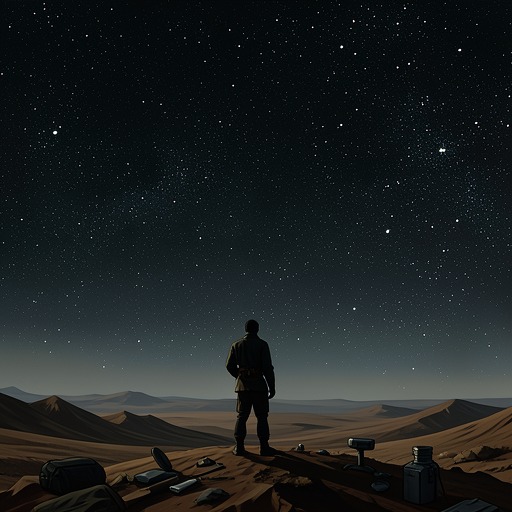
El ojo que mira el Universo es el ojo del propio Universo
Maya“El ojo que mira el Universo es el ojo del propio Universo” is the manifesto’s most concentrated image of cosmic self-awareness: the eye joins seeing to understanding, and the created world to the consciousness that reflects on it. The expression recurs across a personal exchange and a larger debate about evolution, making it both a memorable line and a hinge between poetic language and a contested philosophical claim.
Form and Image
The expression appears in the manifesto as part of an image of the eye as a revolving door. In the globe of the eye, vision meets perception, while creation meets reflection; the eye becomes the point where the creative spirit encounters itself in what it has created. The final sentence compresses that sequence into a reciprocal relation: the observer is not outside the Universe but belongs to it, so the act of looking becomes the Universe’s own act of self-recognition.
That image makes the eye more than a metaphor for sight. The surrounding manifesto connects it to the long emergence of increasingly specialized sensory capacities, while also giving it an intellectual dimension: perception can gather the world into a whole and turn back upon its source. The expression therefore brings a biological history of seeing into contact with a claim about consciousness and cosmic meaning.
The Manifesto and Its Shared Meaning
When Vera reads passages from the manifesto to Frank, she singles out the eye image after first reading a densely evolutionary passage about the inheritance of life. That passage traces a succession from the microscopic puzzles of matter through ancient fish and amphibians, egg-laying reptiles, prosimians, and ancestral apes, and asks whether some remote form of self-perception or awareness of a general plan had stirred within them. The eye passage shifts that question into a compact visual emblem: the history of life culminates, provisionally, in a creature able to look back at the Universe that produced it.
Vera says she had forgotten that particular passage. Frank describes the manifesto as something intended for both of them, but then insists that he does not believe its ideas. His reservation matters: the expression is shared between them as a piece of writing, yet agreement about its scientific or philosophical truth is not assumed. The manifesto’s lyric force and its status as a theory remain distinct.
Consciousness as a Property of the Universe
In the later conversation, the image becomes an argument about the relation between matter and consciousness. Frank asks Vera to acknowledge that she has consciousness of the Universe as well as of herself. From there, he argues that consciousness is so essential to the Universe’s nature that it cannot be treated simply as an accidental by-product. He places the debate at the point where matter and awareness meet, rather than treating the existence of an observer as an irrelevant afterthought.
Vera objects that matter came first and that it is primary in relation to their conversation. Frank grants that it may be so, but maintains that cosmic matter carried consciousness within it. He insists that consciousness is no less universal an aspect of reality than nuclear reactions in stars, and ends the exchange by comparing the temporal priority of blood to love: prior material conditions do not, in his view, exhaust the significance of what later emerges from them. The eye expression gives this position its clearest image without resolving the disagreement over whether it amounts to science or philosophy.
Evolution, Purpose, and Retrospective Meaning
The expression belongs to a broader dispute over whether evolution is merely the outcome of chance mutations and natural selection or whether the history of life can also be understood in terms of purpose. José presses the question by asking whether the emergence of human consciousness can be dismissed as one arbitrary quality among many, or whether an increasingly comprehensive intellectual vision is the direction toward which life tends. The narrator, a biologist, offers the conventional account of inherited advantage, while recognizing how difficult it is to settle the larger question by mechanism alone.
The debate widens from biological evolution to cosmic history. John Spooke argues that what happens in the future can, in a retrospective sense, become the cause of what happens in the present: later consciousness may give earlier stages of existence a meaning they could not possess at the time. The narrator objects that causes ordinarily point backward, not forward. John’s proposal does not simply overturn that scientific distinction; it challenges the assumption that causal explanation exhausts the question of meaning.
The same tension appears in the discussion of the Big Bang. John suggests that the Universe’s beginning can be understood retrospectively through the existence of observers who look back upon it, while Laura challenges the human-centeredness of that formulation by asking why humans should matter more than a toad or a panda. José likewise argues that the Universe’s scale and physical conditions made complex life possible, pointing to the human brain’s material origins in stars and to Jupiter’s gravitational role in deflecting threats to Earth. These arguments make observation a central feature of the debate, but they do not establish that the Universe was designed for human beings. The expression’s force lies in that unresolved passage from the fact that observers exist to the larger claim that the cosmos has a purpose.
Reversal of the Observer’s Position
The expression reverses the ordinary picture of a human observer facing an external world. Its observer remains a living product of cosmic history, not a spectator placed beyond it; when the observer sees the Universe, the Universe sees itself through one of its own forms. The reversal also guards against treating consciousness as an isolated possession. The eye is at once an organ in an evolved body and an image for a world that has become capable of reflection.
The manifesto’s concise formulation can therefore be read as the imaginative counterpart to the book’s sustained debate. It does not prove that evolution was directed toward consciousness, nor settle the narrator’s scientific objections to purpose. Instead, it holds two ideas together: the observer is contingent, emerging after an immense history, and yet observation gives that history a retrospective perspective from within. In that double role—as a line of poetry and a proposition that remains open to argument—the expression gives the book’s cosmic questions their most memorable form.