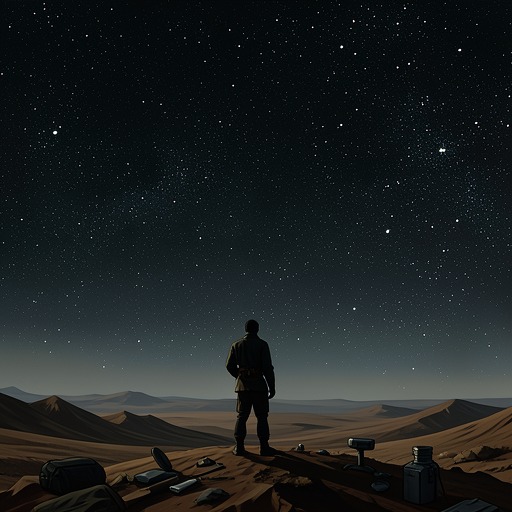
El ser humano es tal vez el único ser vivo en todo el Universo que tiene una conciencia universal
MayaThe expression “El ser humano es tal vez el único ser vivo en todo el Universo que tiene una conciencia universal” is both a claim about human consciousness and a warning about the responsibility that follows from it. It gathers the book’s debate over evolution’s purpose into a final inscription: if living beings can understand the universe, then preserving the conditions for life is not merely a human concern but a cosmic obligation.
From chance to purpose
The expression emerges against a scientific account of evolution that the narrator has long treated as settled. In conversation with José, he is asked whether life on Earth has been propelled solely by unpredictable mutations or whether natural science might have overlooked mechanisms involving intention and purpose. The narrator answers from the standpoint of biology, but José presses him to consider consciousness not as an arbitrary trait in the struggle for existence but as the aim toward which the evolutionary process has been moving.
José supports this interpretation by pointing to repeated developments across the history of life: eyes and vision have evolved independently more than once, as have flight and upright walking. He proposes that nature has also tended toward an intellectual, comprehensive vision—a capacity for understanding that would make consciousness more than one accidental quality among many. The narrator acknowledges the recurrence of eyes and flight but explains these developments through mutation and natural selection: a small advantage increases an individual’s chances of passing on its genes. Their disagreement turns on the difference between a biological mechanism and a larger claim about what the process means.
A future that gives the past meaning
John Spooke enlarges the debate from evolutionary history to cosmic time. He argues that it would have been premature to call life absurd or purposeless hundreds of millions of years ago, because its possible purpose had not yet had time to unfold. Humanity may belong to the vanguard without having reached any final destination; only observers far in the future might know where the process was going. On this account, what happens later can become, retrospectively, the cause or meaning of what happens now.
The narrator objects that causes point backward in time and cannot belong to the future. John suggests that the error may lie in that assumption: if life had not developed beyond its earliest stages, there would have been no one to declare the process meaningless. Likewise, if life had never arisen on Earth, who could have judged the planet to have no purpose beyond existing? The thought experiment does not establish that the universe was made for human beings; it exposes how judgments about purpose depend on the presence of a being capable of making them.
The observer and the universe
At a later discussion, José makes the observer question explicitly cosmic. The universe, he argues, could not have been much smaller or fundamentally different if it was to produce a human being. The human brain, composed of atoms forged in long-dead stars, is among the universe’s most complex formations; without stars and planets there could have been no microorganisms, and ultimately no consciousness capable of considering the cosmos.
José also invokes Jupiter’s enormous gravity as a practical condition of terrestrial life. By drawing in or deflecting some of the meteors and asteroids that might otherwise bombard Earth, the planet acts as a shield for the development of a biosphere. He likens Earth to a chief, the incoming meteors to mosquitoes, and Jupiter to the attendant who keeps them away, while noting that Jupiter itself has suffered impacts capable, in his account, of destroying nearly all life on Earth. From this chain of conditions he concludes that Earth is a living planet and wonders whether the universe’s mass is just sufficient to produce a consciousness able to formulate such theories. The applause for the Big Bang, he says, arrived only fifteen billion years after the explosion.
Laura challenges the human-centered implication of this reasoning: why should humanity be singled out rather than a toad or a panda? John’s answer is not that human life is the only life of value. He argues instead that a universe without life would have been empty and absurd only from the standpoint of a possible observer—and emptiness would be less capable of sensing absurdity than animals such as toads and salamanders. The expression’s claim to universal consciousness thus remains tentative: it identifies a distinctive human capacity without proving that the cosmos exists for humanity.
The photograph and its ethical consequence
The expression returns at the close as writing on the back of a photograph given to the narrator by the garden dwarf at the Alcázar. The image shows the narrator sitting in the square before the Puerta de Marchena. Studying it, he sees a grieving primate, with no consolation in the face looking back at him, and recognizes that the novel he has been writing is not essentially about Frank and Vera or Ana and José; it is about Sheila, her solitaire letters, and himself.
When he turns the photograph over, the inscription links universal consciousness to the duty to conserve the planet’s habitats. That duty is described as cosmic, not merely global, because the darkness may one day cover everything again and the spirit of God may no longer hover over the waters. The statement therefore changes register: what had been a speculative argument about evolution and the universe becomes an ethical charge addressed to the living. Consciousness is not presented as proof of human supremacy but as a capacity that entails responsibility, especially in the face of extinction and the possibility that there may eventually be no observer left to remember what existed.