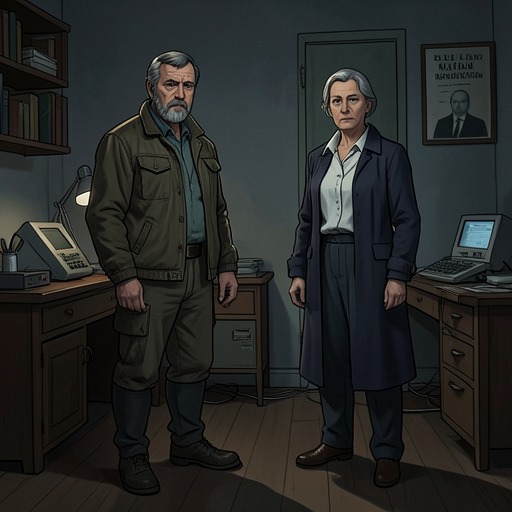
Optaste por partir el dolor en dos
Maya“Optaste por partir el dolor en dos” is the phrase Frank uses to understand Vera’s departure after their daughter Sonia’s death. It reframes their separation not as a failure of forgiveness but as an effort to make a grief too large for one household bearable by dividing it between them.
The phrase and its context
The phrase appears as a heading and returns within Frank’s account of what happened after Sonia died. He insists that he and Vera had fully reconciled; she did not pack and leave because she believed he had not forgiven her. Instead, he says, she fled the pain in their home, a pain she shared but could not escape within herself. The image of splitting the pain in two gives their separation a double meaning: it is both an act of rupture and a response to suffering they could not endure together.
Guilt, grief, and forgiveness
Frank connects their estrangement to the circumstances surrounding Sonia’s fatal accident. Vera had forgotten to apply the handbrake in a moment of distraction after a departmental celebration, and the police did not charge her, saying she had already suffered enough. Frank recognizes that he himself made her guilt worse by deliberately pouring salt into her wound. He later told her that the accident might just as easily have happened to him, and that anyone could make such a mistake. His recollection therefore complicates the idea of forgiveness: reconciliation was possible, but it did not immediately dissolve grief or erase the blame Frank had intentionally intensified.
Separation as an attempt to survive
Frank describes a home crowded with pain, where neither spouse could easily distinguish the other’s sorrow from old reproaches. He admits that he did not know what to do during those weeks, and imagines that he, too, might have left if he had had family in another country. His journey to Oceania came at a moment when the household’s grief had become too concentrated beneath one roof. In this account, Vera’s departure is not presented as indifference or simple rejection; it is a way of living apart from a shared wound that neither could yet bear in the other’s presence.
Retrospective meaning
The phrase also belongs to Frank’s later effort to reinterpret the past. On an old bridge, as the two look at the river and remember Sonia, he considers asking Vera whether they might begin again by a different path, rather than return to the one that led to their separation. He then questions whether events must point only forward: perhaps something undertaken in the present could give new meaning to what happened before, including Sonia’s death. The phrase thus holds together the original division and the possibility of a changed understanding. It does not undo the loss or settle their future, but gives their separation a compassionate explanation rooted in the grief they both carried.