Obligaciones naturales
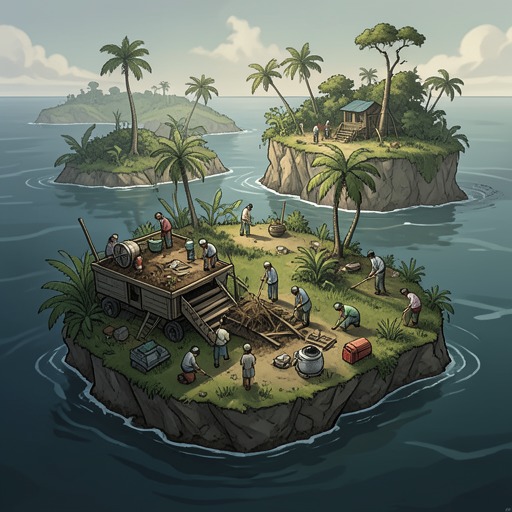
MayaObligaciones naturales names the responsibility humans owe to the natural world, a duty the book sets against the long-established language of natural rights. Its force comes from a pointed reversal: people have spent more than two thousand years debating what they are entitled to claim, while the damage described in Oceania exposes how little attention they have paid to what they are obliged to preserve. The idea links island ecology, local choices about land, environmental accountability, and a larger argument over whether human consciousness has a purpose in the history of life.
From natural rights to natural obligations
The narrator introduces the principle while reflecting on the paradox of Fiji’s ecological history. Some islands retained relatively intact ecological balance because Europeans had been too afraid of cannibalism to land there. He treats the comparison with care: he accepts that cannibalism violates what are called natural rights, yet argues that Western ecological recklessness also violates human obligations. The contrast does not excuse cannibalism; it exposes the narrowness of a moral vocabulary that recognizes protections owed to people but leaves duties toward the living world largely unspoken.
The question turns the historical reflection into a challenge about the present. The concept of natural rights, the narrator observes, has a history of more than two thousand years; he asks when people will be prepared to take up the corresponding concept of natural obligations. The question is not answered by a new legal doctrine. Instead, the book tests the principle against concrete ecological choices: whether people introduce species to solve problems created by earlier introductions, allow commercial extraction to erase habitats, or accept responsibility for the consequences of economic activity.
Island ecology and accumulating consequences
The narrator’s research on Taveuni forms one factual foundation for the argument. His assignment concerns the ecological effects of imported plants and animals, among them rats and mice that arrive as shipboard stowaways; deliberately introduced species such as opossums and mongooses; and escaped domestic animals, including cats, goats, and pigs. Some animals are introduced to control pests associated with new agriculture. The ecological consequences therefore emerge not from one isolated decision, but from repeated attempts to manage one disruption by adding another species.
The book describes this as a chain of consequences. Rats, mice, and insects arrive with ships; to limit their effects, people import species such as toads for plantations or cats to hunt rats. Those newcomers may become worse pests, prompting the arrival of still larger predators. In turn, predators threaten birds and native reptiles, creating pressure to introduce further control species. Later reliance on poisons, viruses, and infertility methods represents another attempt at intervention, now framed as chemical and biological warfare. The narrator stresses the mismatch between the speed of human decisions and the time needed to establish a new food chain: ecological systems built over millions of years can be damaged with frightening ease, while a replacement balance cannot be assembled in an instant.
Taveuni also demonstrates that the results vary with local conditions. The island’s more than one hundred bird species include the native orange-breasted pigeon; the Indian mongoose, a major threat elsewhere in the discussion, was never brought to Taveuni. Magpies and toads were introduced to control insects in coconut plantations, displacing some native frogs toward the forest interior, yet the island’s birdlife remained remarkably rich. The example makes the obligation specific: stewardship means attending to the effects of particular introductions on particular habitats, rather than treating nature as a problem that can be corrected by a succession of convenient imports.
The ecological stakes extend beyond species introductions. The book connects deforestation and imprudent plantation exploitation with erosion and the destruction of traditional habitats. Across Oceania, the proportion of animal species at risk of extinction is described as exceptionally high in relation to the region’s area and population. The narrator also criticizes a commercial order in which food becomes a commodity and land is increasingly used to grow products that people in poorer places cannot access. His account thus places ecological damage alongside unequal economic consequences: local habitats and ways of living bear costs generated by decisions made within a wider system of profit and trade.
Local stewardship and public accountability
Against the pattern of extraction, the village of Bouma offers an example of collective refusal. Its inhabitants understood the tropical forest as a gift of their place, and debated an offer of substantial foreign currency for land to be logged. Although money was scarce in Bouma and Fiji more broadly, the community rejected logging and chose instead to develop the forest as a national park. The choice joined conservation to livelihood: the protected landscape could bring continuing income through ecotourism, rather than a one-time payment for felling trees.
The resulting park covered five thousand hectares and was prepared to receive ecotourists. Village residents maintained the trails, including railings on steep sections, and provided facilities such as toilets, picnic areas, and campsites. The narrator paid five Fijian dollars to enter and received advice about the seven kilometres of prepared trails. Several similar projects were being planned elsewhere on the island. The example gives natural obligations a practical form: the community’s decision protects habitat while keeping local people involved in the work and potential benefits of conservation.
The book also connects responsibility to the production and public use of evidence. Laura explains that environmental advocates have so far held the evidence, and says the aim of her interviews and documentation is transparency. She imagines a possible future proceeding in which those responsible must answer for their actions, even joking that Mario might serve as defence counsel for the toads. Her method is to record statements so that people who minimize pollution’s harm may later be confronted with what they said. The narrator supports the idea of a place where such records could be displayed to expose environmental destruction to public shame. Natural obligations are therefore not only a private ethic: the text associates them with documenting damage, naming responsibility, and creating means of accountability.
Consciousness, evolution, and cosmic responsibility
The discussion of ecological duty develops alongside a debate about purpose in evolution. José argues that life on Earth is not merely a real process but a meaningful one, and that human consciousness may be the process’s end rather than an arbitrary trait selected in the struggle for existence. He compares the repeated development of eyes and vision, flight, and upright walking with a possible movement toward intellectual understanding. The narrator, a biologist, acknowledges that such capacities have arisen more than once but resists treating that recurrence as proof of an intended destination.
His scientific explanation emphasizes mutation and natural selection: an individual with a small advantage in the struggle for existence has a greater chance of passing on its genes. The disagreement is not simply between science and a demonstrated alternative mechanism. It concerns what can be inferred from the history of life. José’s questions press on whether adaptation alone explains the emergence of consciousness and whether the repeated appearance of sensory or locomotor capacities supports a larger account of direction. The book leaves that dispute open, showing how the narrator’s professional confidence is unsettled by questions about assumptions he had rarely examined.
John offers a retrospective account of purpose. A stage of life that appeared absurd three hundred million years ago, he suggests, might only have lacked the time for its purpose to flower. Present humanity could be at the vanguard without having reached a destination; only a future much later—perhaps a hundred, a thousand, or a billion years away—might disclose where the process was going. In that sense, what happens in the future can become, retrospectively, a cause of how present events are understood. The narrator objects that causes ordinarily point backward in time, not forward. John’s proposal therefore remains a reversal of perspective, not an established biological law.
That speculative debate leads to the book’s sharpest statement of natural obligation. The narrator argues that humans may be the only living beings in the universe with universal consciousness. If so, preserving the planet’s habitats is not only a global responsibility but a cosmic one. The claim does not depend on resolving whether evolution has a predetermined goal: it makes humanity’s awareness itself the basis of responsibility. The warning that darkness could one day cover everything gives conservation an existential scale, while the ecological examples keep that scale grounded in forests, habitats, species, and choices made in the present.
Meaning and limits of the principle
Across these episodes, Obligaciones naturales joins ethical language to ecological causation. Its contrast between rights and duties asks readers to widen the community of concern beyond immediate human claims; its account of introduced species shows why good intentions do not cancel harmful consequences; and the Bouma forest demonstrates that rejecting extraction can support both habitat protection and local livelihoods. Environmental responsibility also requires public evidence, since damage that can be minimized or obscured is difficult to hold anyone accountable for.
The book does not present every environmental choice as simple, nor does the evolutionary debate settle the metaphysical question of purpose. Instead, it draws a practical obligation from the precariousness of the systems on which life depends and a wider one from the human capacity to recognize that precariousness. Whether consciousness is the intended destination of evolution remains contested; that human beings can understand ecological damage and act upon it is enough to make their responsibility consequential.