Frank and Vera’s grief over their daughter’s death
MayaFrank and Vera’s grief over their daughter’s death is both the wound that divides them and the surviving connection that brings them back into conversation. Sonia’s absence shapes their separation, their reunion in Salamanca, and their reflections on whether the past can be given a different meaning—not by undoing the loss, but by making room for their daughter in shared memory.
The loss and its aftermath
Frank tells John Spooke at the tropical summit that he and Vera lost their daughter in a traffic accident. By the time they meet again at a scientific congress in Salamanca, eight months have passed since Sonia’s death and six months since Vera packed her things and returned to Barcelona. Their reunion takes place against the fact that they had once been married, had separated in the wake of the loss, and still carry a grief neither can leave behind.
The circumstances of the accident had become a subject they could barely name. Frank recalls that Vera had to give statements to the police two or three times, after which the events turned into a taboo, referred to only as “that” or “what happened.” In Salamanca, both are afraid that returning to those scenes will reopen not only the wound of Sonia’s death, but also the wounds they inflicted on each other while grieving.
Salamanca: grief made speakable
Vera asks Frank to show her the old university city before dinner. They begin at the Plaza Mayor, walk to Monterrey Palace, and talk in a small square between the palace and the Church of the Purísima. The historic buildings are present, but their attention stays on Sonia: the old city becomes the setting for a quiet conversation about a child who is no longer alive.
The past of Salamanca’s buildings helps them talk about their own past. Frank says they were able to speak at length about Sonia because they were surrounded by centuries of human history. Vera shares anecdotes about their daughter that Frank had never heard. The stories hurt him because they make him regret not having spent every possible moment with Sonia, yet they also allow him to know her better. Their conversation does not erase the loss; it gives Sonia’s memories a living place that, Frank insists, only her parents can create together.
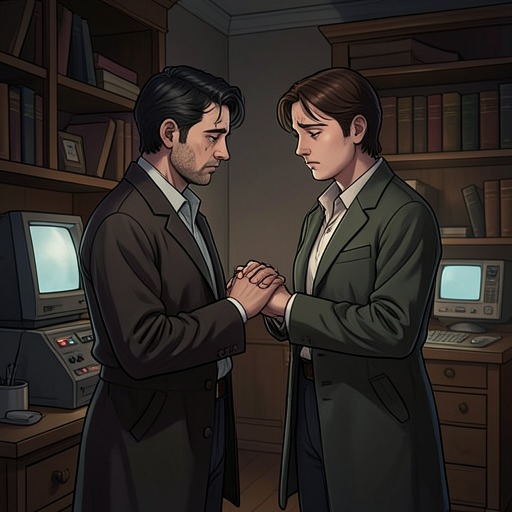
The memory of Sonia’s short life is sharply bounded by time: she did not reach four and a half. Her parents, by contrast, continue to grow older, while each will carry the child at that age for the rest of their lives. In Salamanca they can, for a while, walk not simply as two former spouses but as Sonia’s mother and father. Their shared mourning restores a relationship that separation had left difficult to inhabit, even if it does not settle what that relationship should become.
The accident and the burden of blame
On a later walk, Frank remembers how ordinary the chain of events was, and how terrible its consequence. Vera had collected Sonia from nursery and placed her in the car. She started the engine, then realized the child’s shoes had been left in the entrance lockers. She turned off the engine and took out the key, but forgot to apply the handbrake; the car was in neutral. When she went back for the shoes, the car began to move. Frank recalls Vera’s repeated sense that fate had made her watch what was happening while knowing she could do nothing. The car reached a bend three hundred metres away. Sonia died; three days later, the parents knew the outcome that would divide their lives.
The episode became entangled with police questioning and Frank’s repeated questions to Vera: why she had left Sonia in the car, why she had not applied the handbrake or put the car in gear, and why she had gone back for the shoes. Vera had also been drinking champagne at a departmental end-of-year celebration; when she got into the car, her reading was 0.52. The police did not charge her, saying she had already been punished enough. Frank recognizes that he had been less merciful than the police: in his despair, he insulted and shouted at her, and repeatedly poured salt into her wound by asking the same questions.
He tells Vera that forgiveness is no longer the issue: he had forgiven her long ago. He also acknowledges the possibility that the mistake could have been his, and that a terrible disaster can strike a small family blindly. Their reconciliation, however, did not prevent Vera from leaving. Frank understands that she fled his pain as well as her own; living under one roof meant living with too much grief, and she chose to divide it between them by going away. The separation is thus not presented as proof that they had failed to forgive, but as an attempt to survive a sorrow neither could escape.
A continuing bond, and a possible new meaning
Their later walk along the Tormes returns them to the intimate texture of Sonia’s life. Vera recounts small episodes, including Sonia coming home with a hundred-krona note she said she had found in a nursery teacher’s pocket. As Frank listens, he nearly breaks the promise they had made not to discuss getting back together. He wonders whether they might begin again, but only by taking a different path from the one that led through blame and separation.
Frank also questions whether events point only forward. Could something done in the present reach backward and change the meaning of what came before? He and Vera had treated everything after Sonia’s death as inevitable; now he wonders whether they could do something together that would give the death a new meaning. This is not a claim that the loss can be repaired. It is a question about what shared remembrance and future action might make possible.
That possibility rests on an enduring parental relation, not on a simple return to the marriage. Frank’s grief is inseparable from the recognition that Vera remains Sonia’s mother and he remains her father. Their reunion gives them a way to speak of the child without pretending she is alive, and to carry memories that belong to both of them. The story’s treatment of bereavement therefore resists a clean progression from pain to closure: Sonia remains present in the memories they exchange, while their changing relationship determines whether those memories can be held together or only alone.
Grief beyond the reunion
The novel places Frank and Vera’s shared grief alongside other forms of continuing attachment to the dead. After Sheila’s death, John continues to speak with her in his thoughts and sometimes aloud; Frank, too, is described as someone whose mind remains crowded with voices. The contrast does not make their losses equivalent, but it broadens the book’s attention from bereavement as an ending to the ways the living continue to relate to those who are gone.
Frank’s own childhood memory of finding a dead roe deer gives his response to mortality a much earlier origin. He recalls being unable to tell his parents what he had seen, and describes the discovery that he, too, was a mortal animal as something that stayed within him. He tries to place his brief life within the larger history of life and the universe, but admits that this perspective has not brought peace. Against that expansive effort, the grief for Sonia remains specifically familial: an irreducible attachment to one child, shared by two parents whose memories can preserve a living space for her even as they face the fact of her death.