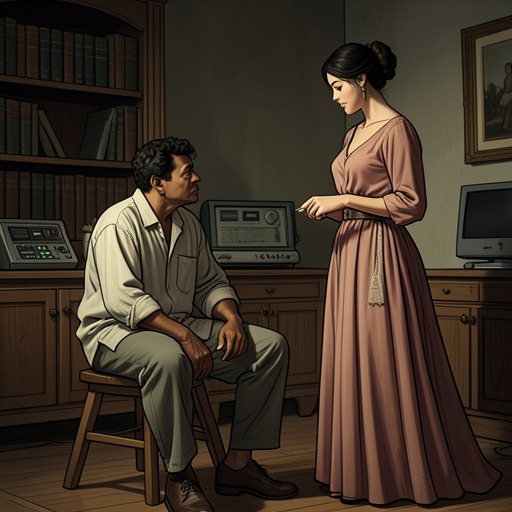
John Spooke’s mourning Sheila’s death
MayaJohn Spooke’s mourning of Sheila takes the form of an ongoing bond rather than a completed farewell. Three years after her death, he still addresses her, hears her answering in his thoughts, and feels her presence in an old photograph and familiar routines. The grief is bodily, domestic, and creative: it has left him unable to write, yet the memories and conversations through which he misses Sheila remain part of his daily life.
Identity and Background
John’s account of loss comes from long intimacy. He and Sheila had known one another for more than forty years when she died; during her last illness, he was unable to write, and in the first years after her death he could not begin a new work. He describes himself as someone who cannot readily hold two thoughts in his mind at once, making the absence of a beloved person more than sorrow: it impairs his capacity to think and create.
The epilogue places this bereavement in an aging body. John is almost thirty years older than Frank, has sciatica and angina, and experiences each further second of life as a gift. His awareness of physical decline gives his mourning a particular urgency: the loss of Sheila is accompanied by the knowledge that his own remaining time is limited.
The Photograph and the Domestic Presence
A large color photograph of Sheila hangs in a black frame above John’s desk. He took it years earlier in front of the old town hall in Croydon. Because Sheila appears to look straight into the camera, John sometimes feels that she had meant the picture to keep watch over him if she died first. Its sharpness intensifies rather than eases the distance: photographs of the dead make their absence newly visible, preserving a vivid face without restoring the person.
The image also connects John’s present grief with Frank’s story. John compares his response to Sheila’s photograph with the shock an Andalusian might have felt two centuries earlier upon encountering the portrait of the beautiful Gypsy carried by the dwarf in the Alcázar gardens. In both cases, a likeness outlives its subject and unsettles the boundary between a remembered person and a living presence.
Conversation, Memory, and Habit
John continues to have long conversations with Sheila. Sometimes he cannot tell whether he is speaking aloud or only thinking; he knows that at least occasionally he answers aloud while her replies take place in his thoughts. He does not treat this exchange as a sudden dramatic change. Conversation had always come easily between them, and their familiarity was such that he could anticipate not just her opinions but the exact words she would use.
Her presence persists in the language of everyday life. John notices Sheila’s characteristic expressions when other people use them, and he sometimes responds aloud when something she says in his mind upsets him—even though he already knows what she will say. A neighbor remarks that John talks to himself, but does not hear Sheila’s side of the conversation. John expects that his own speech may become less private as he grows older; for now, he feels no shame in continuing to talk to her, because he understands the lingering dialogue as something she left behind in him.
Cards make this continuity tangible. Sheila could spend whole afternoons playing solitaire while John worked in the attic. When he came downstairs, she sometimes made him wait until she finished a game; when she was in a playful mood, she asked him to shuffle the deck so she could play another. John associates a deck of cards with Sheila, and after her death he misses even being asked to shuffle for her. An ordinary repeated pastime becomes a surviving form of shared life.
Love Reversed by Loss
The habits John remembers were not always easy to love. Sheila’s solitaire-playing was one of the eccentricities that first made him fall passionately in love with her, but he could later resent the long hours she spent at it. He once told her that solitaire was considered a game of death, which deeply offended her; he was also irritated when he caught her cheating to make the game come out. In bereavement, the old irritations return with their charge reversed: John now misses precisely what once annoyed him.
He describes this reversal as a circle that is not vicious. Loving someone who can no longer be reached is easier, in one respect, than loving someone from whom one cannot escape; distance changes the conditions of attachment but does not erase its particulars. John misses Sheila’s body as well as her conversation and their memories. His grief does not turn her into an abstract emblem: it remains bound to her voice, her routines, her physical presence, and the small negotiations of life together.
Loss, Survival, and Narrative Role
John’s account of Sheila is set beside Frank and Vera’s bereavement after the death of their daughter, Sonia. During a walk in Salamanca, Vera tells Frank small stories about Sonia that he had never heard. Their daughter’s death is not undone, but the parents can give her memories a living place by making that place together. Frank recognizes that Vera remains Sonia’s mother and he her father; the child remains four and a half in the lives of parents who continue to age.
Their separation arose not because Frank had failed to forgive Vera after the accident, but because the shared household had become saturated with pain. Vera could not bear Frank’s grief while struggling with her own, and leaving divided the pain between them. John’s mourning offers a different image of how a relationship can persist: his private conversations with Sheila and his attachment to shared habits keep her present, while Frank and Vera’s later conversation makes remembrance something they can create together. Neither form cancels death. Both make clear that the dead continue to shape the lives, language, and choices of those who remain.