Species endangerment and extinction
MayaSpecies endangerment and extinction are presented as gradual consequences of ecological disruption rather than as isolated natural calamities. Across the islands of Oceania, imported species, deforestation, plantation exploitation, and tourism place endemic life under pressure; the threatened loss is at once biological and cultural, as habitats and the conditions for locally sustained ways of life are transformed.
Island ecosystems under pressure
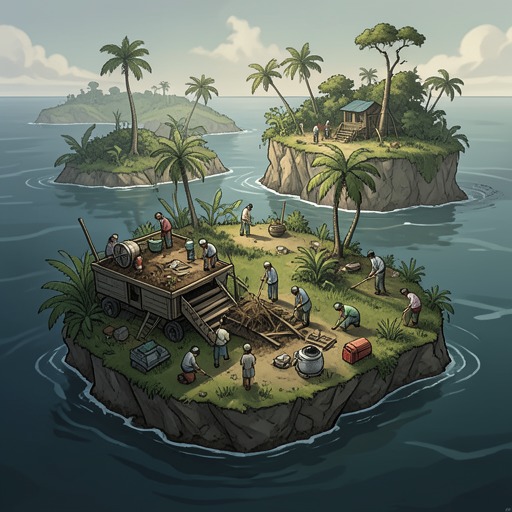
The narrator’s fieldwork on Taveuni forms part of a two-month Pacific expedition studying how imported plants and animals have altered ecological balances. Introductions range from accidental stowaways—rats, mice, insects, and lizards—to species brought deliberately for agriculture or pest control, including opossums and mongooses. Domestic animals that escape, such as cats, goats, and pigs, add further pressure, while rabbits and roe deer can become readily available prey. Plants, too, have been imported for decoration and food, though the range varies so widely from island to island that the narrator declines to list them individually.
The vulnerability of these systems is rooted in their history of relative isolation. Until fairly recently, many southern Pacific islands maintained ancient ecological balances and distinctive assemblages of endemic plants and animals. European colonization, which reached some islands only a little more than a century earlier, brought shipborne rats, mice, and insects as an early wave of ecological disruption. The damage is not attributed to introduced species alone: deforestation and the imprudent exploitation of plantations have accelerated soil erosion and ultimately ruined traditional habitats. The book’s account thus connects species decline to both biological invasion and the conversion of land for human use.
The cascade of introductions
The efforts to repair ecological damage often deepen it. Imported to suppress insects, cane toads can become a worse pest; cats introduced to combat rats create a demand for another predator, and successive introductions produce further disruption. Predators may then devastate bird populations and native reptiles, prompting calls for still larger predators. The resulting chain is difficult to reverse: a new food web cannot be assembled at once, and the narrator questions whether it can be deliberately reconstructed at all. The sequence is presented as a recurring cycle of intervention, unintended consequence, and renewed intervention, rather than as a single failed experiment.
The proposed remedies have also changed in character. Instead of relying only on one introduced species to counter another, contemporary control increasingly turns to poisons, viruses, and sterilization—in the narrator’s phrasing, chemical and biological warfare. Such measures indicate how far human management has moved from the effort to restore ecological balance toward the use of increasingly forceful tools. Against that history, the narrator emphasizes a stark asymmetry: nature’s balance has developed over many millions of years, yet human interventions can disrupt it with remarkable ease.
Taveuni as a fragile refuge
Taveuni demonstrates both the possibility of survival and the contingency on which it depends. Its more than one hundred bird species include many endemic forms, among them the orange-breasted pigeon. A consequential absence helps explain their continued abundance: the Indian mongoose was never introduced to the island. Other introductions have nevertheless altered local life. Magpies and cane toads were brought in to control insects in coconut plantations; the magpies have occupied ecological space, while the toads have displaced native frogs toward the forest interior. Even so, the island’s exceptional bird life remains largely intact. Fruit bats also persist, including a species with a wingspan reaching five feet; these flying foxes, locally called beka, are eaten as a delicacy by some of the island’s older residents.
The wider setting is similarly rich but not untouched. Taveuni has more than a thousand identified plant species, many endemic, with mangroves and coconut palms along the coast and a rainforest interior of ferns and native trees. The island’s Tagimaucia flower occurs only there and on neighboring Vanua Levu. Its marine life is described as especially abundant, from fish and echinoderms to mollusks, fungi, and corals. These details make ecological loss specific: what is at stake is not an abstract inventory of species, but interdependent habitats and a concentration of life shaped by island isolation.
Taveuni’s rugged volcanic terrain has limited both tourism and plantation exploitation, while frequent rain and black lava beaches impose additional constraints on development. Those same conditions have not prevented commercial use: European settlers began plantations in the mid-nineteenth century, first emphasizing cotton, then sugar in the south as cotton prices fell. Coconut later became the principal crop, alongside steadily growing tourism. The island’s relative ecological resilience is therefore not a story of freedom from development, but of limits that have so far slowed it.
Conservation, livelihood, and public attention
The village of Bouma provides a practical alternative to forest clearance. When villagers were offered substantial foreign currency for land to be logged, they discussed the proposal before refusing to sell the forest and choosing instead to support a national park. The protected area covers five thousand hectares, and local residents maintain trails, install railings on steeper stretches, and look after toilets, picnic sites, and campsites. Ecotourism offers income that may endure longer than a one-time payment for timber; similar projects are being planned elsewhere on the island. Protection here is tied to community decision-making and local work, not merely to the declaration of a reserve.
The narrator sets this model against a global economy that treats food as a commodity and encourages communities to grow products intended for wealthy markets rather than rely on what they can harvest locally. The critique links ecological damage to greed and profit, and to systems described through the euphemisms of globalization and trade agreements. In this account, habitat loss and species decline are inseparable from the economic priorities that reshape local livelihoods.
That damage unfolds slowly enough to be overshadowed by the spectacle of the last surviving places. The narrator imagines a future market for “thanatourism,” with visitors invited to see what has already disappeared or may soon vanish: an extinct Lake Baikal, the Maldives shortly before submergence, or a living tiger while one can still be seen. The joke is bleak because tourism may intensify as paradises become dirtier and smaller. On Taveuni, the prospect of the year 2000 sharpens the irony: reports transmitted from one of the few places still without television, along with an influx of visitors seeking the first new day, may help destroy the island’s remaining innocence. To send reports from a dream, the narrator reflects, is already to break it.
Living fossils and the meaning of survival
The book’s concern with extinction also reaches backward through evolutionary time. The narrator’s childhood fascination with reptiles led to a career in biology and to persistent questions about the extinction of specialized reptiles, the survival of mammal-like shrews, and what might have happened if dinosaurs had endured. In Oceania, field study brings him into contact with ancient surviving forms. The tuatara, found on isolated islands of New Zealand, is described as the sole living representative of a reptile lineage that has remained remarkably unchanged for roughly two hundred million years. Its persistence depends not only on the animal itself but also on the old forest habitat preserved around it.
The coelacanth offers a parallel reversal in the record of extinction. A fishing boat caught one off eastern South Africa on 22 December 1938, although the group had previously been known only through fossils and was believed to have vanished nearly one hundred million years earlier. Both the coelacanth and tuatara are called “living fossils,” with the narrator adding the reservation “for now.” That qualification prevents survival from becoming a guarantee: a species may outlast immense spans of time and still remain vulnerable to the destruction of the habitat on which it depends.
The narrator therefore favors direct field study of living species alongside the later systematization of other scientists’ monographs. Fossils reveal what has already disappeared; an intact biotope makes evolutionary history present and observable. Flying between islands above turquoise reefs, he sometimes felt like a modern Darwin, but the comparison carries a warning as well as wonder. The same islands that preserve ancient forms are being opened to plantations, tourism, and global attention. Their extraordinary life is not a timeless paradise outside human history; it is a precarious inheritance, and the repeated lure of seeing what is “last” or “lost” risks turning ecological decline into another attraction.