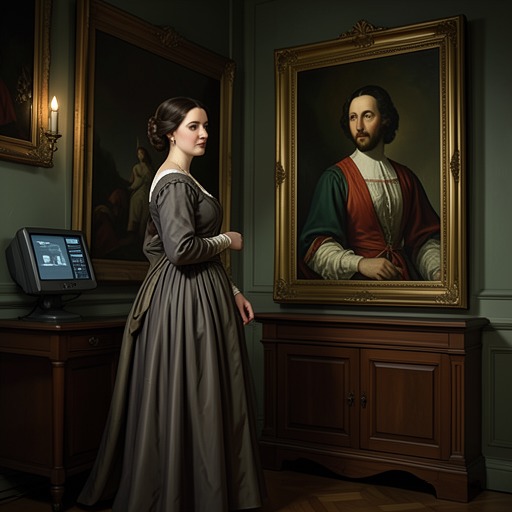
Ana’s resemblance to Goya’s La maja desnuda
MayaAna’s resemblance to Goya’s La maja desnuda is more than a likeness: it becomes a public identity that increasingly overwhelms the woman herself. From adolescence, Ana is told she looks like the woman in Goya’s painting; as the resemblance intensifies, she becomes known in Seville as La Niña del Prado. The novel gives that transformation an uncanny culmination: Ana dies, José says, at the precise point when she has become identical to the model, as though her life had caught up with a completed image.
The likeness and its limits
When the paintings are examined closely, their apparent identity proves partial. La maja vestida seems more hurriedly painted and less detailed than La maja desnuda, and its woman appears fuller and more heavily made up. Yet the narrator recognizes the same face in both paintings: the head, face, and hair belong to Ana, while the naked body belongs to another woman. The distinction is clearest in La maja desnuda, where Ana’s head appears almost transplanted onto the model’s body.
This division turns resemblance into a problem of identity rather than a simple matter of appearance. Ana is not said to be the model whose body Goya painted. Instead, her face has been joined to that painted body, making the image both recognizable and composite. The recognition changes how the narrator sees the canvases: what first seemed to be two versions of one woman resolves into a figure divided between Ana’s likeness and someone else’s body.
From compliment to public identity
Ana’s likeness begins in adolescence, when people tell her that she resembles a woman in a Goya painting. She takes the comparison as a compliment, though being likened to a nude woman also embarrasses her. Over time the resemblance grows so strong that makeup and hairstyling can no longer distinguish her from the painted figure. In Seville she acquires the name La Niña del Prado, and, as José explains, the woman and the image can no longer be separated.
The name marks a change in the social force of the resemblance. What Ana once could receive as praise becomes a label attached to her in public, fixing her in relation to a famous painted woman. The narrative presents that shift not as a single revelation but as a gradual encroachment: recognition hardens into identification, until other people encounter Ana through the picture they already know.
The gaze and its cost
The identification carries a particular burden because the image is nude. Ana can laugh off the stories attached to her likeness, but that does not make the resemblance easy to live with. In Madrid, people stop in the street and point at her; some react almost with horror. José imagines that this treatment may help explain why Ana feels at ease in the Botanical Garden, where she can hide. He describes her as stigmatized, as though she carried a conspicuous birthmark on her face.
The comparison makes the stigma visible without treating it as a bodily defect: the mark is the social meaning attached to Ana’s appearance and the attention it attracts. Her face becomes something strangers believe they recognize and have a right to comment on. Even her comfort in a place where she can withdraw is presented as a possible response to that unwanted scrutiny, not as proof that the public gaze has ceased to matter.
The image, the legend, and the ending
Ana’s own interest in the tales surrounding 1998 includes the story of a dwarf who saves himself by displaying a magical portrait of a young woman. Because old versions describe the portrait in terms that make Ana imagine a photograph, the tale folds an anachronistic modern image into an episode set long before photography existed. Other stories suggest that the dwarf sold his magical portrait to Goya. One version claims that Goya’s real model was beheaded for allowing herself to be painted nude, and that her head was displayed on a pole for ridicule. These stories are not spoken aloud in Ana’s presence, though José acknowledges that she thinks about them.
The legends turn the resemblance into more than a matter of public identification: they connect the painted woman to a magical image, the history of Goya’s painting, and the threat of death. Ana’s ability to laugh at the stories coexists with the difficulty of living under the likeness; the tales do not cancel the stigma. At the same time, their impossible and conflicting explanations leave the connection unsettled rather than offering a single cause for it.
José gives the resemblance its starkest temporal shape. Ana, he says, did not merely resemble the painted woman: she grew more like her, and died when she was identical to the model. The painting was finished, and Ana did not live even one day longer. At a later encounter, Ana herself remarks that a few weeks afterward she probably looked even more like Goya’s maja. Together, those details make the likeness a process with an apparent endpoint, while leaving the mechanism unexplained. Ana’s face, the divided figure on the canvases, and the legends of magical portraits converge on an unsettling question of whether an image represents a life or begins to claim it.