Ana María Maya’s heart condition
MayaAna María Maya’s heart condition is a mild lesion that cannot readily be operated on without considerable risk, yet its consequences steadily narrow the life of a celebrated flamenco dancer. It frightens Ana and José, forces her to leave the stage, and makes doctors advise against her having children; later, her collapse after a frantic pursuit through the Alcázar gardens turns that chronic vulnerability into an apparent emergency. The subsequent disclosure that Ana was pregnant, and that José initially misunderstood what was happening, gives the condition a further consequence without making it the whole explanation of her life or death.
Diagnosis and Everyday Effects
A couple of years after Ana and José met, doctors identified a lesion in Ana’s heart. They considered it difficult to operate on, at least without considerable risk, and expected her to live with it for the rest of her life. At first, the diagnosis did not require special measures in her ordinary routine. The threat was therefore neither an immediate prohibition nor a problem that could simply be removed: it became part of the couple’s life as an uncertainty they had to carry.
That uncertainty periodically became visible in Ana’s body. Her circulation would worsen enough for her face to lose its color, usually for only a minute or two. The doctors described those brief episodes as not especially alarming in themselves, but their reassurance did not settle Ana and José’s fear. The gap between a medically qualified warning and the couple’s lived alarm is central to the condition’s portrayal: what might be transient from the clinical point of view could still make them fear the sudden failure of a body they could not control.
The End of Ana’s Dancing
About a year before José recounts the history, Ana suffered her first serious setback: she collapsed onstage and was taken to hospital by ambulance. The doctors continued to offer reassuring messages, but they also told her that she had to stop performing. Flamenco was not a peripheral occupation in her life; José describes it as her soul, and emphasizes the dance’s passion and physical intensity. The diagnosis thus altered not only what Ana could safely do, but also her relation to the defining art through which she had lived and been known.
The restriction was especially painful because it arrived after intermittent episodes had already made the couple anxious, and after the heart lesion had been treated as something Ana could otherwise live with. Her body’s limits became newly consequential when the demands of performance could no longer be reconciled with medical advice. The story presents this as a loss imposed by the condition, not as a change in Ana’s devotion to flamenco.
The Advice Against Pregnancy
The doctors also advised Ana not to have children, telling the couple that the exertion involved would not be safe for her. José recalls that this was at least as bad a piece of news as being told to abandon dancing. Ana wanted children; when she saw something she particularly liked, she would even buy children’s clothes. The medical warning therefore placed a second cherished desire under restriction, alongside the career she had already been told to give up.
The later discovery that Ana was pregnant gives this advice a painful new context. Frank asks whether she had been pregnant, and José and Frank’s companion both shake their heads: neither had known at the time. Frank suggests that pregnancy may have been why Ana felt dizzy that day. The revelation does not establish that pregnancy caused her collapse, but it shows that the episode occurred against a condition for which doctors had specifically discouraged pregnancy, and adds an undisclosed bodily circumstance to the crisis as it had first appeared to those around her.
Collapse in the Alcázar Gardens
Ana’s heart condition becomes acutely visible when she runs after Comodín through the gardens of the Alcázar. José recounts her route at length: she follows him through gates and garden paths, past fountains and the maze, and on to the Garden of the Poets. José tries to keep up, while bystanders see what appears to be a couple pursuing a little person. In José’s account, however, Ana has chosen to pursue Comodín in order to put an end to a story that has followed her throughout her life.
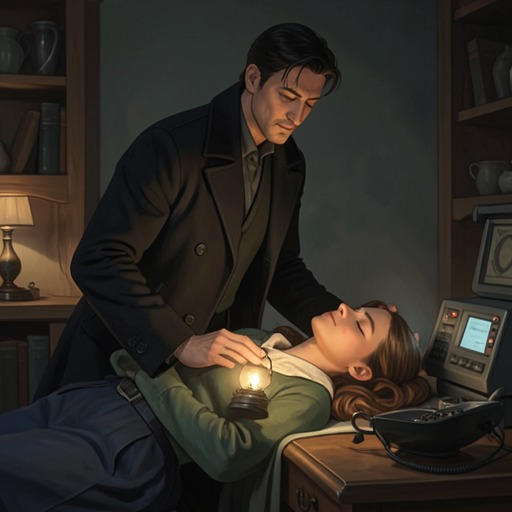
In the Garden of the Poets, Ana collapses over a hedge beside the last pool. She is close to Plaza de Santa Cruz and to Los Gallos, where she had long been a major flamenco figure, so the place joins her medical crisis to the performance identity she has lost. She has not lost consciousness, but her face is almost blue and she is struggling to breathe. José lifts her into a large marble fountain to cool her feverish body, cries out that she has a heart condition, and sees an ambulance arrive with a stretcher. His recollection does not give a precise measure of the time taken; in the emergency, he cannot track the events accurately.
When Frank later points out that the chase was an intense exertion, comparable in its demands to flamenco, José answers that it may have been the dance of her death. He explains that Ana ran because Comodín had taken her photograph, and that the image had pursued her throughout her life; she had grown up with it. His answer connects the immediate physical danger with the larger history that impels her, but does not turn her heart condition into a complete explanation of why she runs.
Misread Symptoms and the Story’s Limits
The later conversation also reveals how little José understood during the collapse. After learning that Ana had been pregnant, he says that at the time he feared an anaphylactic attack because she had always been allergic to insect bites. He was not thinking clearly and believed that a slap might stimulate adrenaline. This mistaken emergency response exposes the confusion of the moment: the pregnancy was unknown, the symptoms were alarming, and José reached for an explanation grounded in a familiar allergy rather than the heart condition he had earlier described.
The condition’s significance lies in the accumulating limits it places on Ana—first the frightening episodes, then the prohibition on dancing, then the medical advice against children—and in the way those limits collide with what she most wants. Yet the narrative preserves a distinction between diagnosis and person. Ana remains a dancer whose art is described as her soul, a woman who desires children, and the pursuer of an image bound up with her past. Her collapse makes the heart condition impossible to ignore, but neither the doctors’ warnings nor José’s retrospective account fully contains the meaning of her choices.