Chiyo’s early childhood in Yoroido
The Tipsy House
Chiyo grows up in a leaning house on the Sea of Japan with her older sister, [Satsu](entity:character-recall-character-satsu-c3e5736044b5), and their parents. Her mother’s unusual gray eyes and her father’s age shape the girl’s sense of family; a visit to the graveyard reveals that her father’s first wife and sons died years earlier.
When Chiyo is about nine, her mother’s illness worsens, and the village doctor tells her father she has only weeks to live. Chiyo does not yet understand how completely her family’s life is about to change.
A stormy afternoon before Chiyo leaves Yoroido
The First Meeting
After falling on a rain-soaked village road, Chiyo is carried into the Japan Coastal Seafood Company, where [Mr. Tanaka](entity:character-recall-character-905e0a655b3c) examines her injured lip. He notices her striking eyes, treats her with a kindness that makes a deep impression, and sends medicine for her sick mother.
Chiyo begins imagining that Mr. Tanaka might adopt her. His attention seems to offer a way out of her fear and poverty, though she cannot foresee that his decision will separate her from her family.
Soon after Chiyo meets Mr. Tanaka
A Visit to Senzuru
[Mr. Tanaka](entity:character-recall-character-905e0a655b3c) invites [Chiyo and Satsu](entity:relation-recall-relation-chiyo-satsu-d523c92d7b25) to visit his household in [Senzuru](entity:location-recall-location-senzuru-c83890fe680f). Chiyo befriends his daughter, Kuniko, and is dazzled by the brighter home and the world beyond her village. She mistakes his proposal to her father for a promise that the girls will be adopted.
At the seafood company, an old woman examines the sisters and declares them suitable. Chiyo interprets the examination and the journey as steps toward a new family, while [Satsu](entity:character-recall-character-satsu-c3e5736044b5) is frightened and uncertain.
The day after the visit to Senzuru
The Sisters Are Separated
[Mr. Tanaka](entity:character-recall-character-905e0a655b3c) and his assistant, Sugi, take the girls to a railway station, where the silent [Mr. Bekku](entity:character-recall-character-mr-bekku-b94adb62d20c) escorts them onto a train bound for [Kyoto](entity:location-recall-location-eea1a33e8137). Chiyo still believes they are going to the Tanaka home, but the journey carries them far from their village and their dying mother.
In [Gion](entity:location-recall-location-gion-5ab2b9ea0e73), Mr. Bekku leaves [Satsu](entity:character-recall-character-satsu-c3e5736044b5) to be taken elsewhere and brings Chiyo to an okiya. The separation is a decisive rupture: Chiyo enters a world in which adults treat children as property and the sisters have no power to choose their futures.
Chiyo’s first evening at the Nitta okiya
Hatsumomo’s Contempt
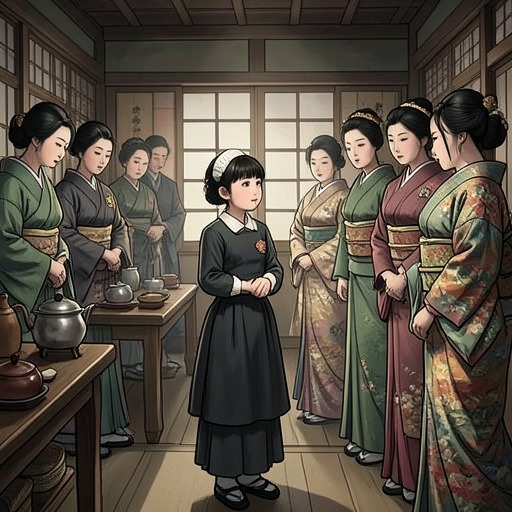
At the okiya, Chiyo meets [Auntie](entity:character-recall-character-auntie-c55342ae0d86), [Mother of Nitta Okiya](entity:character-recall-character-mother-nitta-b9edf8b4c24b), [Granny](entity:character-recall-character-granny-39cc4c22c92a), and Pumpkin. [Mother](entity:character-recall-character-84cf5babf108) warns that Chiyo must obey and work hard if she is to be trained as a geisha; Hatsumomo, the okiya’s celebrated geisha, mocks her as garbage and treats her as an intruder.
Chiyo is left to grieve for her family while learning the house’s hierarchy through chores, punishments, and strict rules. She hopes that finding [Satsu](entity:character-recall-character-satsu-c3e5736044b5) will give her a route out of [Gion](entity:location-recall-location-gion-5ab2b9ea0e73), but has no reliable way to learn where her sister has gone.
Chiyo’s first weeks in Kyoto
The Maid’s Burden
Chiyo spends her days cleaning, running errands, and serving [Granny](entity:character-recall-character-granny-39cc4c22c92a), whose demands repeatedly interfere with her other work. Hatsumomo humiliates her and forbids her to touch her makeup, while [Mother](entity:character-recall-character-84cf5babf108) makes clear that the okiya’s income and Hatsumomo’s success take priority over Chiyo’s comfort.
When Hatsumomo lies that [Satsu](entity:character-recall-character-satsu-c3e5736044b5) visited and teases Chiyo with the possibility of a message, Chiyo is desperate to learn her sister’s whereabouts. She is not yet allowed to attend the geisha school, and her future as a maid begins to seem like a trap.
During Chiyo’s first months at the okiya
Hatsumomo’s Secret Lover
Chiyo discovers that Hatsumomo secretly brings Koichi, a married noodle-shop chef, into the maids’ room. The relationship violates the okiya’s rules and threatens its income, but Hatsumomo’s power keeps the other servants silent.
Hatsumomo later uses Chiyo’s forbidden trip to find [Satsu](entity:character-recall-character-satsu-c3e5736044b5) as leverage, pretending to help her escape and then accusing her of stealing an emerald brooch. [Mother](entity:character-recall-character-84cf5babf108) discovers Hatsumomo’s lover, but the false theft still adds to Chiyo’s debt and deepens her isolation.
Before Chiyo’s lessons begin
The Stolen Kimono
Hatsumomo and her friend Korin make Chiyo write on Mameha’s exquisite borrowed kimono, threatening to withhold information about [Satsu](entity:character-recall-character-satsu-c3e5736044b5) if she refuses. They force Chiyo to deliver the ruined garment to Mameha’s maid, then Hatsumomo blames Chiyo for the damage.
[Mother](entity:character-recall-character-84cf5babf108) orders Chiyo to be beaten and makes her repay the kimono through her future earnings. [Auntie](entity:character-recall-character-auntie-c55342ae0d86) explains the okiya debt system: Chiyo owes for her purchase, food, lessons, medical care, and the damage. Her attempt to obey has made her burden heavier and gives Hatsumomo another means of control.
The spring after Chiyo accepts her family is gone
The Chairman’s Kindness
After Hatsumomo tells Chiyo she will never become a geisha, Chiyo breaks down beside the [Shirakawa Stream](entity:location-recall-location-shirakawa-stream-529b286d7e96). The Chairman stops to comfort her, wipes the dirt from her face, and gives her a coin and his handkerchief so she can buy shaved ice.
Chiyo treats the encounter as the sign she had been waiting for. She decides that becoming a geisha could bring her into the orbit of a man like him, and prays at the [Gion Shrine](entity:location-recall-location-0bf54178ace9) for a chance to pursue that life.
Several months after the Chairman’s encounter
Granny’s Death
[Granny](entity:character-recall-character-granny-39cc4c22c92a) dies after an electrical fault in her heater shocks her and leaves her face against the hot metal. The okiya holds an elaborate funeral, partly out of respect and partly to preserve its standing in [Gion](entity:location-recall-location-gion-5ab2b9ea0e73).
With Granny gone, Pumpkin is freed from chores to practice for her geisha debut, while Chiyo remains a maid. During the funeral, Mameha notices Chiyo’s unusual blue-gray eyes and begins to consider her potential.
A few weeks after Granny’s funeral
Mameha Takes Chiyo On
Mameha summons Chiyo to her apartment and asks why she has stopped training. Chiyo explains her debts and failed escape; Mameha recognizes that [Mother](entity:character-recall-character-84cf5babf108) is unlikely to restart her lessons without a strong incentive and offers to become her older sister.
Mameha explains the risks and obligations of the older-sister relationship, then uses an almanac to choose an auspicious time for approaching Mother. She visits the okiya and persuades Mother that Chiyo could repay her debts quickly, proposing a financial wager that makes renewed training attractive to the house.
After Mameha’s agreement with Mother
Training Resumes
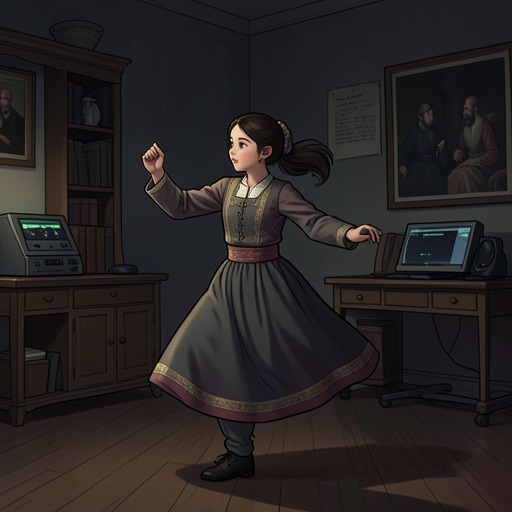
Chiyo returns to the school and resumes lessons in dance, shamisen, flute, drums, singing, and tea ceremony while continuing her heavy chores. Hatsumomo tries to sabotage her dance training by flattering the instructor into treating Chiyo harshly, but Mameha exposes the manipulation and the teacher later becomes supportive.
Chiyo develops her own ways to practice and discovers that sorrow can give her dancing a quiet dignity. Her work begins to show the promise Mameha sees in her, though Hatsumomo remains determined to block her rise.
Spring 1934
Pumpkin’s Debut
Pumpkin makes her debut as an apprentice geisha and becomes Hatsumomo’s younger sister, while Chiyo is left out of the ceremony. Chiyo feels both jealousy and grief, especially because Pumpkin’s advancement comes while Chiyo is still struggling to establish herself.
Mameha begins taking Chiyo through [Gion](entity:location-recall-location-gion-5ab2b9ea0e73) in her own kimono, presenting her to people and building recognition without yet revealing the full plan. Chiyo learns that the public’s attention can be deliberately cultivated, but also that her debut must wait until the moment is right.
November, when Chiyo is about fourteen
The Name Sayuri
Mameha arranges Chiyo’s debut date and teaches her how to use her eyes, posture, and walk to make an impression. After a test in which Chiyo’s practiced glance causes a delivery boy to stumble, Mameha concludes that she is ready.
Chiyo undergoes the painful styling of her hair and prepares for the formal ceremony at the Ichiriki. The sisterhood ceremony changes her name to [Sayuri](entity:character-recall-character-sayuri-4cb2eaa4c473), marking the end of her childhood identity and the beginning of her public life as a novice geisha.
The evening of Sayuri’s debut
First Banquet
[Sayuri](entity:character-recall-character-sayuri-4cb2eaa4c473) accompanies Mameha to her first banquet and is introduced as a novice, spending most of the evening quietly observing. At a later party, Hatsumomo arrives with Pumpkin and tells a humiliating story designed to make the men imagine Sayuri in a compromising situation.
Sayuri answers with a playful remark that turns the joke back on Hatsumomo. Her small success establishes that she can meet public humiliation with wit, but Hatsumomo retaliates with a slap and intensifies her efforts to undermine Sayuri.
During Sayuri’s first months as a novice
Hatsumomo Tracks Sayuri
Hatsumomo bribes maids at [Gion](entity:location-recall-location-gion-5ab2b9ea0e73)’s teahouses to report where [Sayuri](entity:character-recall-character-sayuri-4cb2eaa4c473) and Mameha are entertaining. Their appearances repeatedly force Mameha to leave engagements early, damaging Sayuri’s chance to become known and making her seem unpopular.
Mameha identifies the sabotage and keeps Sayuri out of Gion when necessary, while searching for a way to turn Hatsumomo’s interference against her. Sayuri is left dependent on Mameha’s strategy and must endure a period of public exclusion.
A few months after Sayuri’s debut
The Sumo Strategy
Mameha takes [Sayuri](entity:character-recall-character-sayuri-4cb2eaa4c473) to a sumo exhibition at [Kyoto University](entity:location-recall-location-3dead2ecadee), where they meet the Chairman and [Nobu Toshikazu](entity:character-recall-character-4a1699b7f6c8). Sayuri recognizes the Chairman as the man who helped her beside the [Shirakawa Stream](entity:location-recall-location-shirakawa-stream-529b286d7e96), while [Nobu](entity:character-recall-character-11fd5cc3583a) becomes interested in her and begins teaching her about sumo.
When Hatsumomo arrives, Mameha tells Sayuri to pretend she is fascinated by Nobu. Sayuri plays the part convincingly, and Mameha sees a possible strategy: Hatsumomo’s delight in the apparent attachment may conceal how that interest could be used to raise Sayuri’s value.
The months after the sumo exhibition
The Artist’s Model
Mameha introduces [Sayuri](entity:character-recall-character-sayuri-4cb2eaa4c473) to [Dr. Crab](entity:character-recall-character-ec750d666193) by arranging a staged leg injury and taking her to the hospital. She also brings Sayuri to the artist [Uchida Kosaburo](entity:character-recall-character-80d767ee160c), who eventually notices her eyes and uses her as a model for his work.
The introductions are part of Mameha’s larger plan to make Sayuri attractive to influential men and build the possibility of a high mizuage bid. Sayuri does not yet know the whole scheme, and remains emotionally focused on the Chairman.
When Sayuri is about fifteen
The Mizuage Contest
Mameha explains that she hopes [Dr. Crab](entity:character-recall-character-ec750d666193) and [Nobu](entity:character-recall-character-11fd5cc3583a) will compete for [Sayuri’s mizuage](entity:event-recall-event-sayuri-f635f0058928), raising the price enough to repay her debts and secure her position. Hatsumomo discovers the plan and tells Dr. Crab that [Sayuri](entity:character-recall-character-sayuri-4cb2eaa4c473) has a boyfriend, falsely suggesting that she is no longer untouched.
Mameha counters by presenting ekubo cakes and arguing that Hatsumomo is lying. Dr. Crab accepts the offering, and the competition resumes, but Sayuri remains unaware of how much the plan depends on the rivalries among the men and the teahouse’s financial interests.
Late summer 1938
The General’s Arrangement
Mameha persuades [Mother](entity:character-recall-character-84cf5babf108) that [General Tottori](entity:character-recall-character-1ef8c002f273)’s military procurement position could benefit the okiya during a time of looming shortages. Mother chooses the General over [Nobu](entity:character-recall-character-11fd5cc3583a), and [Sayuri](entity:character-recall-character-sayuri-4cb2eaa4c473) enters a danna arrangement with him through a sake ceremony.
The General provides supplies and services for the household, but their relationship is emotionally empty and their meetings become a routine. Nobu withdraws from Sayuri, and she loses regular access to the Chairman through [Iwamura Electric](entity:organization-recall-organization-iwamura-electric-dc6e76921649)’s parties.
Several years after Sayuri’s mizuage
The Emerald Brooch Revealed
As [Sayuri](entity:character-recall-character-sayuri-4cb2eaa4c473) and Hatsumomo exchange rooms, Hatsumomo enters Sayuri’s room, reads her private journal, and threatens to expose its coded entries about [Nobu](entity:character-recall-character-11fd5cc3583a) and the Chairman. In the disorder of Hatsumomo’s room, Sayuri finds the emerald brooch that Hatsumomo once claimed she had stolen.
Sayuri retrieves her journal and takes the brooch to [Mother](entity:character-recall-character-84cf5babf108), who recognizes that Hatsumomo’s accusation was false. Mother charges Hatsumomo for the brooch and the damage she caused, while Sayuri’s position as the okiya’s adopted daughter protects her from being punished as before.
Soon after the journal confrontation
Hatsumomo’s Expulsion
Mameha and [Sayuri](entity:character-recall-character-sayuri-4cb2eaa4c473) follow Hatsumomo around [Gion](entity:location-recall-location-gion-5ab2b9ea0e73), worsening the pressure on a geisha who is already drinking heavily and losing control. At a Pontocho gathering, Hatsumomo becomes jealous when the Kabuki actor Bando Shojiro turns his attention to Mameha, bites him, and attacks him.
The theater director has Hatsumomo removed from the party. [Mother](entity:character-recall-character-84cf5babf108) soon expels her from the okiya, and Hatsumomo disappears from Gion, reportedly later living as a prostitute. Her departure ends the long threat that shaped Sayuri’s early years.
December 1942
The General Is Detained
A soldier came to Nitta's house to investigate the garden and the violation of wartime regulations. The stepmother of Nitta's house told [Sayuri](entity:character-recall-character-sayuri-4cb2eaa4c473) that Taneo Toshizumi had been detained; after losing his protection, the goods and valuables hidden by Nitta's house were confiscated
January 1944
The Districts Close
The government announced that the geisha district in Japan would close, and ordered geishas to report to the registration office to prepare for labor in factories. Saya Yuriko rushed to find General Tanimoto Shun'zō, but he was already powerless to exert influence, and warned
Early 1944
Refuge with the Arashinos
Saya left [Gion](entity:location-recall-location-gion-5ab2b9ea0e73) and moved into the residence and workshop of the Sakano family. They made parachutes for the war there. She lived with the family, sharing scarce food, and slept on the mats in the workshop at night; [Kyoto](entity:location-recall-location-eea1a33e8137) had avoided the most intense bombing. This shelter was both
August 1945
The War Ends
After the devastation of war, Japan surrendered. Saya and the Sawayama family survived, but the country had lost the war, and the city was destroyed; the years of fear and scarcity left a deep, heavy sense in those who had experienced war as children
The first years after the war
A Life Outside Gion
Kabukicho re-opened, but Ochiai Oyabu's mother did not immediately call [Sayuri](entity:character-recall-character-sayuri-4cb2eaa4c473) back. Sayuri continued to work for the Kuranashi family, briefly falling in love with a young tatami maker, and once went alone to [Gion](entity:location-recall-location-gion-5ab2b9ea0e73) to visit. There
About five years after leaving during the war
Sayuri Returns to Gion
Saya returns to [Gion](entity:location-recall-location-gion-5ab2b9ea0e73), helping Shinoda Teiyo's mother and Teiyo's aunt to repair the old Teiyo. She visits Meiya; Meiya now lives in a simple apartment. Although Gion has changed since the war, Saya prepares to resume her work as
During Sayuri’s first weeks back in Gion
Pumpkin’s Return
Saya goes to Tsubuki. Tsubuki lives in a damaged shack, surviving the war through factory work and prostitution. Saya invites her to a dinner with Shin and Sato, partly to help the company, and partly to repair their old friendship. Tsubuki treats Saya politely
The months after Sayuri’s return
Iwamura Electric’s Recovery
Saya, Miyako, Tsubuki, and the president of Shinko continued to entertain Sato. The minister was reserved and often silent, but his involvement reactivated the Allied occupation authorities' investigation into [Iwamura Electric](entity:organization-recall-organization-iwamura-electric-dc6e76921649) Company and helped the company avoid being taken over. The company
After Iwamura Electric’s financing is secured
Nobu’s Proposal
Shin told [Sayuri](entity:character-recall-character-sayuri-4cb2eaa4c473) that he had discussed with the owner of Ikushaya about making Sato her. He said he had not intended to arrange this, but the conversation clearly showed that his friendship with Sayuri and the company's recovery were already entangled with her future. Shin asked
The following weekend
The Amami Plan
Saya and the president, Shin, Sato, Mima, and Tsubuki went to Yonaguni. On the flight and during the journey, she realized that Shin did not understand how deep her feelings for the president were; if Shin accepted to be her husband, her only remaining
The afternoon of the Amami theater incident
Pumpkin’s Betrayal
Sayaori took Sato to the old theater, yielded to him, and anticipated that Toma would bring the letter to the door. However, Toma brought the president; the president saw Sayaori with the minister. Toma later explained that she intentionally brought the president there because she wanted
A few days after returning from Amami
The Chairman’s Confession
The president met with [Sayuri](entity:character-recall-character-sayuri-4cb2eaa4c473) at Ikuno Tea House and told her that he had heard about the girl who had been helped by her along the white river. He arranged for Misa to take care of her. He had always hidden his feelings because he knew that Shingo loved Sayuri and felt
After Nobu relinquishes his claim
The Chairman Becomes Sayuri’s Danna
Saya and the president established their relationship through a sake ceremony. The president became her husband, and she exited her daily work in the geisha industry; however, she still lived in Nitta Tejya, compensated by an economic arrangement for the new Tejya mother. This relationship fulfilled the
The year after Sayuri becomes the Chairman’s mistress
Leaving Gion
The president bought Ryouma-ann. He and [Sayuri](entity:character-recall-character-sayuri-4cb2eaa4c473) would spend several nights there every week. Their life was comfortable and private, but Sayuri gradually realized that she had left [Gion](entity:location-recall-location-gion-5ab2b9ea0e73)'s work, daily life, and friendships. After the president's intended son-in-law Nishikawa
August 1956
A New York Teahouse
Saya moved to [New York City](entity:location-recall-location-new-york-city-65df0a129d4c), opening a small tea house for Japanese businessmen and politicians. The president supported her leaving; his accounting staff also ensured that Nitta Teiya's foster mother paid her the money she owed, allowing Saya to escape economic ties with Nitta Teiya
A few months before Sayuri tells her story
The Chairman’s Death
In old age, [Sayuri](entity:character-recall-character-sayuri-4cb2eaa4c473) remembers traveling through Central Park with the Chairman and hearing him say that remembered things can feel more real than what is present. Their shared past remains vivid even as time changes [Gion](entity:location-recall-location-gion-5ab2b9ea0e73), New York, and their own bodies.
The Chairman dies after a long life. Sayuri understands his death as a natural parting and keeps him through memory, just as she carries the people who left her earlier in life. In telling the story, she relives the course that led from [Yoroido](entity:location-recall-location-yoroido-a7ff8d51612d) to the world she made for herself.