Diagnosis of Miles Vorkosigan’s post-cryorevival seizures
MemoryThe diagnosis of Miles Vorkosigan’s post-cryorevival seizures turns a frightening, poorly understood recurrence into a specific biochemical mechanism—and, without promising a cure, a possible way to manage it. The breakthrough comes not from the separate team still testing hypotheses, but from two Imperial Military medical specialists who reproduce an attack in the laboratory and trace it to abnormal neurotransmitter storage and release. Their findings replace uncertainty with a practical, if experimental, choice: Miles may be able to trigger an attack deliberately before it overtakes him.
Establishing the cause
For six days, Miles waits for a definitive medical explanation while Admiral Avakli’s team makes steady progress by eliminating possibilities. Avakli is careful not to claim more than the evidence warrants, and Miles does not press him for a premature answer. The harm already done cannot be undone, and a rushed conclusion could be dangerous in either direction. The decisive result instead comes from an Imperial Military cryonicist and neurologist working together on Miles’s case: they manage to induce one of his seizures in their laboratory.
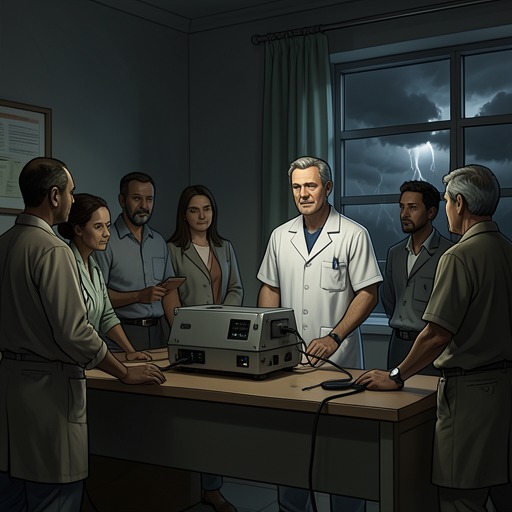
The experiment reproduces an experience Miles knows too well. He emerges from colored, confetti-like visions and blackness still on the examination table, his head held in a scanner nearly half the size of the room and his body connected to monitoring equipment. Three technicians are on hand, apparently to keep him from spasming off the table or to keep the monitors correctly adjusted. The doctors are absorbed in the readings, excitedly pointing them out to each other while Miles groans; he has to dress and wait in Dr. Chenko’s office before Chenko addresses him directly. The scene makes the difference between undergoing a seizure and observing one plain: for Miles it is a familiar, disruptive ordeal, while for the clinicians it is finally an event they can measure.
The biochemical cycle
Dr. Chenko presents the explanation through data disks, holovid models, and graphs. After cryonic revival, Miles’s brain began producing unusually high levels of neurotransmitters. These collect over time in neural reservoirs until they become abnormally engorged. Stress or excitement, among other forms of heavy brain activity, can then trigger a sudden cascade release. The reservoir does not empty gradually; the release is sharp enough to interrupt normal neural function temporarily.
This sequence accounts for the attacks’ characteristic stages. The release shuts down ordinary neural activity and helps explain the hallucinations Miles has reported. After a minute or two, the reservoirs have emptied to normal or below-normal levels, followed by the few minutes of unconsciousness. Equilibrium then begins to return, and Miles regains consciousness in a fatigued state. The cycle can begin again as the reservoirs refill. What had presented as a seizure disorder is thus described as an entirely biochemical form of epilepsy, rather than a phase-electrical one. Chenko calls the mechanism idiosyncratic, fascinating, and unique; the novelty is medically significant, but it is also why the team cannot simply apply a familiar treatment.
Treatment without a simple cure
The diagnosis does not reveal a straightforward way to stop the attacks. Chenko rules out a purely medical approach such as drugs to slow neurotransmitter production. The apparent overproduction may involve dozens or hundreds of chemicals, perhaps all of them, making it impractical to suppress them collectively. More importantly, closer examination suggests that production is not the main fault: the molecular release mechanism of the reservoirs is the more likely source of the malfunction. Even if medication reduced the frequency of attacks, Chenko cautions, it would not eliminate them.
Surgery is not an obvious alternative either. The cause is spread through large areas of Miles’s brain, rather than concentrated in one readily treatable site. Its concentration in the frontal lobes, rather than the brain stem, is fortunate in one limited sense: the seizures do not kill him outright. But that distinction offers no easy repair. The problem is diffuse, and the available response must work with the recurring cycle rather than remove a single lesion.
The proposed intervention is therefore a control system. The team believes it can miniaturize the neural stimulators used to trigger Miles’s laboratory seizure and install an array beneath his skull, together with feedback sensors that detect when the neurotransmitter reservoirs are becoming dangerously overloaded. Miles could then use the stimulator to bring on an attack at a chosen time and place, in effect releasing the buildup safely instead of waiting for an uncontrolled seizure. If the attacks were scheduled, Chenko expects them to be milder and shorter. Driving or flying might remain possible if the levels could be properly monitored and maintained, although he makes clear that this depends on the system working.
Miles’s decision and the diagnosis’s limits
The proposed device offers management, not certainty. Chenko cannot say whether anyone will discover a better treatment or whether Miles will have the condition for the rest of his life; his experience of it is unique. Miles sits silently before agreeing to try the implant approach and see what happens. His brief smile at Gregor’s habitual turn of phrase gives the decision a private, familiar note, but the medical facts remain unresolved: the intervention is still a proposal, and no successful outcome has yet been established.
The diagnosis matters because it changes the problem Miles faces without making it disappear. The attacks now have a causal account, a recognizable progression, and a possible means of control. At the same time, that account rules out the most reassuring versions of treatment: neither a simple drug nor a clear surgical fix is available. The possibility of choosing when an episode occurs would give Miles some control over its timing and setting, but it would require him to live with a system whose effectiveness is not yet known. The event therefore marks a turn from investigation toward an experiment in living with the condition, not a declaration that the danger has passed.